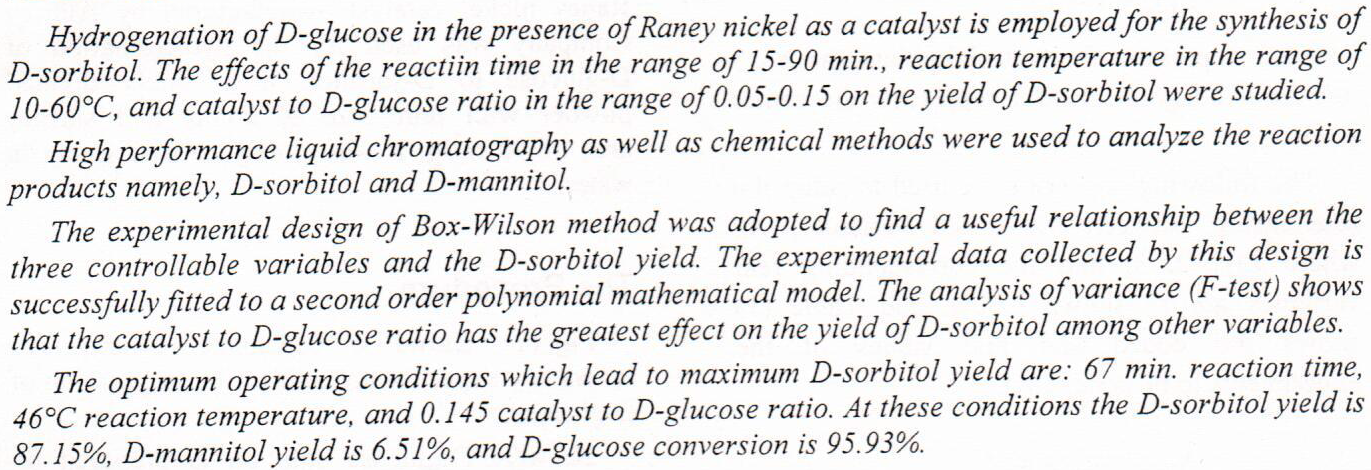
D-Sorbitol Production by Catalytic Hydrogenation of D-Glucose

In this work the production of activated carbon (AC) from Imperata is done by microwave assisted Potassium hydroxide (KOH) activation and using this activated carbon for the purpose of the uptake of amoxicillin (AMX) by adsorption process from aqueous solution. The effects for irradiation power (450-800W), irradiation time (6-12min) as well as impregnation ratio (0.5-1 g/g) on the AMX uptake and yield AMX uptake at an initial concentration of AMX (150 mg/g). The optimum conditions were 700 W irradiation power, 10 min time of irradiation, as well as 0.8 g/g impregnation ratio with 14.821% yield and 12.456 mg/g AMX uptake. Total volume of hole and the area of the surface (BET) are 0.3027 m³/g, and 552.7638 m²/g respectively. The properti
... Show More (49)
 (45)



This work was conducted to study the recovery of catalyst and desirable components from tar formed in phenol production unit and more particularly relates to such a method whereby better recovery of copper salts, phenol, benzoic acid and benzoate salts from tar by aqueous acid solution was accomplished.
The effect of solvent type, solvent concentration (5, 10, 15, 20, 25 and 30 wt%), agitation speed (100, 200, 300 and 400 rpm), agitation time (5, 10, 15, 20 and 25 min), temperature (90, 100, 110, 120, 130 and 140 oC) , phase ratio (1/1, 2/1, 3/1, 4/1 and 5/1) and number of extraction (1, 2, 3, 4, and 5) were examined in order to increase the catalyst and desirable components extraction.
Four types of solvent were used; hydrochloric
Baker's Yeast is an important additive among the substances, which improves bred quality, thus, a consideration has been made to study the conditions and parameters that affecting the production of the yeast in a batch fermenter experimentally and theoretically. Experimental runs were implemented in a 12-liter pilot-scale fermenter to predict the rate of growth and other parameters such as amount of additive consumed and the amount of heat generated. The process is modeled and performed using a computer programming prepped for this purpose, the model gave a good agreement comparing to the experimental work specially in the log phase.
This article will address autoclave design considerations and
manufacturing working with high pressure low temperature
supercritical drying technique to produce silica aerogel. The design
elects carbon dioxide as a supercritical fluid (31.7 oC and 72.3 bar).
Both temperature and pressure have independently controlling
facility through present design. The autoclave was light weight (4.5
kg) and factory-made from stainless steel. It contains a high pressure
window for monitoring both transfer carbon dioxide gas to liquid
carbon dioxide and watching supercritical drying via aerogel
preparation process. In this work aerogel samples were prepared and
the true apparent densities, total pore volume and pore size
(3)
(53)
(48)
Introduction: Although soap industry is known from hundreds of years, the development accompanied with this industry was little. The development implied the mechanical equipment and the additive materials necessary to produce soap with the best specifications of shape, physical and chemical properties. Objectives: This research studies the use of vacuum reactive distillation VRD technique for soap production. Methods: Olein and Palmitin in the ratio of 3 to 1 were mixed in a flask with NaOH solution in stoichiometric amount under different vacuum pressures from -0.35 to -0.5 bar. Total conversion was reached by using the VRD technique. The soap produced by the VRD method was compared with soap prepared by the reaction - only method which
... Show More
Worldwide, enormous amounts of waste cause major environmental issues, including scrap tires and plastic, and large waste, a consequence of the demolition of buildings, including crushed concrete, crushed clay bricks, and crushed thermo-stone. From that point, it’s possible to consider that the recycling processes for these materials and using them in the manufacturing field will reduce the adverse effects on the environment of these wastes and the consumption of natural resources. Sustainable concrete blocks can be considered as one of the products produced by using these materials as partial volume replacement of the coarse, fine aggregate, or cement content, considering their dry density, workability, absorption, co
... Show More
(8)
(6)
Worldwide, enormous amounts of waste cause major environmental issues, including scrap tires and plastic, and large waste, a consequence of the demolition of buildings, including crushed concrete, crushed clay bricks, and crushed thermo-stone. From that point, it’s possible to consider that the recycling processes for these materials and using them in the manufacturing field will reduce the adverse effects on the environment of these wastes and the consumption of natural resources. Sustainable concrete blocks can be considered as one of the products produced by using these materials as partial volume replacement of the coarse, fine aggregate, or cement content, considering their dry density, workability, absorption, compressive st
... Show More
(8)
(6)
(5)
(3)