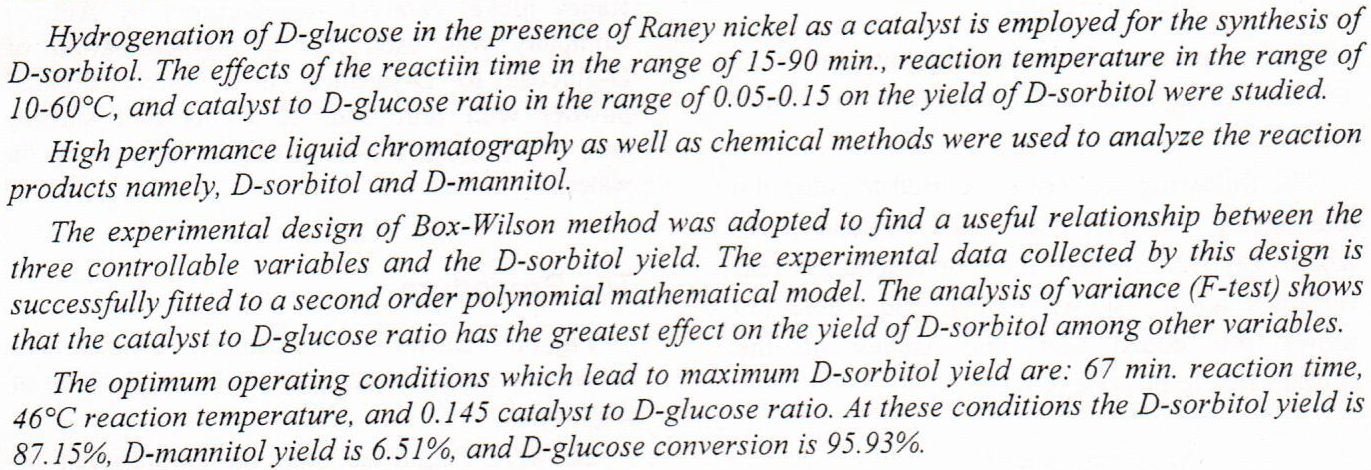
D-Sorbitol Production by Catalytic Hydrogenation of D-Glucose

 (57)
(57)
 (46)
(46)



In this paper, some series of new complexes of Mn(II), Co(II), Ni (II) Cu(II) and Hg(II) are prepared from the Schiff bases (L1,L2). (L1) derived from 4-aminoantipyrine and O-phenylene dia mine then (L2) derived from (L1) and 2-benzoyl benzoic acid. Structural features are obtained from their elemental microanalyses, molar conductance, IR, UV–Vis, 1H, 13CNMR spectra and magnetic susceptibility. The magnetic susceptibility and UV–Vis, IR spectral data of the ligand (L1) complexes get square–planar and tetrahedral geometries and the complexes oflig and (L2) get an octahedral geometry. Antimicrobial examinations show good results in the sharing complexes.
(20)
(3)
To assess the impact of COVID‐19 on oral hygiene (OH) awareness, attitude towards dental treatment, fear of infection and economic impact in the Middle East.
This survey was performed by online distribution of questionnaires in three countries in the Middle East (Jordan, Iraq and Egypt). The questionnaire consisted of five sections: the first section was aimed at collecting demographic data and the rest sections used to assess OH awareness, attitude towards dental treatment, degree of fear and economic impact of COVID‐19. The answers were either multiple choice, closed‐end (Yes or N
(21)
(20)
Poly(ethylene oxide) is a promising material for solid-state lithium batteries due to its safety, ease of processing, and compatibility with lithium. However, conventional linear PEO falls short of practical requirements due to its limited ionic conductivity, a consequence of the high crystallinity of its ethylene oxide chains. This crystallinity hinders the movement of lithium ions, limiting its performance in solid-state battery applications. In this study, we successfully prepared the plasticized solid polymer electrolytes (PSPEs) based on poly(ethylene oxide) (PEO)/ tetracyanoethylene (TCE) complexed with lithium bis(trifluoromethanesulfonyl)imide (LiTFSI) salt and studied the effect of TCE on structural, mechanical, electrical and elec
... Show More
(74)
(73)
Lowering specific energy consumption (SEC) in reverse osmosis (RO) plants is one of the most important criteria in water treatment industry. The present work focused on best suggested RO pilot plant configurations for minimizing specific energy consumption, finding the best configurations experimentally to recover the water with minimizing salts in permeate side in RO module, study the factors affecting the performance of single and two stage systems, TFC membrane is used in spiral wound module. Brackish water is used as feed solution with different concentrations (2000, 3000, 4000 and 5000 ppm). The operating parameters studied were permeate flux, rejection and SEC. The experimental results showed the permeate concentration increased and w
... Show More
In this paper, some series of new complexes of Mn(II), Co(II), Ni (II) Cu(II) and Hg(II) are prepared from the Schiff bases (L1,L2). (L1) derived from 4-aminoantipyrine and O-phenylene dia mine then (L2) derived from (L1) and 2-benzoyl benzoic acid. Structural features are obtained from their elemental microanalyses, molar conductance, IR, UV–Vis, 1H, 13CNMR spectra and magnetic susceptibility. The magnetic susceptibility and UV–Vis, IR spectral data of the ligand (L1) complexes get square–planar and tetrahedral geometries and the complexes oflig and (L2) get an octahedral geometry. Antimicrobial examinations show good results in the sharing complexes.
(20)
(3)
(82)
(64)
(2)
(2)
(12)
(12)
Blastocystis is a ubiquitous human and animal protozoa that inhabit the gastrointestinal tract. Metronidazole is considered the standard drug for the treatment of Blastocystis infection; however, there is growing evidence of treatment failure, hazardous side effects, and appearance of strains resistant to metronidazole. In the last era, many studies have been implicated in the quest for new treatments for Blastocystis infection, especially natural products. Attention has been focused on the effect of Amygdalin (B17) and pumpkin seed on eradicating parasitic infections. The current work was built up to explore the in vitro efficacy of two natural compounds, Amygdalin (B17) and pumpkin seeds against
... Show More
(8)
(5)