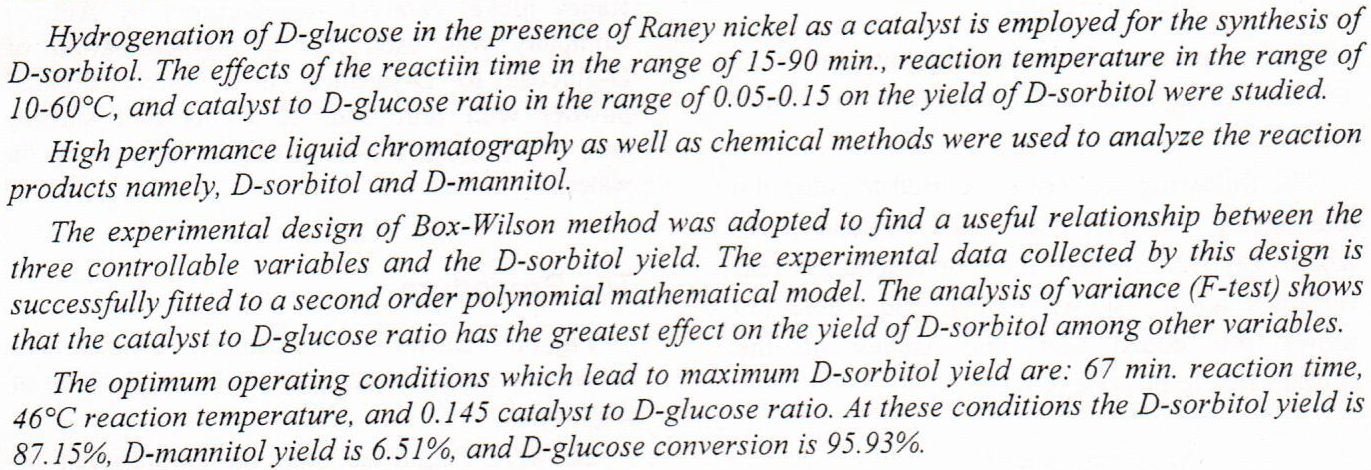
D-Sorbitol Production by Catalytic Hydrogenation of D-Glucose

This work was conducted to study the oxidation of phenol in aqueous solution using copper based catalyst with zinc as promoter and different carrier, i.e. γ-Alumina and silica. These catalysts were prepared by impregnation method.
The effect of catalyst composition, pH (5.6-9), phenol to catalyst concentration ratio (2-0.5), air feed rate (30-50) ml/s, stirring speed (400-800) rpm, and temperature (80-100) °C were examined in order to find the best conditions for phenol conversion.
The best operating conditions which lead to maximum phenol conversion (73.1%) are : 7.5 pH, 4/6 phenol to catalyst concentration, 40 ml/s air feed rate, 600 rpm stirring speed, and 100 °C reaction temperature. The reaction involved an induction period
The science of jurisprudence is one of the legal sciences that scholars have been interested in since the first centuries of Islam, and they wrote many books about it, and the science of manuscripts is considered one of the scientific achievements in which many scholars emerged, including Imam Al-Samaani, so I chose this manuscript related to Istism to clarify its concept and meaning for all people, The student (Ali Ahmed Abdel-Aziz Sheikh Hamad) preceded me in the investigation of part of the book, and it was facilitated for me, by the grace of God Almighty, to investigate the issue (if one of the Muslim spouses apostatized and one of the infidel spouses converted to Islam until the end of the issue of if the two spouses were taken capt
... Show MoreThe effect of different antibiotics on growth pigment and plasmid curing of Serratia marcescens were studied, S. marcescens was cultured in media containing(16_500)µg/ml of antibiotics, curing mutants unable to produce prodigiosin and lost one plasmid band were obtained of of ampicillin, amoxillin, antibiotics concentrations (64 500) µg/ml metheprim, ultracloxam, azithromycin, cephalexin and erythromycin treated with (350 500) µg/ml of The mutant cells rose- light color and and refampicin revealed S.marcescens inhibited ciprodar and tetracyclin, lincomycin did not lost the plasmid band chlaforan
The present study was investigated the activity of aqueous extract from Cinnamomum cassia bark on the blood glucose levels in healthy and diabetic rats induced by Streptozotcin (STZ). In healthy rats the blood glucose levels were slightly decreased after six hoursof single oral administration with dose (25 mg/kg) of body wight, as well as four weeks after twice daily repeated oral administration of aqueous extract of Cinnamomum cassia bark. In streptozotocin induced diabetic rats we absorved high significant decreased (p<0.05) in blood glucose levels, after four weeks of oral administration of aqueous extract (25 mg /kg ).And blood glucose levels seems to be normal after the period of treatment .Glibenclamide used as standard drug to com
... Show More
In this work, fluid catalytic cracking of vacuum gas oil to produce gasoline over prepared faujasite type Y zeolite was investigated using experimental laboratory plant scale of fluidized bed reactor.
The catalytic activity of prepared faujasite type NaY, NaNH4Y and NaHY zeolites was investigated. The cracking process was carried out in the temperature range 440 to 500 oC, weight hourly space velocity (WHSV) range 10 to 25 h-1 ,and atmospheric pressure . The catalytic activities of the prepared faujasite type NaY , NaNH4Y and NaHY zeolites were determined in terms of vacuum gas oil (VGO) conversion, and gasoline yield . The conversion at 500oC and WHSV10 hr-1 by using faujasite type NaY, NaNH4Y and NaHY zeolite were 50.2%, 64.1% and 6
 (3)
(3)
 (2)
(2)
 (31)
(32)
(31)
(32)

Toxicity with advanced glycation end products (AGEs) is a major problem in uremic patients. Treatment with peritoneal dialysis (PD) exacerbates AGE formation as a result of bioincompatibility of the conventional peritoneal dialysis fluid (PDF). The presence of glucose degradation products (GDPs) in PDF is the main cause of its bioincompatibility. Carnosine is an endogenous dipeptide with a powerful antiglycation/antioxidant activity. In an attempt to improve PDF biocompatibility, we evaluated the effect of carnosine in human peritoneal mesothelial cells (HPMC) incubated with PDF or GDPs in vitro. Methods: HPMC were incubated for short or prolonged time with PDF in the presence or absence of carnosine. Similarly, HPMC were incubated in the s
... Show MoreAbstract
In this work, diabetic glucose concentration level control under disturbing meal has been controlled using two set of advanced controllers. The first set is sliding mode controllers (classical and integral) and the second set is represented by optimal LQR controllers (classical and Min-, ax). Due to their characteristic features of disturbance rejection, both integral sliding mode controller and LQR Minmax controller are dedicated here for comparison. The Bergman minimal mathematical model was used to represent the dynamic behavior of a diabetic patient’s blood glucose concentration to the insulin injection. Simulations based on Matlab/Simulink, were performed to verify the performance of each controll
... Show More
