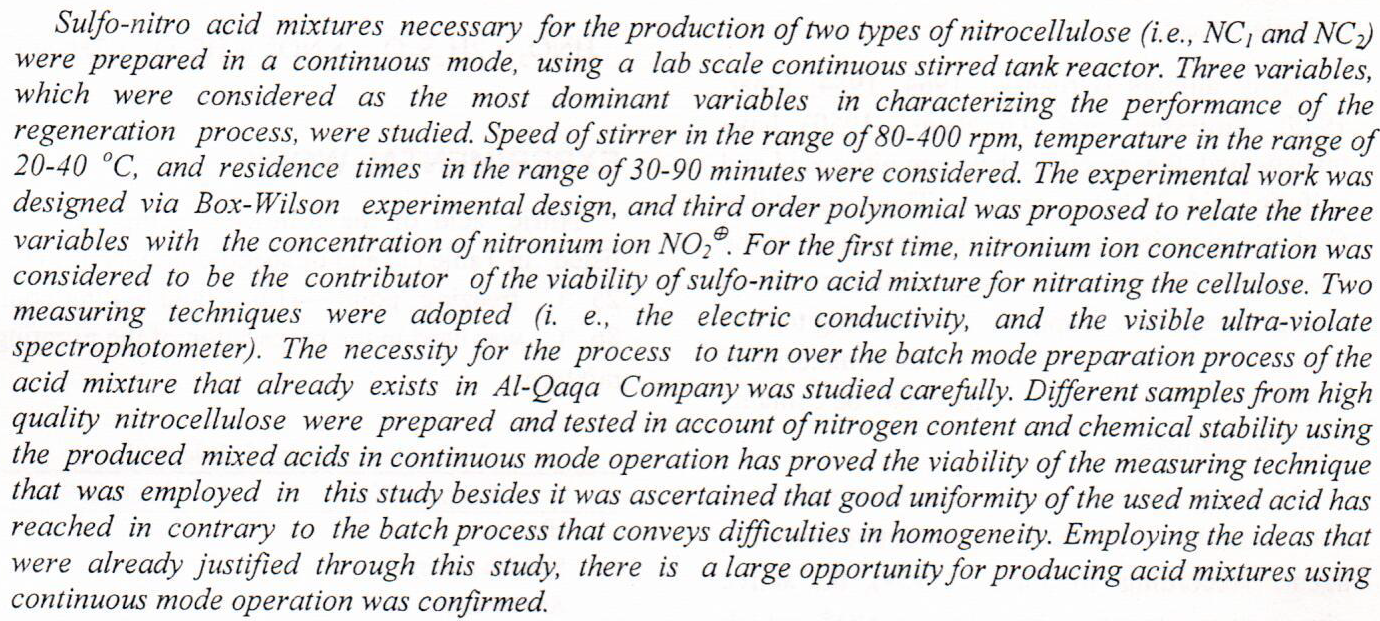
Regeneration of SLFO_Nitro Acid Mixture in Continuous Mode Operation

A field experiment was carried out in Horticulture Department / Collage of Agricultur e/University of Baghdad to study influence of adding ascorbic acid(asa) and bread yeast extract in snap bean cv.primel under irrigation with saline water using sodium chloride salt (NaCl) during spr ing season of 2016 .A factorial experiment using Randomized Complete Block Design( RCBD) with three replications wereconducted . The first factor includes three treatments of salinity which were tap water ( S0), 4ds.m-1(S1) and 8ds.m-1 (S2) . The second factor includes three treatments which were control treatment without any adding (C) ,ascorbic acid 0.3g.l-1( A ) and yeast extract 12g.l -1( Y ). Results showed significant and gradually decreases in all studie
... Show MoreMixed ligand complexes of bivalent metal ions, viz; Co(II), Ni(II), Cu(II) and Zn(II) of the composition [M(A)2((PBu3)2]in(1:2:2)(M:A:(PBu3). molar ratio, (where A- Anthranilate ion ,(PBu3)= tributylphosphine. M= Co(II),Ni(II),Cu(II) and Zn(II). The prepared complexes were characterized using flame atomic absorption, by FT-IR, UV/visible spectra methods as well as magnetic susceptibility and conductivity measurements. The metal complexes were tested in vitro against three types of pathogenic bacteria microorganisms: (Staphylococcus, Klebsiella SPP .and Bacillas)to assess their antimicrobial properties. Results. The study shows that all complexes have octahedral geometry; in addition, it has high activity against tested bacteria. Based on th
... Show MoreMixed ligand metal complexes are synthesized from oxalic acid with Schiff base, and the Schiff base was obtained from trimethoprim and acetylacetone. The synthesized complexes were of the type [M(L1)(L2)], where the metal, M, is Ni(II), Cu(II), Cr(III), and Zn(II), L1 corresponds to the trimethoprim ((Z)-4-((4-amino-5-(3,4,5- trimethoxybenzyl)pyrimidine-2-yl)imino)pentane-2-one) as the first ligand and L2 represent the oxalate anion (𝐶𝑂 ) as a second ligand. Characterization of the prepared compounds was performed by elemental analysis, molar conductivity, magnetic measurements, 1H-NMR, 13C-NMR, FT-IR, and Ultraviolet-visible (UV-Vis) spectral studies. The recorded infrared data is reinforced with density functional th
... Show MoreLaser shock peening (LSP) is deemed as a deep-rooted technology for stimulating compressive residual stresses below the surface of metallic elements. As a result, fatigue lifespan is improved, and the substance properties become further resistant to wear and corrosion. The LSP provides more unfailing surface treatment and a potential decrease in microstructural damage. Laser shock peening is a well-organized method measured up to the mechanical shoot peening. This kind of surface handling can be fulfilled via an intense laser pulse focused on a substantial surface in extremely shorter intervals. In this work, Hydrofluoric Acid (HF) and pure water as a coating layer were utilized as a new technique to improve the properti
... Show MoreMixed ligand complexes of bivalent metal ions, viz; Co(II), Ni(II), Cu(II) and Zn(II) of the composition [M(A)2((PBu3)2]in(1:2:2)(M:A:(PBu3). molar ratio, (where A- Anthranilate ion ,(PBu3)= tributylphosphine. M= Co(II),Ni(II),Cu(II) and Zn(II). The prepared complexes were characterized using flame atomic absorption, by FT-IR, UV/visible spectra methods as well as magnetic susceptibility and conductivity measurements. The metal complexes were tested in vitro against three types of pathogenic bacteria microorganisms: (Staphylococcus, Klebsiella SPP .and Bacillas)to assess their antimicrobial properties. Results. The study shows that all complexes have octahedral geometry; in addition, it has high activity against tested bacteria. Based on th
... Show MoreMixed ligand metal complexes are synthesized from oxalic acid with Schiff base, and the Schiff base was obtained from trimethoprim and acetylacetone. The synthesized complexes were of the type [M(L1)(L2)], where the metal, M, is Ni(II), Cu(II), Cr(III), and Zn(II), L1 corresponds to the trimethoprim ((Z)-4-((4-amino-5-(3,4,5-trimethoxybenzyl)pyrimidine-2-yl)imino)pentane-2-one) as the first ligand and L2 represent the oxalate anion ( ) as a second ligand. Characterization of the prepared compounds was performed by elemental analysis, molar conductivity, magnetic measurements, 1H-NMR, 13C-NMR, FT-IR, and Ultraviolet-visible (UV-Vis) spectral studies. The recorded infrared data is reinforced with density functional theory (DFT) calcul
... Show More (15)
(15)
 (8)
(8)



Background: With the increasing demands for adult orthodontics, a growing need arises to bond attachments to porcelain surfaces. Optimal adhesion to porcelain surface should allow orthodontic treatment without bond failure but not jeopardize porcelain integrity after debonding.The present study was carried out to compare the shear bond strength of metal bracket bonded to porcelain surface prepared by two mechanical treatments and by using different etching systems (Hydrofluoric acid 9% and acidulated phosphate fluoride 1.23%). Materials and Methods: The samples were comprised of 60 models (28mm *15mm*28mm) of metal fused to porcelain (feldspathic porcelain). They were divided as the following: group I (control): the porcelain surface left u
... Show MoreThe search involve the synthesis of some new 1,3-oxazepine and 1,3-diazepine derivatives were synthesized from Schiff base. The Schiff base (VIII) prepared from reaction of aldehyde (IV) derived from L-ascorbic acid with aromatic amine ([2-(4- nitrophenyl)-5-(4-aminophenyl)-1,3,4-oxadiazole] (VII). Oxazepine compounds (IX-XI) were synthesized from the cyclic condensation of Schiff base (VIII) with (maleic, phthalic and 3-nitrophthalic) anhydride, compounds (IX-XI) that were reacted with p-methoxyaniline to give diazepine derivatives (XII-XIV). The structures of the new synthesized compounds have been confirmed by physical properties and spectroscopy measurements such as FTIR, and some of them by 1 H-NMR, 13 CNMR, Mass, and evaluated
... Show More
(6)
(2)
(25)