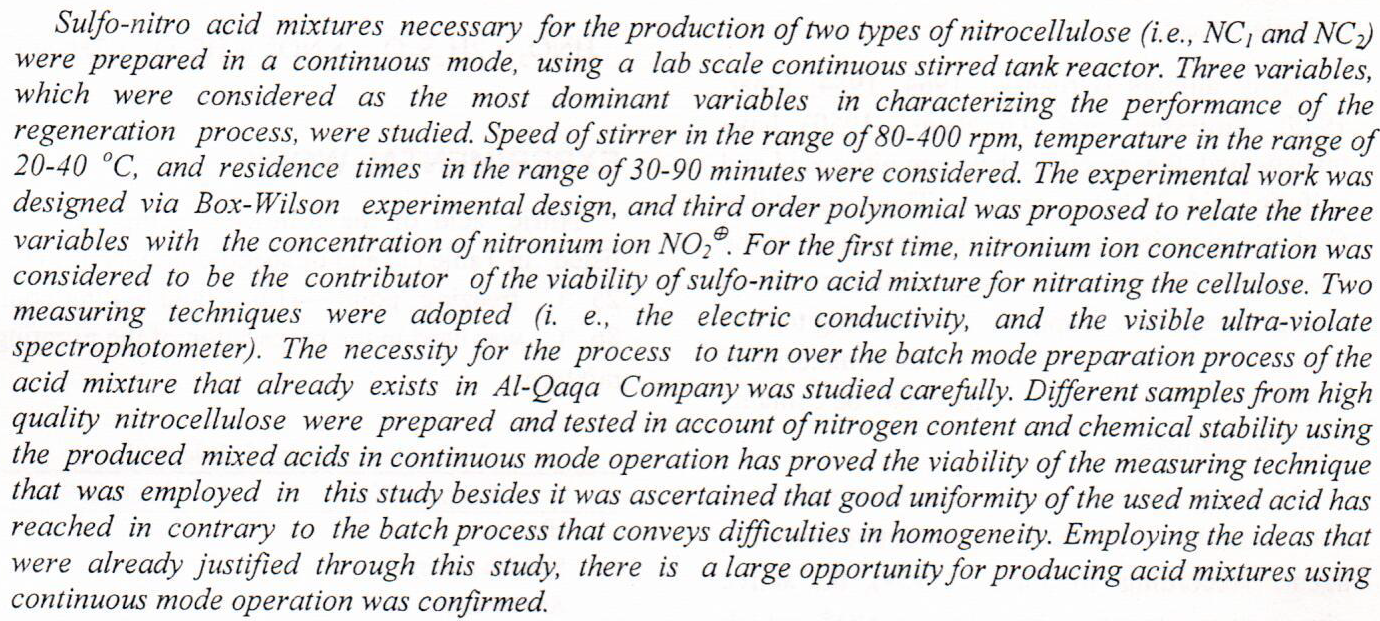
Regeneration of SLFO_Nitro Acid Mixture in Continuous Mode Operation

Plantation of humic acid nanoparticles on the inert sand through simple impregnation to obtain the permeable reactive barrier (PRB) for treating of groundwater contaminated with copper and cadmium ions. The humic acid was extracted from sewage sludge which is byproduct of the wastewater treatment plant; so, this considers an application of sustainable development. Batch tests signified that the coated sand by humic acid (CSHA) had removal efficiencies exceeded 98 % at contact time, sorbent dosage, and initial pH of 1 h, 0.25 g/50 mL and 7, respectively for 10 mg/L initial concentration and 200 rpm agitation speed. Results proved that physicosorption was the predominant mechanism for metals-CSHA interaction because the sorption data followed
... Show More (36)
(36)

 (10)
(10)
(10)
(10)


In this research various of 2,5-disubstituted 1,3,4-oxadiazole (Schiff base, oxo-thiazolidine , and other compounds) were synthesized from 2,5-di(4,4?- amino-1,3,4-oxadiazole ) which use quently synthesized from mixture of 4-amino benzoic acid and hydrazine in the presence of polyphosphorus acid. The synthesized compounds were characterized by using some Spectral data (UV, FT-IR, and 1H-NMR).
(10)
(10)
Samarium(III) ions react with (l-2(2-benzoinidazolyl-azo)-2-hydroxy-3-naphthoic acid in basic medium (pH = 8.0) forms a red-orange complex at A.max (550nm). The complex was found to be stable for at least 48 hrs. at the given pH. The apparent molar absorptivity is 7776.77 L.mol-1.Cm-1 and a linear calibration curve is obtained in the range (0.639x 10⁻⁵M - 6.350x 10 -5M). The stoichiometry of complex was confirmed by using mole ratio method which indicated that ratio of reagent to metal is 3:1. The effects of the presence of different cations and anions as interferences in the determination of samarium(III) under the given conditions were investigated
(10)
(10)
The organic compound imidazole has the chemical formula C3N2H4. Numerous significant biological compounds contain imidazole. The amino acid histidine is the most prevalent. The substituted imidazole derivatives have great potential for treating a variety of systemic fungi infections. Thiourea is an organosulfur compound with the formula SC(NH2)2. It is a reagent in organic synthesis. In this paper, some new imidazole and thiourea derivatives are synthesized, characterized, and studied for their biological activity. These new compounds were synthesized from the starting material terephthalic acid, which was transformed to corresponding ester [I] by the refluxing of diacid with methanol in the presence of H2SO4 as a catalyst, compound [I] con
... Show More
(1)
This study evaluated the structural changes of enamel treated by the Regenerate system and carbon dioxide (CO2) laser against acid challenge. Thirty human enamel slabs were prepared and assigned into three groups: Group I: untreated (control); Group II: treated with the Regenerate system; and Group III exposed to CO2 laser. All specimens were subjected to an acid challenge (pH 4.5–7.0) for 14 days. Specimens were evaluated and compared at 120 points using five Raman microspectroscopic peaks; the phosphate vibrations ν1, ν2, ν3, and ν4 at 960, 433, 1029, and 579 cm−1, respectively, and the carbonate at 1070 cm−1, followed by Vickers microhardness test. The ratio of carbonate to phosphate was correlated to the equivalent mic
... Show More
(6)
(6)
Background: In spite of all efforts, Non-small cell lung cancer (NSCLC) is a fatal solid tumor with a poor prognosis as of its high metastasis and resistance to present treatments. Tyrosine kinase inhibitors (TKI) such as erlotinib are efficient in treating NSCLC but the emergence of chemoresistance and adverse effects substantially limits their single use. Objective: in this study, the combination treatments of either 2-deoxy-D-glucose (2DG) or cinnamic acid (CINN) with erlotinib (ERL) were tested for their possible synergistic effect on the proliferation and migration capacity of NSCLC cells. Methods: In this study, NSCLC model cell line A549 was used to investigate the effects of single compounds and their combination on cell gro
... Show More
(6)
(3)
Mefenamic acid (MA) is one of the non-steroidal anti-inflammatory drugs, it is widely used probably due to having both anti-inflammatory and analgesic activity, the main side effects of mefenamic acid include gastrointestinal tract (GIT) disturbance mainly diarrhea, peptic ulceration, and gastric bleeding. The analgesic effects of NSAIDs are probably linked to COX-2 inhibition, while COX-1 inhibition is the major cause of this classic adverse effects. Introduction of thiazolidinone may lead to the increase in the bulkiness leads to the preferential inhibition of COX-2 rather than COX-1 enzyme. The study aimed to synthesize derivatives of mefenamic acid with more potency and to decrease the drug's potential side effects, new series of 4-t
... Show More
(1)
(4)