Regeneration of SLFO_Nitro Acid Mixture in Continuous Mode Operation
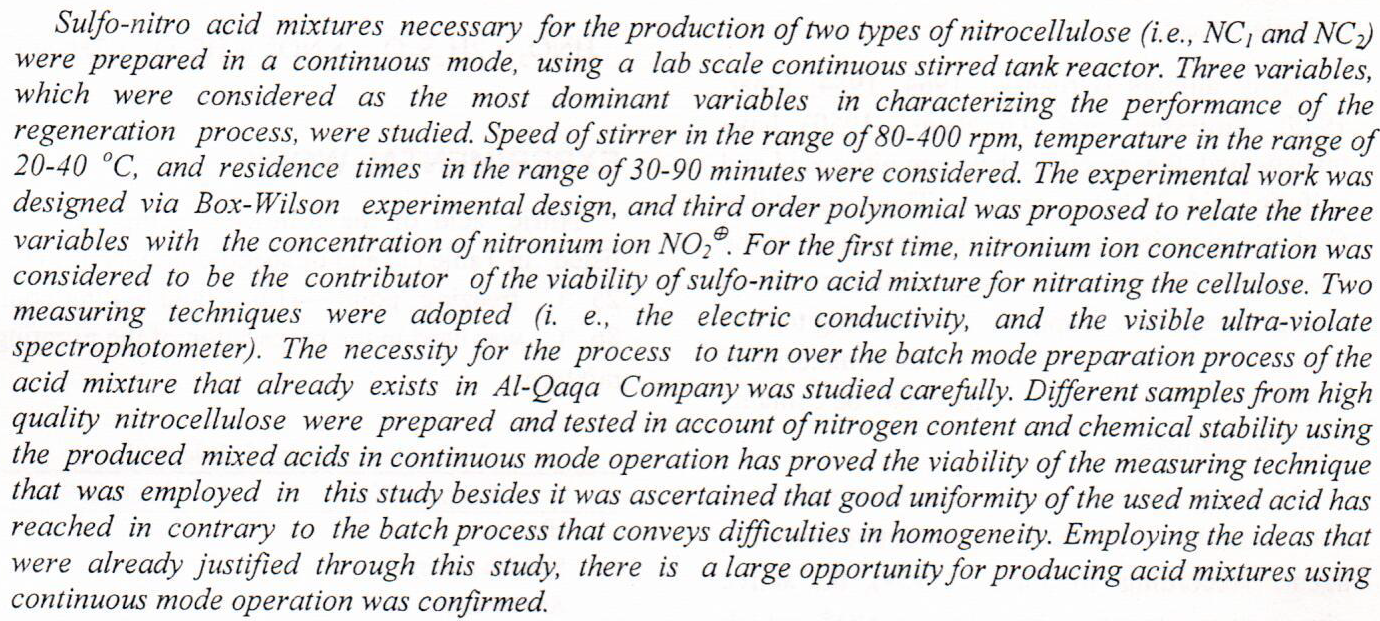

 (11)
(11)

Bacteria could produce bacterial nanocellulose through a procedure steps: polymerization and crystallization, that occur in the cytoplasm of the bacteria, the residues of glucose polymerize to (β-1,4) lineal glucan chains that produced from bacterial cell extracellularly, these lineal glucan are converted to microfbrils, after that these microfbrils collected together to shape very pure three dimensional pored net. It could be obtained a pure cellulose that created by some M.O, from the one of the active producer organism like Acetic acid bacteria (AAB), that it is a gram -ve, motile and live in aerobic condition. The bacterial nanocellulose (BNC) have great consideration in many fields because of its flexible properties, features
... Show More
The concrete industry consumes millions of tons of aggregate comprising of natural sands and gravels, each year. In recent years there has been an increasing trend towards using recycled aggregate to save natural resources and to produce lightweight concrete. This study investigates the possibility of using waste plastic as one of the components of lead-acid batteries to replace the fine aggregate by 50 and 70% by volume of concrete masonry units. Compared to the reference concrete mix, results demonstrated that a reduction of approximately 32.5% to 39.6% in the density for replacement of 50% to 70% respectively. At 28 days curing age, the compressive strength was decreased while the water absorption increased by increas
... Show More (2)
(2)
ABSTRACT. 4-Sulfosalicylic acid (SSA) was used as a ligand to prepare new triphenyltin and dimethyl-tin complexes by condensation with the corresponding organotin chloride salts. The complexes were identified by different techniques, such as infrared spectra (tin and proton), magnetic resonance, and elemental analyses. The 119Sn-NMR was studied to determine the prepared complexes' geometrical shape. Two methods examined the antioxidant activity of (SSA) and prepared complexes; Free radical scavenging activity (DPPH) and CUPRRAC methods. Tri and di-tin complexes gave high percentage inhibition than ligands with both methods due to tin moiety; the triphenyltin carboxylate complex was the best compared with the others. Also, antibacter
... Show More
(10)
(1)

This experiment was conducted to evaluate the effect of foliar spraying with gibberellic acid concentrations (0,50,100)mg.L¹ and proline acid concentrations (0, 25, 50)mg.L¹ and their interactions on some growth parameters of pea plant using clay pots in the botanical garden of Biology Department College of Education for pure science Ibn –Al-Haitham ,Baghdad University, for the growing season 2012-2013 the experiment involved the studing of some growth parameters as plant?s height, dry weight, wt. of pods.plant¹, biology yield and the concentration of some major elements (nitrogen, phosphorus and calcium) in plant?s seeds. The experiment was designed according to Completely Randomized Desig(CRD) with three replications. R
... Show More
A detailed experimental study was devoted to the anodic oxidation of oxalic acid using manganese dioxide rotating cylinder anode with the objective to evaluate in a systematic way the effect on the oxalic acid oxidation process of several relevant parameters, including the presence of sodium chloride, the current density (J), the rotation speed, the temperature, and the initial concentration of oxalic acid. Thin manganese dioxide film on graphite substrate has been prepared by electrochemical oxidation from MnSO4-H2SO4 electrolyte. The morphology of this electrode was investigated by XRD, SEM, EDS and AFM techniques. The results show that a firm γ-structure of MnO2 film on graphite rod can be obtained successfully. The results indicate tha
... Show More
(18)
(16)
(1)
1,3,4-oxadizole and pyrazole derivatives are very important scaffolds for medicinal chemistry. A literature survey revealed that they possess a wide spectrum of biological activities including anti-inflammatory and antitumor effects.
To describe the synthesis and evaluation of two classes of new niflumic acid (NF) derivatives, the 1,3,4-oxadizole derivatives (compounds 3 and (4A-E) and pyrazole derivatives (compounds 5 and 6), as EGFR tyrosine kinase inhibitors in silico and in vitro.
The designed compounds were synthesized using convent
(11)
(9)
(1)
Succinic acid is an essential base ingredient for manufacturing various industrial chemicals. Succinic acid has been acknowledged as one of the most significant bio based building block chemicals. Rapid demand for succinic acid has been noticed in the last 10 years. The production methods and mechanisms developed. Hence, these techniques and operations need to be revised. Recently, an omnibus rule for developing succinic acid is to find renewable carbohydrate Feedstocks. The sustainability of the resource is crucial to disintegrate the massive use of petroleum based-production. Accordingly, systematically reviewing the latest findings of bacterial production and related fermentation methods is critical. Therefore, this paper aims to stud
... Show More