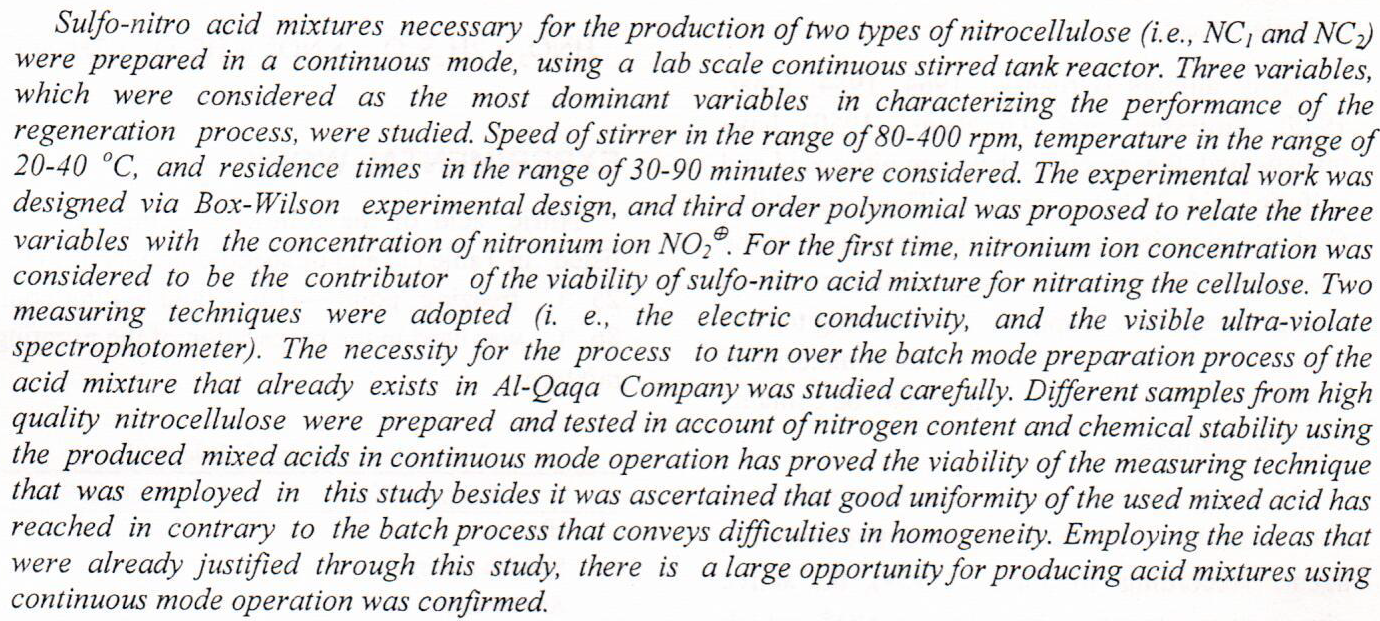
Regeneration of SLFO_Nitro Acid Mixture in Continuous Mode Operation

This study examined the adsorption behavior of anionic dye (orange G) from aqueous solution onto the raw and activated a mixture of illite, kaolinite and chlorite clays from area of Zorbatiya (east of Iraq).The chemical treatment involved alkali and acid activation. The alkali activation obtained by treated the raw clay (RC) with 5M NaOH (ACSO) and the acid activation founded by treated it with 0.25M HCl (ACH) and 0.25M (ACS). The thermal treatment carried out by calcination the produce activated clay at 750oC for acid activation and 105oC for alkali activation. Batch
... Show MoreObjective: To study the protective eff ects of cinnamic acid on dextran sodium sulfate (DSS) induced ulcerative colitis (UC) in mice. Materials and methods. Forty adult male mice were randomLy divided into fi ve groups, control group, an induction group received 3% DSS in drinking water for 7 consecutive days. Two treatment groups received oral suspension of cinnamic acid 50 and 25 mg/kg, respectively and 3% DSS in drinking water, for 7 consecutive days. The fi nal group received oral suspension of cinnamic acid 50 mg/kg for the latter 7 days without DSS in drinking water. All the animals were euthanized on day eight. The colon of animals was extracted and divided into two sections, the middle was homogenized and biochemically analy
... Show More (4)
(4)
 (5)
(5)


The inhibitive power of Polyvinyl Alcohol (PVA) was investigated toward the corrosion of carbon steel in 0.2N H2SO4 solution in the temperature range of 30-60˚C and PVA concentration range of 150-2000 ppm.
The corrosion rate was measured using both the weight loss and the electrochemical techniques. The weight loss results showed that PVA could serve as a corrosion inhibitor but its inhibition power was found to be low for the corrosion of carbon steel in the acidic media. Electrochemical analysis of the corrosion process of carbon steel in an electrochemical corrosion cell was investigated using 3-Electrode corrosion cell. Polarization technique was used for carbon steel corrosion in 0.2N H
(2)
(31)
(16)
(13)
 (7)
(10)
(7)
(10)
Expired drug Metoclopramide was investigated as an antibacterial corrosion inhibitor for carbon steel in 0.5M H3PO4 solution using the electrochemical method at 30oC and 60oC. The results showed that this drug is an efficient inhibitor for carbon steel and the efficiency reached to 82.244 % for 175 ppm at 30oC and 76.146% for 225 ppm at 60oC. The adsorption of drug on carbon steel surface follows Langmuir adsorption isotherm with small values of adsorption-desorption constant. The polarization plots revealed that Metoclopramide acts as mixed-type inhibitor. Some parameters of inhibition process were calculated and discussed. The surface morphology of the carbon steel speci
... Show More
(6)
This study was conducted in the field of the Poultry Research Station of the Department of Animal Production / Department of Agricultural Research / Ministry of Agriculture for the period 4/4/2021 to 16/5/2021, in which 300 one-day-old Ross308 chicks that fed on diets used avocado oil and Chia with percentages 0, 0.2, 0.4, 0.6% respectively, and their mixture consisting of 0.0, 0.1, 0.2, 0.3 each of avocado and Chia oil (50% avocado + 50% Chia oil). The experiment included 4 treatments with 3 replicates for each treatment (10 birds/replicates), in order to study the effect of using avocado and chia oil and their mixture in meat broiler diets on some physiological and microbial characteristics of blood plasma. The results indicate a
... Show More
(1)
Esterification reaction is most important reaction in biodiesel production. In this study, oleic acid was used as a suggested feedstock to study and simulate production of biodiesel. Batch esterification of oleic acid was carried out at operating conditions; temperature from 40 to 70 °C, ethanol to oleic acid molar ratio from 1/1 to 6/1, H2SO4 as the catalyst 1 and 5% wt of oleic acid, reaction time up to 180 min. The optimum conditions for the esterification reaction were molar ratio of ethanol/oleic acid 6/1, 5%wt H2SO4 relative to oleic acid, 70 °C, 90 min and conversion of oleic 0.92. The activation energy for the suggested model was 26625 J/mole for forward reaction and 42189 J/mole for equilibrium constant. The obtained results s
... Show More