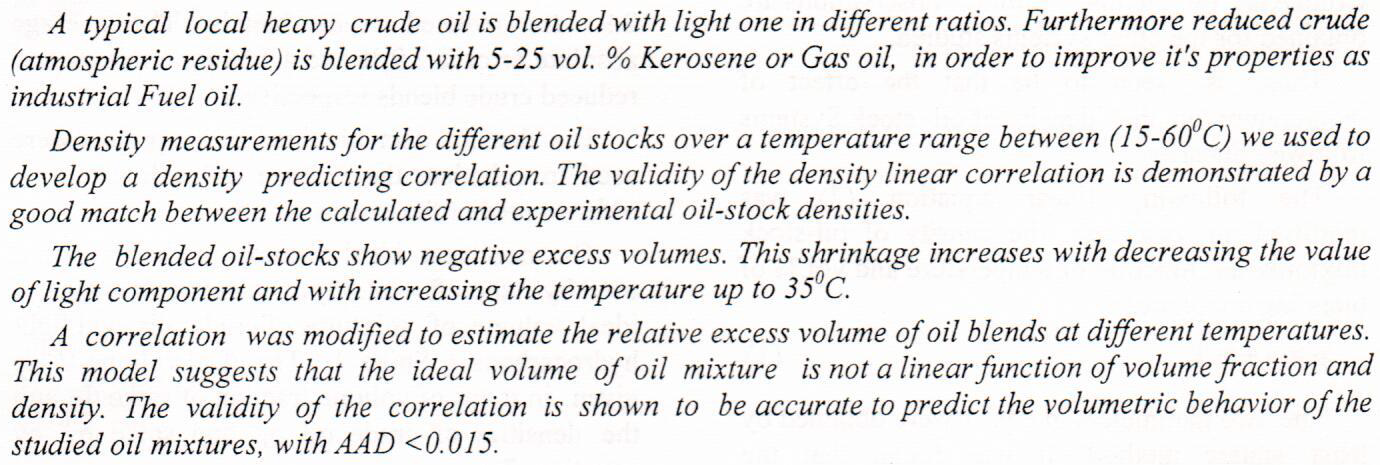
Predicting the Change in Volume of Mixed Oil Stocks

The Gas Assisted Gravity Drainage (GAGD) process has become one of the most important processes to enhance oil recovery in both secondary and tertiary recovery stages and through immiscible and miscible modes. Its advantages came from the ability to provide gravity-stable oil displacement for improving oil recovery, when compared with conventional gas injection methods such as Continuous Gas Injection (CGI) and Water – Alternative Gas (WAG). Vertical injectors for CO2 gas were placed at the top of the reservoir to form a gas cap which drives the oil towards the horizontal oil producing wells which are located above the oil-water-contact. The GAGD process was developed and tested in vertical wells to increase oil r
... Show More (6)
(6)

In this study, oxidative desulfurization of dibenzothiophene (DBT) with H2O2 as an oxidant was studied, whereas the catalyst used was zirconium oxide supported on Activated carbon (AC). Zirconium oxide (ZrO2) was impregnated over prepared activated carbon (AC) and characterized by various techniques such as XRD, FTIR, BET, SEM, and EDX. This composite was used as a heterogeneous catalyst for oxidation desulfurization of simulated oil. The results of this study showed that ZrO2/AC composite exhibited significant catalytic activity and stability, effectively lowering sulfur content under mild conditions. Factors such as reaction temperature (30, 40, 50, 60°C), time (5, 10, 15,20,30,60, 80 100 min), catalyst dose (0.3, 0.5,
... Show More
 (7)
(7)
(7)
(7)


In this research, the effect of reinforcing epoxy resin composites with a filler derived from chopped agriculture waste from oil palm (OP). Epoxy/OP composites were formed by dispersing (1, 3, 5, and 10 wt%) OP filler using a high-speed mechanical stirrer utilizing a hand lay-up method. The effect of adding zinc oxide (ZnO) nanoparticles, with an average size of 10-30 nm, with different wt% (1,2,3, and 5wt%) to the epoxy/oil palm composite, on the behavior of an epoxy/oil palm composite was studied with different ratios (1,2,3, and 5wt%) and an average size of 10-30 nm. Fourier Transform Infrared (FTIR) spectrometry and mechanical properties (tensile, impact, hardness, and wear rate) were used to examine the composites. The FTIR
... Show More
(6)
The antimicrobial activity of ginger extracts ( cold-water, hot-water, ethanolic and essential oil ) against some of pathogenic bacteria ( Escherichia coli , Salmonella sp , Klebsiella sp , Serratia marcescens, Vibrio cholerae , Staphylococcus aureus , Streptococcus sp) was investigated using Disc diffusion method , and the results were compared with the antimicrobial activity of 12 antibiotics on the same bacteria . The results showed that the ginger extracts were more effective on gram-positive bacteria than gram-negative . V. cholerae and S. marcescens,were the most resistant bacteria to the extracts used , while highest inhibition was noticed against Streptococcus sp (28 mm) . The ethanolic extract showed the broadest antibacterial ac
... Show More
(7)
Nanofluid treatment of oil reservoirs is being developed to enhance oil recovery and increase residual trapping capacities of CO2 at the reservoir scale. Recent studies have demonstrated good potential for silica nanoparticles for enhanced oil recovery (EOR) at ambient conditions. Nanofluid composition and exposure time have shown significant effects on the efficiency of EOR. However, there is a serious lack of information regarding the influence of temperature on nanofluid performance; thus the effects of temperature, exposure time and particle size on wettability alteration of oil-wet calcite surface were comprehensively investigated; moreover, the stability of the nanofluids was examined. We found that nanofluid treatment is more efficie
... Show More
(161)
(154)
Mixed ligand metal complexes of CrIII, FeIII,II, NiII and CuII have been synthesized using 5-chlorosalicylic acid (5-CSA) as a primary ligand and L-Valine (L-Val) as secondary ligand. The metal complexes have been characterized by elemental analysis, electrical conductance, magnetic susceptibility measurements and spectral studies. The electrical conductance studies of the complexes indicate their electrolytic nature. Magnetic susceptibility measurements revealed paramagnetic nature of the all complexes. Bonding of the metal ion through –OHand –COOgroups of bidentate to the 5-chlorosalicylic acid and through –NH2 and –COOgroups of bidentate to the L-valine by FT-IR studies . The agar diffusion method has been used to study the antib
... Show MoreMixed ligand metal complexes of CrIII, FeIII,II, NiII and CuII have been synthesized using 5-chlorosalicylic acid (5-CSA) as a primary ligand and L-Valine (L-Val) as secondary ligand. The metal complexes have been characterized by elemental analysis, electrical conductance, magnetic susceptibility measurements and spectral studies. The electrical conductance studies of the complexes indicate their electrolytic nature. Magnetic susceptibility measurements revealed paramagnetic nature of the all complexes. Bonding
This study was conducted in the field of the Poultry Research Station of the animal resources Department / office of Agricultural Research / Ministry of Agriculture from the period 4th April to16th May2021.This study was aimed to investigate the effect of using avocado and chia oil and their mixture in broiler diets on the final productive performance and meat cholesterol concentration and measuring meat oxidation indicators after storing it for 60 days. 300 one-day-old (Ross308) chicks were fed on diets that used avocado oil and chia with percentages of 0, 0.2, 0.4, 0.6%, respectively, and their mixture consisting of 0.0, 0.1, 0.2, 0.3 each of avocado and chia oil (50% avocado + 50% chia oil). The experiment included 10 treatments
... Show More