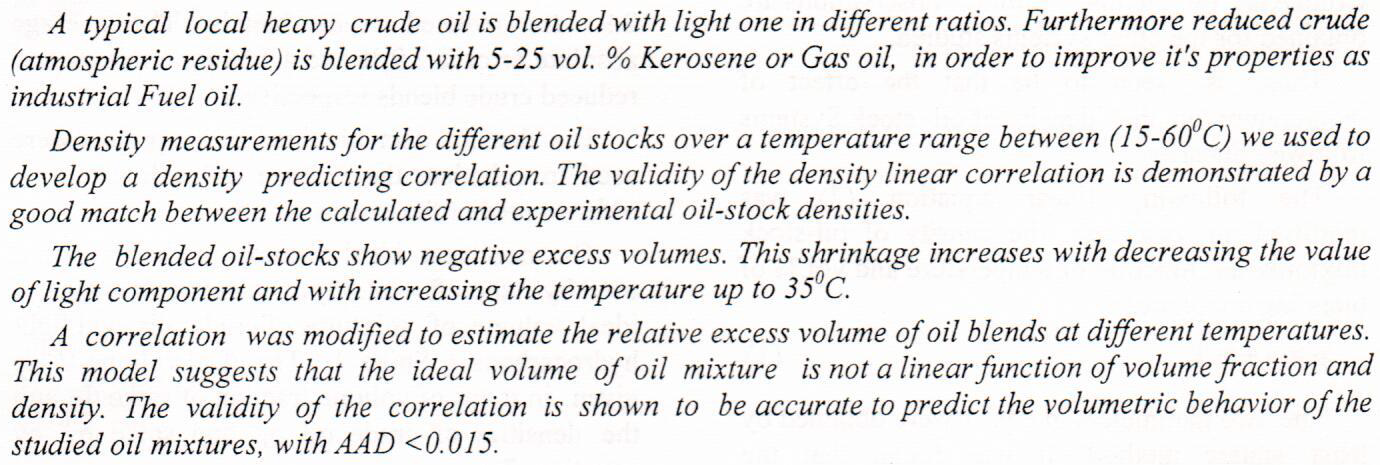
Predicting the Change in Volume of Mixed Oil Stocks

ole in all sta Oil well logging, also known as wireline logging, is a method of collecting data from the well environment to determine subterranean physical properties and reservoir parameters. Measurements are collected against depth along the well's length, and many types of wire cabling tools depend on the physical property of interest. Well probes generally has a dynamic respon to changes in rock layers and fluid composition. These probes or well logs are legal documents that record the history of a well during the drilling stages until its completion. Well probes record the physical properties of the well, which must then be interpreted in petrographic terms to obtain the characteristics of the rocks and fluids associated with
... Show More
 (3)
(3)
 (2)
(2)


The present work aims to study the efficiency of coagulation/ flocculation as 1st stage, natural gravity water filter or microfiltration (MF) as 2nd stage and nanofiltration (NF) technology as final stage for treatment of water of main outfall drain (MOD) for injection in Nasiriyah oil field. Effects of operating parameters such as coagulant dosage, speed and time of slow mixing step and settling time in the 1st stage were studied. Also feed turbidity and total suspended solids (TSS) in the 2
... Show MoreThis research includes the study of dual data models with mixed random parameters, which contain two types of parameters, the first is random and the other is fixed. For the random parameter, it is obtained as a result of differences in the marginal tendencies of the cross sections, and for the fixed parameter, it is obtained as a result of differences in fixed limits, and random errors for each section. Accidental bearing the characteristic of heterogeneity of variance in addition to the presence of serial correlation of the first degree, and the main objective in this research is the use of efficient methods commensurate with the paired data in the case of small samples, and to achieve this goal, the feasible general least squa
... Show MoreBackground: The interest in herbal extracts as antimicrobial agents has increased over the past few years in endodontic therapy. Nasturtium officinale (watercress) is a promising plant with great medicinal values. This study aimed to investigate the antifungal activity of watercress oil in combination with calcium hydroxide against Candida albicans as intracanal medicament. Materials and Methods: Candida albicans was isolated from patients with necrotic root canal or failed root canal treatment. The sensitivity of Candida albicans to different concentrations of watercress oil extract was determined by using the agar well diffusion method in comparison with calcium hydroxide paste. The agar plate method was used to determine the minimum fung
... Show More
(6)
(6)
This paper presents a study of the application of gas lift (GL) to improve oil production in a Middle East field. The field has been experiencing a rapid decline in production due to a drop in reservoir pressure. GL is a widely used artificial lift technique that can be used to increase oil production by reducing the hydrostatic pressure in the wellbore. The study used a full field model to simulate the effects of GL on production. The model was run under different production scenarios, including different water cut and reservoir pressure values. The results showed that GL can significantly increase oil production under all scenarios. The study also found that most wells in the field will soon be closed due to high water cuts. Howev
... Show More
The electrospun nanofibers membranes have gained considerable interest in water filtration applications. In this work, the fabrication and characterization of the electrospun polyacrylonitrile-based nonwoven nanofibers membrane are reported. Then, the membrane's performance and antifouling properties were evaluated in removing emulsified oil using a cross flow filtration system. The membranes were fabricated with different polyacrylonitrile (PAN) concentrations (8, 11, and 14 wt. %) in N, N-Dimethylformamide (DMF) solvent resulted in various average fiber sizes, porosity, contact angle, permeability, oil rejection, and antifouling properties. Analyses of surface morphology of the fabricated membranes before and after oil removal revealed
... Show More
(15)
(6)
Oily wastewater is one of the most challenging streams to deal with especially if the oil exists in emulsified form. In this study, electrospinning method was used to prepare nanofiberous polyvinylidene fluoride (PVDF) membranes and study their performance in oil removal. Graphene particles were embedded in the electrospun PVDF membrane to enhance the efficiency of the membranes. The prepared membranes were characterized using a scanning electron microscopy (SEM) to verify the graphene stabilization on the surface of the membrane homogeneously; while FTIR was used to detect the functional groups on the membrane surface. The membrane wettability was assessed by measuring the contact angle. The PVDF and PVDF / Graphene membranes efficiency
... Show More
(1)
Enhanced oil recovery is used in many mature oil reservoirs to increase the oil recovery factor. Surfactant flooding has recently gained interest again. To create micro emulsions at the interface between crude oil and water, surfactant flooding is the injection of surfactants (and co-surfactants) into the reservoir, thus achieving very low interfacial tension, which consequently assists mobilize the trapped oil.
In this study a flooding system, which has been manufactured and described at high pressure. The flooding processes included oil, water and surfactants. 15 core holders has been prepared at first stage of the experiment and filled with washed sand grains 80-500 mm and then packing the sand to obtain sand packs
... Show MoreThe calculation of the oil density is more complex due to a wide range of pressuresand temperatures, which are always determined by specific conditions, pressure andtemperature. Therefore, the calculations that depend on oil components are moreaccurate and easier in finding such kind of requirements. The analyses of twenty liveoil samples are utilized. The three parameters Peng Robinson equation of state istuned to get match between measured and calculated oil viscosity. The Lohrenz-Bray-Clark (LBC) viscosity calculation technique is adopted to calculate the viscosity of oilfrom the given composition, pressure and temperature for 20 samples. The tunedequation of state is used to generate oil viscosity values for a range of temperatu
... Show More
(1)