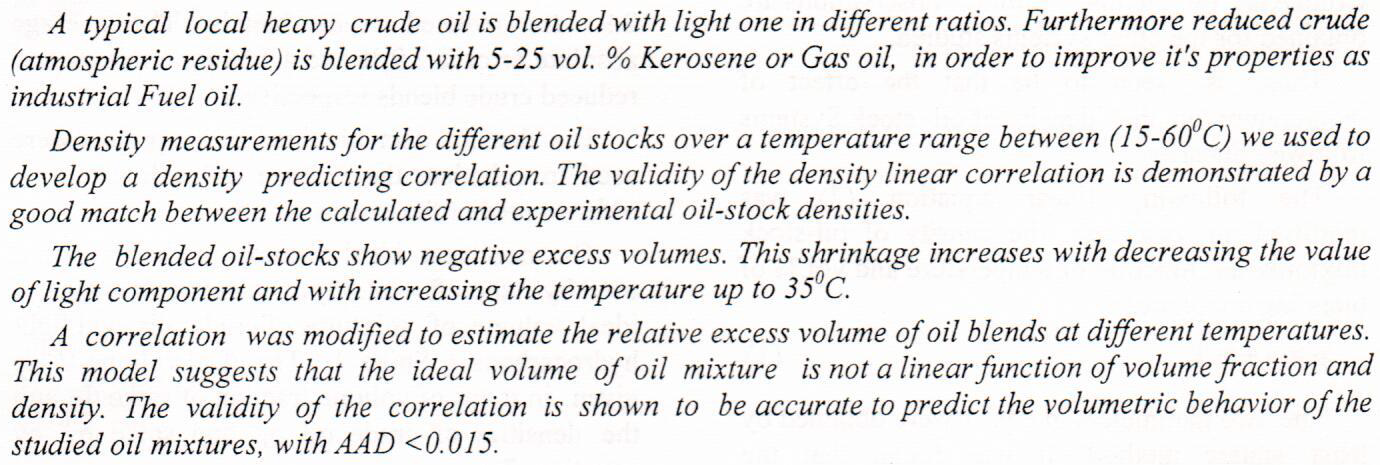
Predicting the Change in Volume of Mixed Oil Stocks

The M(II) complexes [M2 (phen)2 (L)(H2O)2Cl2 ] in (2:1:2 (M:L:phen) molar ratio, (where M(II) =Mn(II), Co(II), Cu(II), Ni(II) and Hg(II), phen = 1,10-phenanthroline; L = 2,2'-(1Z,1'Z)-(biphenyl-4,4'-diylbis(azan-1-yl-1-ylidene))bis(methan-1-yl-1- ylidene)diphenol] were synthesized. The mixed complexes have been prepared and characterized using 1H and13C NMR, UV/Visible, FTIR spectra methods and elemental microanalysis, as well as magnetic susceptibility and conductivity measurements. The metal complexes were tested in vitro against three types of pathogenic bacteria microorganisms: Staphylococcus aurous, Escherichia coli, Bacillussubtilis and Pseudomonasaeroginosa to assess their antimicrobial properties. From this study shows that all the
... Show More (6)
(6)

The compound [L] was produced in the current study through the reaction of 4-aminoacetophenon with 4-methoxyaniline in the cold, concentrated HCl with 10% NaNO2. Curcumin, several transition metal complexes (Ni (II), La (III), and Hg (II)), and compound [L] were combined in EtOH to create new complexes. UV-vis spectroscopy, FTIR, AA, TGA-DSC, conductivity, chloride content, and elemental analysis (CHNS) were used to describe the structure of produced complexes. Biological activities against fungi, S. aureus (G+), Pseudomonas (G-), E. coli (G-), and Proteus (G-) were demonstrated using complexes. Depending on the outcomes of the aforementioned methods, octahedral formulas were given as the geometrical structures for each created comp
... Show More (1)
(1)

Innovative various Schiff bases and their Co(II), Ni(II) and Cu(II) and Hg(II) compounds made by the condensation of 4-amino antipyrine with derived aminobenzoic acid (2-aminobenzoic acid, 3-aminobenzoic acid, and 4-aminobenzoic acid ) have been prepared by conventional approaches. These complexes were described by magnetic sensibility analysis, FT-IR spectra, and molar-conductance and elemental analysis. Analytical values appeared which the mixed-ligand complexes presented ratio about 2:1 (ligand: metal) with the chelation 4 or 6. The prepared compounds offered a good effect on the organisms; bacteria Staphylococcus-aurous, Escherichia-coli and fungi C. albicans, A. niger. Also, the biological products signalize which the mixed compl
... Show More
(5)
(3)
 (5)
(3)
(5)
(3)
The complexes of Schiff base of 4-aminoantipyrine and 1,10-phenanthroline with metal ions Mn (II), Cu (II), Ni (II) and Cd (II) were prepared in ethanolic solution, these complexes were characterized by Infrared , electronic spectra, molar conductance, Atomic Absorption ,microanalysis elemental and magnetic moment measurements. From these studies the tetrahedral geometry structure for the prepared complexes were suggested.The prepared ligand of 4-aminoantipyrine was characterized by using Gc-mass spectrometer .
(3)
Salicylaldehyde was react with 4-amino-2,3-dimethyl-1-phenyl-3-Pyrazoline-5-on to produce the novel Schiff base ligand 2,3-dimethyl-1-phenyl-4-salicylidene-3-pyrazoline-5-on (HL). A new complexes of VO(II), Cr(Ш), Zn(II), Cd(II), Hg(II) and UO2(II) with mixed ligands of bipyridyl and new shiff base ( 2,3-dimethyl-1-phenyl-4-salicylidene-3-pyrazoline-5-on) (HL) were prepared . All prepared compounds were identified by atomic absorption, FT.IR , UV-Visable spectra and molar conductivity. From the above data, the proposed molecular structure for VO(II) complex is squre pyramidal while (Zn(II), Cd(II), Hg(II)) and ( UO2(II),Cr(III)) complexes are forming tetrahedral and octahedral geometry respectively.
The Co(II), Ni(II) ,Cu(II), Zn(II) ,Cd(II) and Hg(II) complexes of mixed of amino acid (L-Proline ) and Trimethoprim antibiotic were synthesized. The complexes were characterized using solubility, melting point, conductivity measurement ,. and determination the percentage of the metal in the complexes by flame(AAS).Magnetic susceptibility, Spectroscopic Method [FT-IR and UV-Vis]. Draw the proposed structure of the complexes using program , Chem. office 3D(2006). The ligands and there metal complexes were screened for their antimicrobial activity against four bacteria (gram + ve) and (gram -ve){Escherichia coli, Pseudomonas aeruginosa, Staphylococcus aureus and Bacillus}.The proposed structure of the complexes using program , Chem office 3D(
... Show MoreMixed ligand complexes of bivalent metal ions, viz ; M= Co(II),Ni(II),Cu(II), Zn(II), Cd (II), and Hg(II) of the composition [M(Anth)2(TMP)] in 1:2:1 molar ratio, (where . AnthrH= Anthranilic acid (C7H7NO2) and Trimethoprime (TMP) = (C14H18N4O3) have been synthesized and characterized by repeated melting point determination, Solubility, Molar conductivity (Λm ),determination the percentage of the metal (M%) in the complexes by (AAS), FT-IR, magnetic susceptibility measurements [μeff (BM)] and electronic spectral data. The two ligands and their metal complexes have been screened for their bacterial activity against selected microbial strains (Gram +ve) & (Gram -ve).
The Co(II), Ni(II) ,Cu(II), Zn(II) ,Cd(II) and Hg(II) complexes of mixed of amino acid (L-Proline) and Trimethoprim antibiotic were synthesized. The complexes were characterized using solubility, melting point, conductivity measurement ,. and determination the percentage of the metal in the complexes by flame(AAS).Magnetic susceptibility, Spectroscopic Method [FT-IR and UV-Vis]. Draw the proposed structure of the complexes using program , Chem. office 3D(2006). The ligands and there metal complexes were screened for their antimicrobial activity against four bacteria (gram + ve) and (gram-ve){Escherichia coli, Pseudomonas aeruginosa, Staphylococcus aureus and Bacillus}.The proposed structure of the complexes using program , Chem office 3D(20
... Show MoreMixed ligand complexes of bivalent metal ions, viz ; M= Co(II),Ni(II),Cu(II), Zn(II), Cd (II), and Hg(II) of the composition [M(Anth)2(TMP)] in 1:2:1 molar ratio, (where . AnthrH= Anthranilic acid (C7H7NO2) and Trimethoprime (TMP) = (C14H18N4O3) have been synthesized and characterized by repeated melting point determination, Solubility, Molar conductivity (Λm ),determination the percentage of the metal (M%) in the complexes by (AAS), FT-IR, magnetic susceptibility measurements [µeff (BM)] and electronic spectral data. The two ligands and their metal complexes have been screened for their bacterial activity against selected microbial strains (Gram +ve) & (Gram -ve).