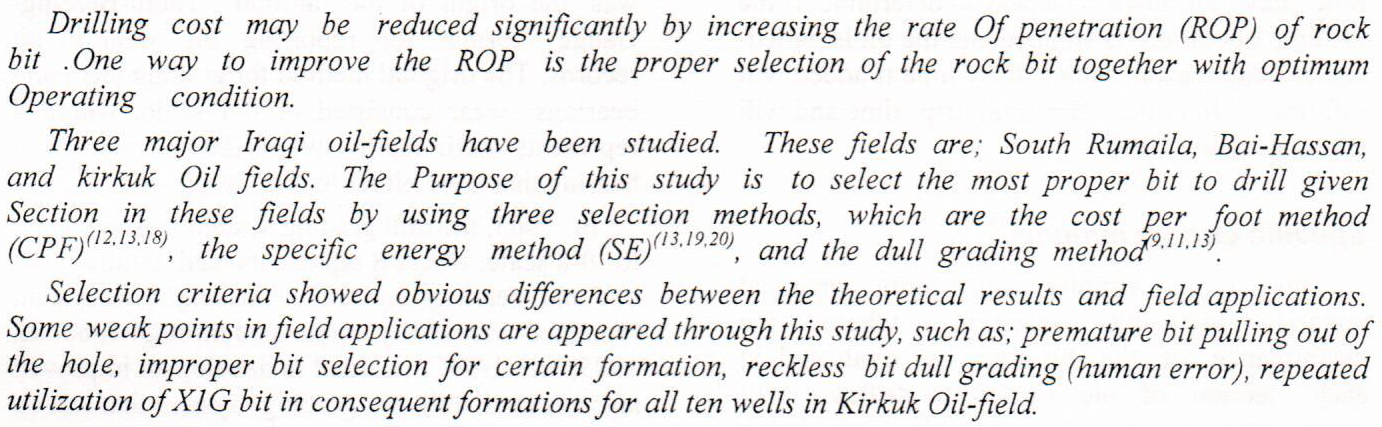
Analyzing and Optimizing Bits Performance in Three Iraqi Oil-Fields

 (1)
(1)
 (1)
(1)



Background: The ideal force-delivery system must: provide optimal tooth moving forces that elicit the desired effects, be comfortable and hygienic for the patient, require minimal operator manipulation and patient cooperation and provide rapid tooth movement with minimal mobility during orthodontic therapy, the elastomeric chains have the greatest potential to fulfill these requirements. Materials and Methods: This in vitro study was designed to determine the effect of three different mechanisms for canine retraction : (6-3 , 6-5-3 and chain loop ) on the load relaxation behavior of three types of elastomeric chains : (maximum clear , maximum silver and extreme silver) from the same company (Ortho Technology company) with two different bran
... Show MoreNew two experiments of the three factors, in this study were constructed to investigate the effects, of the fixed variations to the box plot on subjects' judgments of the box lengths. These two experiments were constructed as an extension to the group B experiments, the ratio experiments the experiments with two variables carried out previously by Hussin, M.M. (1989, 2006, 2007). The first experiment box notch experiment, and the second experiment outlier values experiment. Subjects were asked to judge what percentage the shorter represented of the longer length in pairs of box lengths and give an estimate of percentage, one being a standard plot and the other being of a different box lengths and
... Show More
Examining and comparing the image quality of degenerative cervical spine diseases through the application of three MRI sequences; the Two-Dimension T2 Weighed Turbo Spin Echo (2D T2W TSE), the Three-Dimension T2 Weighted Turbo Spin Echo (3D T2W TSE), and the T2 Turbo Field Echo (T2_TFE). Thirty-three patients who were diagnosed as having degenerative cervical spine diseases were involved in this study. Their age range was 40-60 years old. The images were produced via a 1.5 Tesla MRI device using (2D T2W TSE, 3D T2W TSE, and T2_TFE) sequences in the sagittal plane. The image quality was examined by objective and subjective assessments. The MRI image characteristics of the cervical spines (C4-C5, C5-C6, C6-C7) showed significant difference
... Show More
(3)
In this paper, the memorization capability of a multilayer interpolative neural network is exploited to estimate a mobile position based on three angles of arrival. The neural network is trained with ideal angles-position patterns distributed uniformly throughout the region. This approach is compared with two other analytical methods, the average-position method which relies on finding the average position of the vertices of the uncertainty triangular region and the optimal position method which relies on finding the nearest ideal angles-position pattern to the measured angles. Simulation results based on estimations of the mobile position of particles moving along a nonlinear path show that the interpolative neural network approach outperf
... Show MoreObjective(s): To assess the effect of removable partial dentures on the abutment teeth in comparison with that of the
remaining dentition, and to investigate the effect of regular check up on periodontal health for patients using this
type of prosthesis.
Methodology: One hundred patients wearing removable partial dentures for at least three years included in the
study. Teeth used as direct or in direct retainers for the removable partial denture were considered as the study
group, while the remaining dentition in the same jaw was considered as the control group. The following periodontal
parameters were registered for each tooth, plaque and gingival indices, clinical attachment level and tooth mobility.
Patients were
The aim of this study is to investigate the antibacterial capabilities of different coating durations of three nanoparticle (NP) coatings: molybdenum (Mo), tantalum (Ta), and zinc oxide (ZnO), and their effects on the surface characteristics of 316L stainless steel (SS). The coated substrates underwent characterization utilizing field emission scanning electron microscopy (FE-SEM), energy dispersive X-ray spectrometry (EDX), and X-ray diffractometer (XRD) techniques. The antibacterial efficacy of NPs was evaluated using the agar diffusion method. The FE-SEM and EDX images confirmed the presence of nano-sized particles of Mo, Ta, and ZnO on the surface of the substrates with perfectly symmetrical spheres and a uniform distribution of
... Show More
(4)
(4)
The present work represents description of three new species of genus Anthrenus
Geoffory from Iraq, these are : A. aradensis sp. nov., A. fabrici sp. nov. and A.
unicolor sp. nov. Locality, host plants and date of collection were given.
A field experiment was carried out to find out the effect of some herbicides(Pallas, Crash, U46) on the companion weed to three cultivars of the oat crop (Shefa, Hamel, and Pimula) and the yield and its components of these cultivars. The results showed the superiority of the two treatments of spraying weed herbicides (T1 and T2 ) by giving the best results, as they recorded the lowest number of weed plants after 30 days of spraying reached 1.44 and 1.67 plant/m2 . Besides, the lowest weed dry weight was 0.11 and 0.00 g/m2, and the highest inhibition percentage in dry weight was 98.44% and 100.0% of the two treatments, respectively. The treatment T2 was also superior by giving the highest control percentage of 93.28% compared to the compari
... Show More
(7)
Abstract: Recently, there is increasing interest in using mode-division multipelexing (MDM) technique to enhace data rate transmission over multimode fibers. In this technique, each fiber mode is treated as a separate optical carrier to transfer its own data. This paper presents a broadband, compact, and low loss three-mode (de)multiplexer designed for C+L band using subwavelength grating (SWG) technology and built-in silicon-on-insulator SOI platform. SWG offers refractive index engineering for wider operating bandwidth and compact devices compared to conventional ones. The designed (de)multiplex deals with three modes (TE0, TE1, and TE2) and has a loss > -1 dB and crosstalk < −15 dB, and its operation c
... Show More