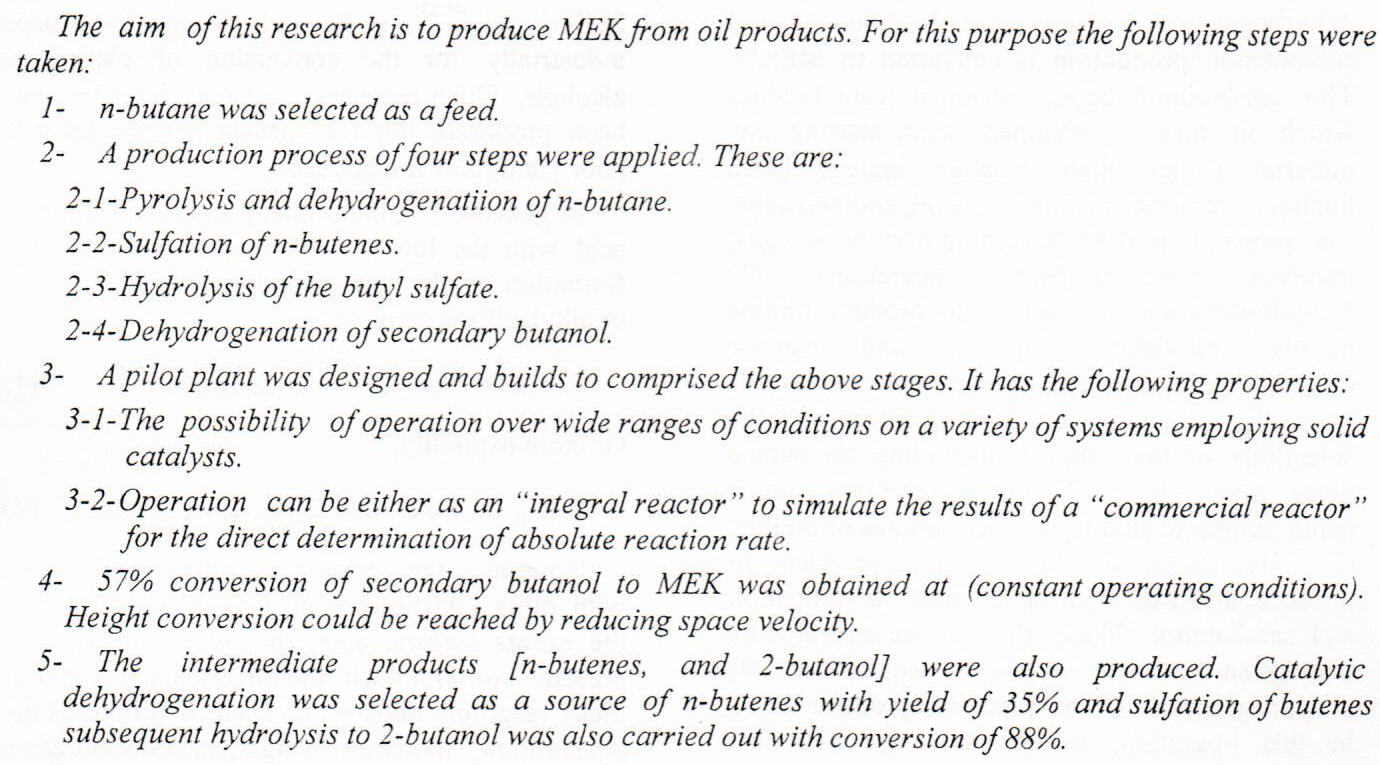
Production of Methyl Ethyl Ketone from N-Butane

This research is a theoretical study that deals with the presentation of the literature of statistical analysis from the perspective of gender or what is called Engendering Statistics. The researcher relied on a number of UN reports as well as some foreign sources to conduct the current study. Gender statistics are defined as statistics that reflect the differences and inequality of the status of women and men overall domains of life, and their importance stems from the fact that it is an important tool in promoting equality as a necessity for the process of sustainable development and the formulation of national and effective development policies and programs. The empowerment of women and the achievement of equality between men and wome
... Show MoreThe family Ormyridae has been very much neglected by workers and only two species has been recorded so far from Iraq. The present study, based mainly on my collection, deals with five species, of which one is new to science. The new species is described together with notes on locality data, host records, distribution and taxonomical remarks for all the species.
The present study provides a new insight into valuable information on the diverse structure of the Anisakid population and discusses the limited species richness in the Nemipterus japonicus (Bloch,1791) (Perciformes, Nemiperidae). The fishing area consists of various locations in the Arabian Gulf (29°58 0 33 00 N48°28 0 20 E). A total of 315 marine fish were examined, (n=287) were infected. Larval stages (n= 763) encysted within the mesenteries peritoneum and viscera of fish organs were isolated, with a prevalence of 91.11% of infection and, the intensity was 2.65. Molecular analysis was carried out on thirty individuals who have examined the morphology and showed some appearance differences, by amplifying internal transcribed spacers
... Show More (3)
(3)
 (1)
(1)


In this study, from a total of 856 mastitis cases in lactating ewes, only 34 Streptococcus agalactiae isolates showed various types of resistance to three types of antibiotics (Penicillin, Erythromycin and Tetracycline). St. agalactiae isolates were identified according to the standard methods, including a new suggested technique called specific Chromogenic agar. It was found that antibiotic bacterial resistance was clearly identified by using MIC-microplate assay (dilution method). Also, by real-time PCR technique, it was determined that there were three antibiotics genes resistance ( pbp2b, tetO and mefA ). The high percentage of isolate carried of a single gene which was the Tetracycline (20.59%) followed by percentage Penicillin was
... Show More
(4)

Fifty three hydatid cysts were collected from different hosts, sheep, goats and cattle , from many slaughterhouse in Salahadin and Baghdad , while human's hydatid cysts samples were collected from Tikrit educational hospital and Tofiqe civilian hospital patients . The study included a biochemical comparison of some hydatid cyst fluid criteria such as, glucose, total protein, pH, glutamate pyrovate transaminase enzyme (GPT) , glutamate oxaloacetate transaminase enzyme (GOT) , acid phosphatase (ACP) , Alkaline Phosphatase (ALP) , and also studied protoscolices viability,the current study showed the differences in chemical composition of hydatid cyst fluids back to host type and parasite strain .
(1)
The aim of this study is to propose mathematical expressions for estimation of the flexural strength of plain concrete members from ultrasonic pulse velocity (UPV) measurements. More than two hundred pieces of precast concrete kerb units were subjected to a scheduled test program. The tests were divided into two categories; non-destructive ultrasonic and bending or rupture tests. For each precast unit, direct and indirect (surface) ultrasonic pulses were subjected to the concrete media to measure their travel velocities. The results of the tests were monitored in two graphs so that two mathematical relationships can be drawn. Direct pulse velocity versus the flexural strength was given in the first relationship while the second equation des
... Show MoreIn the present research, the chemical washing method has been selected using three chelating agents: citric acid, acetic acid and Ethylene Diamine Tetraacetic Acid (EDTA) to remove 137Cs from two different contaminated soil samples were classified as fine and coarse grained. The factors that affecting removal efficiency such as type of soil, mixing ratio and molarity have been investigated. The results revealed that no correlation relation was found between removal efficiency and the studied factors. The results also showed that conventional chemical washing method was not effective in removing 137Cs and that there are further studies still need to achieve this objective.
The extraction of iron from aqueous chloride media in presence of aluminum was studied at different kinds of extractants(cyclohexanone, tributyl phosphate, diethyl ketone), different values of normality (pH of the feed solution), agitation time, agitation speed, operating temperature, phase ratio (O/A), iron concentration in the feed, and extractant concentration]. The stripping of iron from organic solutions was also studied at different values of normality (pH of the strip solution) and phase ratio (A/O). Atomic absorption spectrophotometer was used to measure the concentration of iron and aluminum in the aqueous phase throughout the experiments.The best values of extraction coefficient and stripping coefficient are obtained under the
... Show MoreEndoglucanase produced from Aspergillus flavus was purified by several steps including precipitation with 25 % ammonium sulphate followed by Ion –exchange chromatography, the obtained specific activity was 377.35 U/ mg protein, with a yield of 51.32 % .This step was followed by gel filtration chromatography (Sepharose -6B), when a value of specific activity was 400 U/ mg protein, with a yield of 48 %. Certain properties of this purified enzyme were investigated, the optimum pH of activity was 7 and the pH of its stability was 4.5, while the temperature stability was 40 °C for 60 min. The enzyme retained 100% of its original activity after incubation at 40 °C for 60 min; the optimum temperature for enzyme activity was 40 °C.