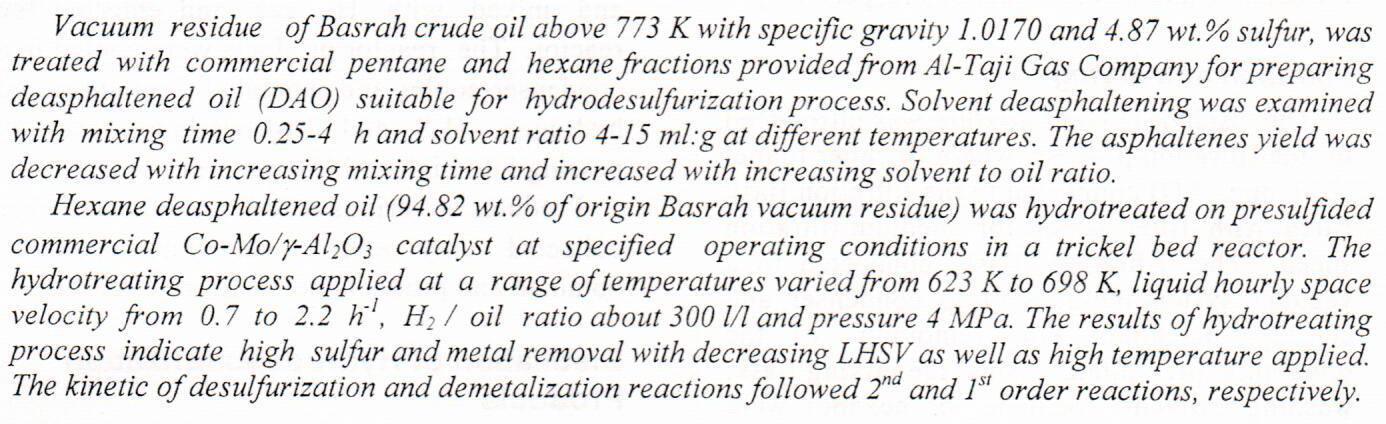
Deasphaltening and Hydrodesulfurization of Basrah Vacuum Residue

Development of a precise and delicate reaction has been acquired for the determination of vancomycin hydrochloride using batch and cloud point extraction (CPE) methods. The first method is based on the formation of azo dye as a result of diazotized dapsone coupled with vancomycin HCl (VAN) in a basic medium. The sensitivity of this reaction was enhanced by utilizing a nonionic surfactant (Triton X-114) and the cloud point extraction technique (second method). The azo dye formed was extracted into the surfactant-rich phase, dissolved in ethanol and detected at λmax 440 nm spectrophotometrically. The reaction was investigated using both batch and CPE methods (with and without extraction), and a simple comparison between the two
... Show More (7)
(7)
 (5)
(5)


Phosphorus‐based Schiff base were synthesized by treating bis{3‐[2‐(4‐amino‐1.5‐dimethyl‐2‐phenyl‐pyrazol‐3‐ylideneamino)ethyl]‐indol‐1‐ylmethyl}‐phosphinic acid with paraformaldehyde and characterized as a novel antioxidant. Its corresponding complexes [(VO)2L(SO4)2], [Ni2LCl4], [Co2LCl4], [Cu2LCl4], [Zn2LCl4], [Cd2LCl4], [Hg2LCl4], [Pd2LCl4], and [PtL
... Show More
(46)
(25)
 (51)
(46)
(51)
(46)
This paper is interested in certain subclasses of univalent and bi-univalent functions concerning to shell- like curves connected with k-Fibonacci numbers involving modified Sigmoid activation function θ(t)=2/(1+e^(-t) ) ,t ≥0 in unit disk |z|<1 . For estimating of the initial coefficients |c_2 | , |c_3 |, Fekete-Szego ̈ inequality and the second Hankel determinant have been investigated for the functions in our classes.
(4)
(1)
(4)
(20)
(19)
Water is a resource and a crucial aspect of living and surviving. In Iraq, the Tigris River is one of the most critical water sources. The present study aimed to provide an insight analysis of some water quality parameters including the microbial content of drinkable tap water and river water. Ten Water samples (T1- T10) in triplicate were collected from sampling sites -Site I (Tap water) from home water taps, supplied by the Water Filtration Station/ Al Karama Project/ Al-Karkh> 10 from Site II (R1- R10)River water from Tigris River (around or near the Water Filtration Station/ Al Karama Project) every week (from September to half of November 2022), then were immediately placed in sterile bottles and transported to Microbiolo
... Show More
(5)
(2)
A total of sixty raw milk samples were collected from (street vendors and shops) from Baghdad city, Iraq. The samples were inoculated into peptone water and, then, subcultured onto MacConkey agar and Blood agar. Identification of isolates was confirmed by microscopic examination, cultural characteristic, biochemical tests, Vitek (VITEK®2 system), and Biolog GN substrate reactions followed by 16S rRNA and specific genes sequencing. Of 60 raw cow’s milk samples, Providencia spp. were identified only in 4 samples (6.67%) and P. rettgeri was the most common, 2/4 (50%), followed by P. stuartii and P. vermicola, 1/4 (25%). Antimicrobial susceptibility tests were conducted against ten antibiotics by the disc diffusion method. All Provid
... Show More
(11)
(9)
(56)
(40)