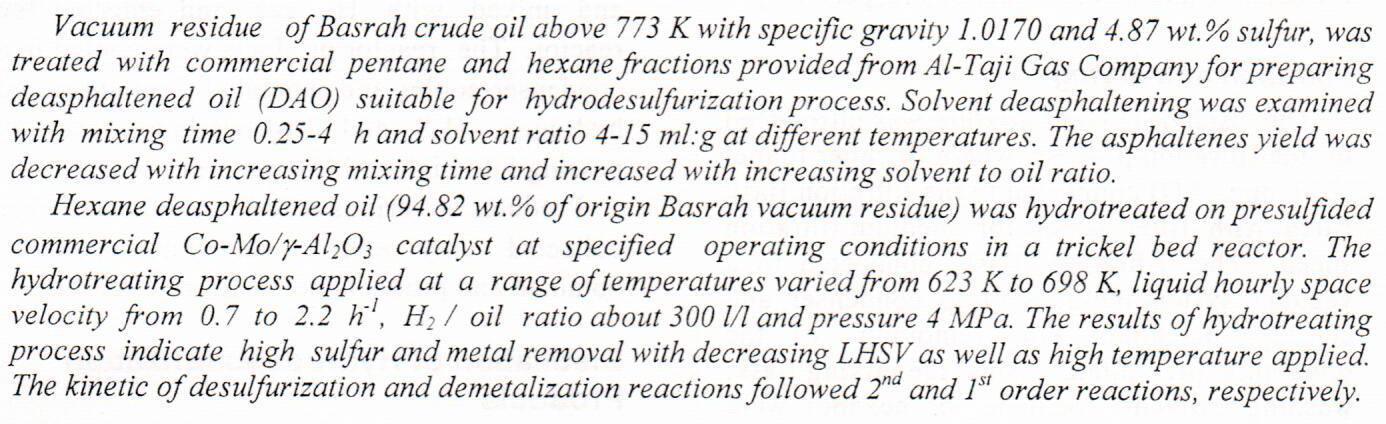
Deasphaltening and Hydrodesulfurization of Basrah Vacuum Residue

Staphylococcus lugdunensis, isolation between 12.5 to 1.8% routine works may be a possible peroral route of infective endocarditis and found in the oral cavity by examined using saliva. Similar supragingival plaque isolation was observed. The increased bacteria resistance to antibiotics multiple have led to novel methods for resistance bacteria; antimicrobial agents are well known (ZnO NPs) by biological method and are lower toxicity and biology safety ZnNOPs activity by plant extraction and less toxicity as well as bio-safe. The nanoparticle was synthesized by biological method (Green) by barberry (Berberis vulgaris) extract. In this study using (WAD) method using different concentrations between (128, 64, 32, and 16) mg/mL of ZnO
... Show More (5)
(5)
 (3)
(3)


Staphylococcus lugdunensis, isolation between 12.5 to 1.8% routine works may be a possible peroral route of infective endocarditis and found in the oral cavity by examined using saliva. Similar supragingival plaque isolation was observed. The increased bacteria resistance to antibiotics multiple have led to novel methods for resistance bacteria; antimicrobial agents are well known (ZnO NPs) by biological method and are lower toxicity and biology safety ZnNOPs activity by plant extraction and less toxicity as well as bio-safe. The nanoparticle was synthesized by biological method (Green) by barberry (Berberis vulgaris) extract. In this study using (WAD) method using different concentrations between (128, 64, 32, and 16) mg/mL of ZnO NPs, The
... Show More
(5)
(3)
Lead acetate as one of the environmental pollutants can threats the life of living creatures in many ways, it has a long half-life, accumulates mainly in the soft tissue and leads to adverse effects in these tissues. An experiment was conducted to study the effect of oral feeding of lead acetate on histological features of liver, kidney, testis and muscle of albino mice. Mice were treated with 0.05 mg/100 ml lead acetate (LA) for 10 days (group A) and for and for 20 days (group B) and for 30 days (group C). The histological section of liver of mice group A characterized by slightly blurred trabecular structure with foci of hepatitis which increased with cytoplasmic vacules in group B but in group C liver reveal necrosis, heamorrhage,
... Show More
(1)
Levofloxacin belongs to the fluoroquinolone family; it is a potent broad-spectrum bactericidal agent. The pharmacophore required for significant antibacterial activity is the C-3 carboxylic acid group and the 4-pyridine ring with the C-4 carbonyl group, into which binding to the DNA bases occur. In this work, we tried to show that by masking the carboxyl group through amide formation using certain amines to form levofloxacin carboxamides, an interesting activity is kept. Levofloxacin carboxamides on the C-3 group were prepared, followed by the formation of their copper complexes. The target compounds were characterized by FT-IR, elemental analysis. The antimicrobial activity of the target compounds was evaluated and showed satisfactory resu
... Show More
(12)
(1)

A novel series of liquid crystalline compounds containing 2,4-thiazolidinedione units with varying terminal alkyl chain lengths was successfully synthesized and characterized. The chemical structures of the synthesized compounds were confirmed by FT-IR, ¹H-NMR, and mass spectrometry. The mesomorphic behavior was investigated using polarized optical microscopy (POM) and differential scanning calorimetry (DSC). Compounds [V]₄, [V]₅, and [V]₆ exhibited enantiotropic nematic phases, while compound [V]₈ displayed a smectic A (SmA) phase. No liquid crystalline behavior was observed for compound [V]₃. The liquid crystalline properties were found to depend on the terminal-to-lateral chain length ratio, molecular geometry, and the nature
... Show More