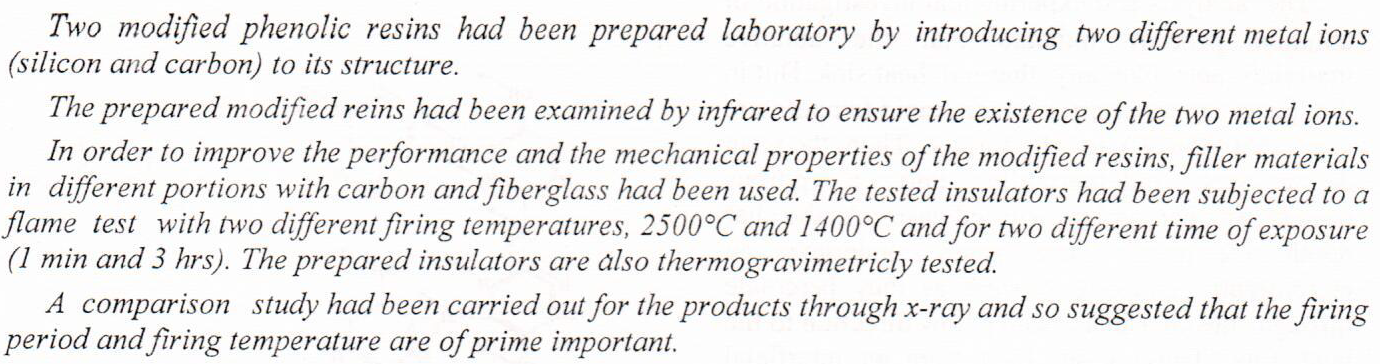
Isolation Behavior of Metal Modified Novolac Resin

In this work the corrosion behavior of Al metal was studied by using non- destructive testing (NDT), which is a noninvasive technique for determining the integrity of a material. The ultrasonic waves was used to measure the corrosion which occur by two corrosive medium (0.1N sodium chloride and 0.1N sodium hydroxide) and study the corrosion by weight-loss method and electrochemical method in addition to performance the microscopic inspection for the samples before and after the immersion in the corrosive medium. Corrosion parameters were interpreted in these media which involve corrosion potential (Ecorr) and corrosion current density (icorr). The results indicate that both
... Show More
In this study, the preparation and characterization of hyacinth plant /chitosan composite, as a heavy metal removal, were done. Water hyacinth plant (Eichhorniacrasspes) was collected from Tigris river in Baghdad. The root and shoot parts of plant were ground to powder. Composite materials were prepared at different ratios of plant part (from 2.9% to 30.3%, wt /wt) which corresponds to (30-500mg) of hyacinth plant (root and shoot) and chitosan. The results showed that all examined ratios of plant parts have an excellent absorption to copper (Cu (II)). Moreover, it was observed that 2.9% corresponds (30mg) of plant root revealed highest removal (82.7%) of Pb (II), while 20.23% of shoot removed 61% of Cd (II) within 24 hr
... Show More (10)
(10)
 (6)
(6)


Salicylaldehyde was reacting with 2-amino benzoic acid to produce the Schiff base ligand benzoic acid 2-salicylidene (L). The prepared ligand was identified by Microelemental Analysis, FT.IR and UV-Vis spectroscopic techniques. A new complexes of Co(II),Ni(II),Cu(II) and Zn(II) with Schiff base was prepared in aqueous ethanol with a (1:1) M:L. The prepared complexes were characterized using flame atomic absorption, (C.H.N) Analysis, FT.IR and UV-Vis spectroscopic methods as well as magnetic susceptibility and conductivity measurements. Biological activity of the ligand and complexes against three selected types of bacteria were also examined. Some of the complexes exhibit good bacterial activities. From the obtained data the tetrahedral str
... Show MoreAs they include both nucleophilic and electrophilic moieties on the same skeleton, enaminones are an important subclass of chemical compounds that contain conjugated NC=CC=O fragments. These active sites aid in the production of organic molecules containing linear or cyclic heteroatoms. Enaminones and the chemica1 compounds produced from them are both biologically active against the most dangerous bacteria. As a result, they have been utilized as starting materials for the synthesis of anti-inf1ammatory, antibacteria1, anticonvulsant, anticancer, anti-urease, anti-malaria1, optically luminescent, corrosion inhibition, and antitumor agents. Their synthesis has usually a terrific deal of interest and a plethora of synthetic paths have been na
... Show MoreFour mixed ligand complexes were prepared from 1,10-phenanthroline (Phen), 5-chlorosalicylic acid (CSA), and anthranilic acid (Anthra) dissolved in aqueous ethanol at a ratio of (1:1:1:1) M: Phen:CSA: Anthra, M(II)= Cu, Zn, Cd, and Hg. The prepared compounds were analyzed by flame atomic absorption, FT-IR, UV-Vis, and spectroscopic methods, as well as conductivity measurements and magnetic properties. After analyzing the prepared compounds using the acquired data, the complexes formed by mixing ligands were concluded to adopt an octahedral geometry. That study has been conducted to test the inhibitory effectiveness of the complexes (1,10-Phenanthroline (Phen), 5-Chlorosalicylic acid (CSA), Na[Cu(Phen)(CSA)(Anthra), Na[Zn(Phen)(CSA
... Show More
The preparation and characterization of the Cu (II), Co(II), Ni(II), Zn(II), Cd(II), and Hg(II) metal complexes of heterocyclic azo ligand 2-[(4`-sulphamide phenyl) azo] -4,5-diphenyl imidazole (4-SuBAI) have been studied by elemental analysis, FT-IR and UV-Vis Spectroscopic, magnetic moment and molar conductance methods. The analytical data showed that all chelate complexes were prepared with (metal-ligand) ratio of (1:2). The general formula of these complexes was [ML2X2]. nH2O [were L=2-[(4`-sulphamide phenyl) azo]-4,5-diphenyl imidazole and X=Cl, and the octahedral geometry were suggested for these complexes .
This study is included the preparation of two tetradentate amide-thiol proligands of the general structure [H2Ln], [where; (n = (1–2)]. The ligands [H2L1] and [H2L2] have been prepared from the reaction of the cyclic thioester 2-oxo-1, 4-dithiacyclohexane (compound 1) and 3-chloro-2-oxo-1, 4 dithiacyclohexane (compound 2) with 2-aminomethanepyridine in (1:1) ratio respetively. The reaction was carried out in chloroform at room temperature and under N2 atmosphere. Structural formula of these two ligands have been reported.
Ortho amino hydrazobenzene (L) has been prepared from the reaction of ortho amino phenyl thiol with phenyl hyrazan in mole ratio(1:1). It has been characterized by elemental analysis (C, H, N), IR, UV–Vis. The complexes of the bivalent ions (Co, Ni, Cu, Zn, Pd, Cd, Hg and Pb) and the trivalent (Cr) have been prepared and characterized too. The structural have been established by elemental analysis(C,H,N), IR , UV – Vis spectra , conductivity measurements , atomic absorption and magnetic susceptibility . The complexes showed characteristic behaviour of octahedral geometry around the metal ion and the( N,N) ligand coordinated in bidentate modeexcept with pd showed square planer. ? ,kf , ?max for the complexes were estimated too . ? for Co
... Show More
New isatinic hydrazone Schiff-base ligands, namely furan-2-carboxylic acid (2-oxo-1,2-dihydro-indol- 3-ylidene)-hydrazide (L1), thiophene-2-carboxylic acid (2- oxo-1,2-dihydro-indol-3-ylidene)-hydrazide (L2) and 2-(pyridine-2-yl-hydrazono)-1,2-dihydro-indol-3-one) (L3) are reported. The ligands were prepared by the condensation of furan-2-carboxylic acid hydrazide (L1), thiophene- 2-carboxylic acid hydrazide (L2), and 2-hydrazino pyridine (L3) with isatine. Monomeric complexes were prepared from the reaction of the corresponding metal chloride with the ligands. The ligands and their nine new complexes of the general formulae [M(Ln)2]Cl2 [where M = Co(II), Zn(II) and Cd(II); n = L1, L2 and L3] were characterised by spectroscopic methods (FTI
... Show More
(20)
(11)