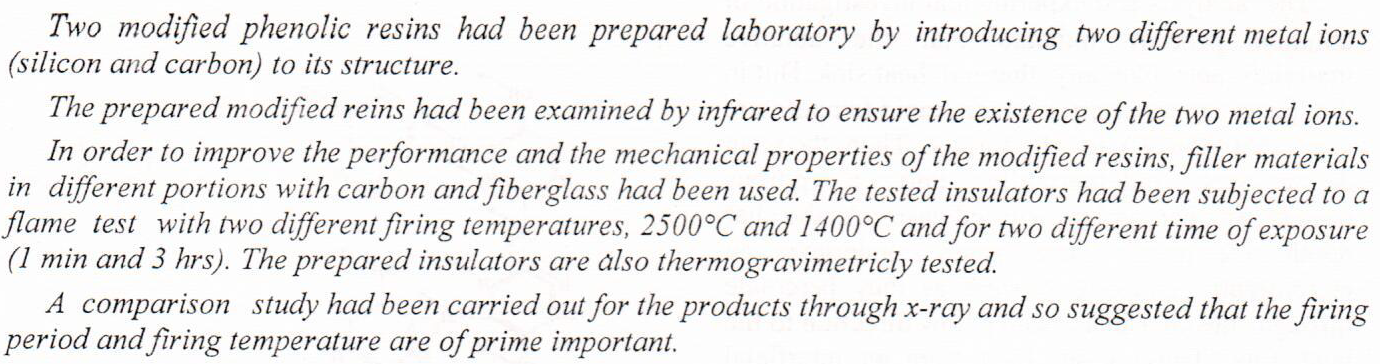
Isolation Behavior of Metal Modified Novolac Resin

Thin-walled members are increasingly used in structural applications, especially in light structures like in constructions and aircraft structures because of their high strength-to-weight ratio. Perforations are often made on these structures for reducing weight and to facilitate the services and maintenance works like in aircraft wing ribs. This type of structures suffers from buckling phenomena due to its dimensions, and this suffering increases with the presence of holes in it. This study investigated experimentally and numerically the buckling behavior of aluminum alloy 6061-O thin-walled lipped channel beam with specific holes subjected to compression load. A nonlinear finite elements analysis was used to obtain the
... Show More (4)
(4)

Conventional concretes are nearly unbendable, and just 0.1 percent of strain potential makes them incredibly brittle and stiff. This absence of bendability is a significant cause of strain failure and has been a guiding force in the production of an elegant substance, bendable concrete, also known as engineered cement composites, abbreviated as ECC. This type of concrete is capable of displaying dramatically increased flexibility. ECC is reinforced with micromechanical polymer fibers. ECC usually uses a 2 percent volume of small, disconnected fibers. Thus, bendable concrete deforms but without breaking any further than conventional concrete. This research aims to involve this type of concrete, bendable concrete, that will give solut
... Show MoreThis research is concerned to investigate the behavior of reinforced concrete (RC) deep beams strengthened with carbon fiber reinforced polymer (CFRP) strips. The experimental part of this research is carried out by testing seven RC deep beams having the same dimensions and steel reinforcement which have been divided into two groups according to the strengthening schemes. Group one was consisted of three deep beams strengthened with vertical U-wrapped CFRP strips. While, Group two was consisted of three deep beams strengthened with inclined CFRP strips oriented by 45o with the longitudinal axis of the beam. The remaining beam is kept unstrengthening as a reference beam. For each group, the variable considered
... Show MoreThe pure ZnS and ZnS-Gr nanocomposite have been prepared
successfully by a novel method using chemical co-precipitation. Also
conductive polymer PPy nanotubes and ZnS-PPy nanocomposite
have been synthesized successfully by chemical route. The effect of
graphene on the characterization of ZnS has been investigated. X-ray
diffraction (XRD) study confirmed the formation of cubic and
hexagonal structure of ZnS-Gr. Dc-conductivity proves that ZnS and
ZnS-Gr have semiconductor behavior. The SEM proved that
formation of PPy nanotubes and the Gr nanosheet. The sensing
properties of ZnS-PPy/ZnS-Gr for NO2 gas was investigated as a
function of operating temperature and time under optimal condition.
The sensitivity,
To investigate the flexural behavior of self-consolidating hybrid fiber-reinforced concrete beams containing voids experimentally, six RC beams were tested, one solid without fiber and the others containing hooked-steel and macro-polypropylene fibers with a volume fraction of 1 and 0.5%, respectively. One of the five fibrous beams was solid; two contain a series of recycled plastic balls of diameters 110 and 120 mm, and another two contain a single longitudinal circular void created by PVC pipes of diameters 90 and 110 mm. The flexural behavior of the beams was assessed depending on the load-deflection curve, load-strain curve, ductility, toughness, stiffness, and crack patterns. The experimental outcomes showed that all the tested
... Show More
In this study, three strengthening techniques, near-surface mounted NSM-CRFP, NSM-CFRP with externally bonding EB-CFRP, and hybrid CFRP with circularization were studied to increase the seismic performance of existing RC slender columns under lateral loads. Experimentally, 1:3 scale RC models were studied and subjected to both lateral static load and seismic excitation. In the dynamic test, a model was subjected to El Centro 1940 NS earthquake excitation by using a shaking table. According to the test results, the strengthening techniques showed a significant increase in load carrying capacity, of about 86.6%, and 46.6%, for circularization and NSM-CFRP respectively, of the reference unstrengthened columns. On the other hand, column
... Show More
(10)
The main objective of this paper is to study the behavior of Non-Prismatic Reinforced Concrete (NPRC) beams with and without rectangular openings either when exposed to fire or not. The experimental program involves casting and testing 9 NPRC beams divided into 3 main groups. These groups were categorized according to heating temperature (ambient temperature, 400°C, and 700°C), with each group containing 3 NPRC beams (solid beams and beams with 6 and 8 trapezoidal openings). For beams with similar geometry, increasing the burning temperature results in their deterioration as reflected in their increasing mid-span deflection throughout the fire exposure period and their residual deflection after cooling. Meanwhile, the existing ope
... Show More (23)
(20)
(4)
(1)
(23)
(20)
(4)
(1)
Al-Chibayish Marsh (CM) is considered as the major part of Central Marshes area of this marsh is 1050 Km². The water quality of these marshes is suffering from salt accumulation due to intensive dam construction, limited supply of water from sources, climate change impacts, and the absence of outlet flow from these marshes, specifically at low flow periods. So, the current research aims to assess and improve these marshes' hydraulic behavior and water quality and define the best location for outlet drains. Field measurements and laboratory tests were conducted for two periods (November 2020 and February 2021) to define the (TDS) concentrations at nine different locations. Samples were also examined for water's phy
... Show More
(2)
(1)