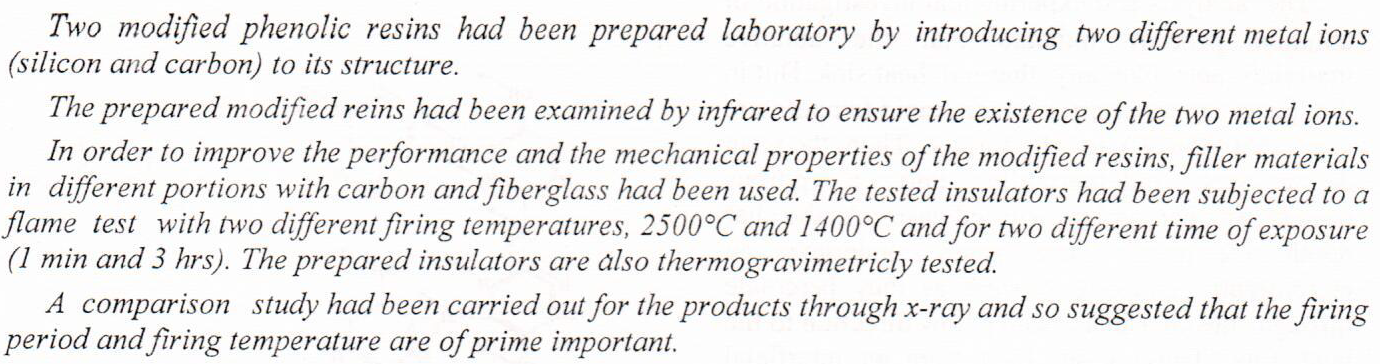
Isolation Behavior of Metal Modified Novolac Resin

|
Natural convection in an annular space provided with metal foam fins attached to the inner cylinder is studied numerically. The metal foam fins made of copper were inserted in different axial sections with three fins in each section. The temperature of the inner cylinder is kept constant while the annular outer surface is adiabatic. The thickness effect of the inner pipe wall was considered. Naiver Stokes equation with Boussinesq approximation is used for the fluid regime while Brinkman-Forchheimer Darcy model is used for metal foam. In addition, the local thermal non-equilibrium condition in the energy equation of the porous media is presumed. The effect of Rayleigh numb |

Synthesis of new Fe+3, Co+2, Cu+2, Ru+3, and Rh+3 complexes of azo ligand; [5-((2-(3 H-1 indol-3-yl) ethyl) diazenyl) quinolin-8-ol], of 1:2 (M: L) and characterized through various techniques. The complexes exhibited octahedral geometries. Thermogravimetric (TGA and DSC) analysis is utilized to study the thermal properties of various compounds and reveal the presence of coordinated water molecules in the complexes. The multi-stage thermal decomposition mechanisms, where the thermal breakdown is ended by the formation of metal oxide as the final stable residue. The antioxidant activity of the ligand and its metal complexes was evaluated using the DPPH free radical scavenging assay and Gallic acid as a standard substance. Among the tested co
... Show More (1)
(1)
 (1)
(1)

Metal complexes chrome(III), manganese(II), iron(III), cobalt(II), nickel(II), cupper(II) and zinc(II) with diazonium of 3-amino-2-chloropyridine of general formula [2-Cl-C5H3N≡N]n[MXm], where n=2 or 3 for divalent and trivalent metal, m= 4 or 6 were synthesized. The complexes have been characterized by flame atomic absorption, (C.H.N), molar conductance, magnetic susceptibility UV-vis spectra, infrared spectra,1H-NMR spectroscopy and thermo gravimetric analysis (TGA and DTA). The measurements showed that the divalent metal ion complexes (M2+) have (1:2) M:L ratio with tetrahedral geometry around metal ions while the trivalent metal ions (M3+) formed (1:3) m
... Show More
Background: Esthetic treatment is the options of patient seeking orthodontic treatment. Therefore this study was conducted to measure the concentration of Aluminum, Nickel, Chromium and Iron ions released from combination of monocrysralline brackets with different arch wires immersed in artificial saliva at different duration, to evaluate the corrosion point on different parts of the orthodontic appliances before and after immersion in artificial saliva, and to evaluate the corrosion potential of each group of the orthodontic appliances. Material and methods: Eighty orthodontic sets prepared. Each set represents half fixed orthodontic appliance, from the central incisor to the first molar, for the maxillary arch, each set consisted of molar
... Show MorePurpose: To use the L25 Taguchi orthogonal array for optimizing the three main solvothermal parameters that affect the synthesis of metal-organic frameworks-5 (MOF-5). Methods: The L25 Taguchi methodology was used to study various parameters that affect the degree of crystallinity (DOC) of MOF-5. The parameters comprised temperature of synthesis, duration of synthesis, and ratio of the solvent, N,N-dimethyl formamide (DMF) to reactants. For each parameter, the volume of DMF was varied while keeping the weight of reactants constant. The weights of 1,4-benzodicarboxylate (BDC) and Zn(NO3)2.6H2O used were 0.390 g and 2.166 g, respectively. For each parameter investigated, five different levels were used. The MOF-5 samples were synthesi
... Show More
(3)
(1)

A novel series of liquid crystalline compounds containing 2,4-thiazolidinedione units with varying terminal alkyl chain lengths was successfully synthesized and characterized. The chemical structures of the synthesized compounds were confirmed by FT-IR, ¹H-NMR, and mass spectrometry. The mesomorphic behavior was investigated using polarized optical microscopy (POM) and differential scanning calorimetry (DSC). Compounds [V]₄, [V]₅, and [V]₆ exhibited enantiotropic nematic phases, while compound [V]₈ displayed a smectic A (SmA) phase. No liquid crystalline behavior was observed for compound [V]₃. The liquid crystalline properties were found to depend on the terminal-to-lateral chain length ratio, molecular geometry, and the nature
... Show More