Removal of Chromium from Wastewater by Adsorption
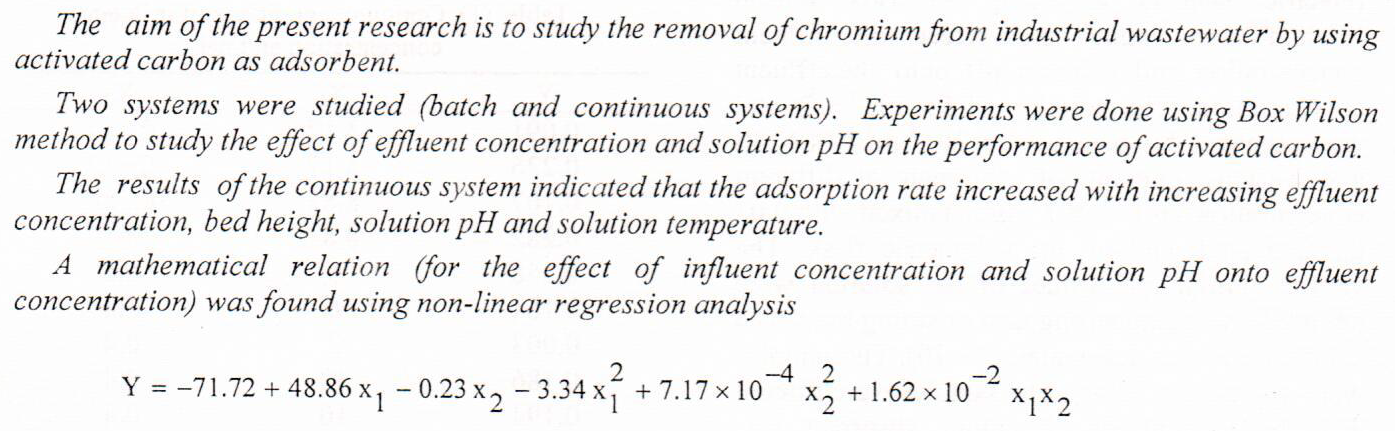

 (50)
(50)
 (50)
(50)


 (10)
(10)
The provision of safe water for people is a human right; historically, a major number of people depend on groundwater as a source of water for their needs, such as agricultural, industrial or human activities. Water resources have recently been affected by organic and/or inorganic contaminants as a result of population growth and increased anthropogenic activity, soil leaching and pollution. Water resource remediation has become a serious environmental concern, since it has a direct impact on many aspects of people’s lives. For decades, the pump-and-treat method has been considered the predominant treatment process for the remediation of contaminated groundwater with organic and inorganic contaminants. On the other side, this tech
... Show More
(149)
(158)
Inundation floodingmap aimedto find outearly warningsto avoidenvironmental damageandhumanin terms of theheight ofthe wave ofwater, speed time arrival, effects of inundation sideanddepth of the water/ distanceand reduce the impact of the flood wave after obtaining the process of collapse of the dam in the lower part of the river to the dam area. The study has been using a numerical model one-dimensional depends on the development of equations (Saint-Venant) so that parts of the river, any river channel main banks of the right and left treated as separate parts, that’s the difference in the characteristics of the hydraulic and engineering, along the line of the flow will take into account in each section of the sections and flow in the riv
... Show More
(13)
(15)
(4)
(6)
Oily wastewater is one of the most challenging streams to deal with especially if the oil exists in emulsified form. In this study, electrospinning method was used to prepare nanofiberous polyvinylidene fluoride (PVDF) membranes and study their performance in oil removal. Graphene particles were embedded in the electrospun PVDF membrane to enhance the efficiency of the membranes. The prepared membranes were characterized using a scanning electron microscopy (SEM) to verify the graphene stabilization on the surface of the membrane homogeneously; while FTIR was used to detect the functional groups on the membrane surface. The membrane wettability was assessed by measuring the contact angle. The PVDF and PVDF / Graphene membranes efficiency
... Show More
(1)
In this study, the sonochemical degradation of phenol in water was investigated using two types of ultrasonic wave generators; 20 kHz ultrasonic processor and 40 kHz ultrasonic cleaner bath. Mineralization rates were determined as a function of phenol concentration, contact time, pH, power density, and type of ultrasonic generator. Results revealed that sonochemical degradation of the phenol conversion was enhanced at increased applied power densities and acidic conditions. At 10 mg/L initial concentration of phenol, pH 7, and applied power density of 3000 W/L, the maximum removal efficiency of phenol was 93% using ultrasonic processor at 2h contact time. Whereby, it was 87% using and ultrasonic cleaner bath at 16h contact time and 150 W
... Show More
(13)