Removal of Chromium from Wastewater by Adsorption
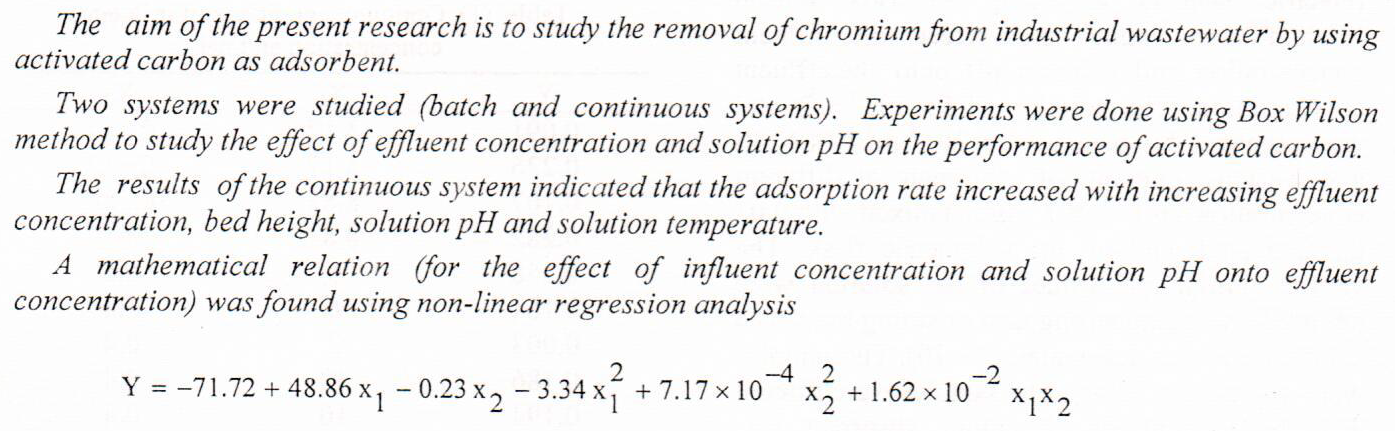

 (39)
(39)
 (35)
(35)



In this paper waste natural material (date seed) and polymer particles(UF) were used for investigation of removal dye of the potassium permanganate. Also study effect some variables such as pH, dye concentration and adsorbent concentration on dye removal. 15 experimental runs were done using the itemized conditions designed established on the Box-Wilson design employed to optimize dye removal. The optimum conditions for the dye removal were found: (pH) 12, (dye con.) 2.38 ppm, (adsorbant con.) 0.0816 gm for date seed with 95.22% removal and for UF (pH) 12, (dye con.) 18 ppm, (adsorbant con.) 0.2235 gm with 91.43%. The value of R-square was 85.47% for Date seed and (88.77%) for UF.
... Show More
The present study aims to remove nickel ions from solution of the simulated wastewater using (Laminaria saccharina) algae as a biosorbent material. Effects of experimental parameters such as temperature at (20 - 40) C⁰, pH at (3 - 7) at time (10 - 120) min on the removal efficiency were studied.
Box-Wilson method was adopted to obtain a relationship between the above three experimental parameters and removal percentage of the nickel ions. The experimental data were fitted to second order polynomial model, and the optimum conditions for the removal process of nickel ions were obtained.
The highest removal percentage of nickel ions obtained was 98.8 %, at best operating conditions (Temperature 35 C⁰, pH 5 and Time 10 min).
Acinetobacter baumannii ability to form biofilm makes it to be opportunistic pathogen causing of nosocomial infections and to be good survivor in adverse environmental conditions including medical devices and hospital environments. Six isolates of A. baumannii were isolated from drinking water and tested to investigate biofilm formation capacity on three different type of abiotic surface, also several factors were examined such as hydrophobicity, PH and temperature. All A. baumannii isolates displayed a positive biofilm on congored aga test CRA (pigmented colonies with black color) and Christensen's test (adhesive layer of stained material to the inside surface of the tube).The obtained data of microbial adhesion to hydrocarbons assay (MATH
... Show MoreKE Sharquie, AA Noaimi, HA Al-Mudaris, Journal of Cosmetics, Dermatological Sciences and Applications, 2012 - Cited by 6
Investigation of the adsorption of acid fuchsin dye (AFD) on Zeolite 5A is carried out using batch scale experiments according to statistical design. Adsorption isotherms, kinetics and thermodynamics were demonstrated. Results showed that the maximum removal efficiency was using zeolite at a temperature of 93.68751 mg/g. Experimental data was found to fit the Langmuir isotherm and pseudo second order kinetics with maximum removal of about 95%. Thermodynamic analysis showed an endothermic adsorption. Optimization was made for the most affecting operating variables and a model equation for the predicted efficiency was suggested.
Abstract
The analysis of Least Squares: LS is often unsuccessful in the case of outliers in the studied phenomena. OLS will lose their properties and then lose the property of Beast Linear Unbiased Estimator (BLUE), because of the Outliers have a bad effect on the phenomenon. To address this problem, new statistical methods have been developed so that they are not easily affected by outliers. These methods are characterized by robustness or (resistance). The Least Trimmed Squares: LTS method was therefore a good alternative to achieving more feasible results and optimization. However, it is possible to assume weights that take into consideration the location of the outliers in the data and det
... Show More
In this research, an organobentonite (HDTMA-BT) was prepared by modifying a jordanian bentonite (BT) with hexadecyltrimethylammonium bromide. By means of in situ free radical polymerization in THF with AIBN as the initiator, this organobentonite is used to prepare the polymethylmethacrylate-bentonite (PMA-HDTMA-BT) nanocomposite. Scanning electron microscopy (SEM), x-ray diffraction (XRD), energy dispersive spectrometer (EDS) and Fourier transform infrared (FTIR) spectroscopy were used to characterize both HDTMA-BT and PMA-HDTMA-BT. Those adsorbents were used in a batch process to remove Pb(II), Cr(III) ions, and p-chlorophenol (PCP) from aqueous solution. Investigated factors included adsorbent dosage, initial pH solution, contact time, an
... Show More
(5)
(4)
The need for renewable energy sources is higher than ever due to rising global warming, climate change, and ozone depletion. For refrigeration and air conditioning applications, adsorption refrigeration systems are viable alternatives cooling techniques. This study is a topic and part of the M.Sc. thesis. A field solar-powered ice maker unit was created, studied, tested, and evaluated on the 13th and 30th of May, 2022. Activated carbon and methanol pair was used to set up a refrigeration system in Baghdad (Al Dora). Experimental tests were carried out outdoors to determine the coefficient of performance COP and specific cooling power SCP of the system. The results showed that the lowest temperature
... Show More
(7)