Removal of Chromium from Wastewater by Adsorption
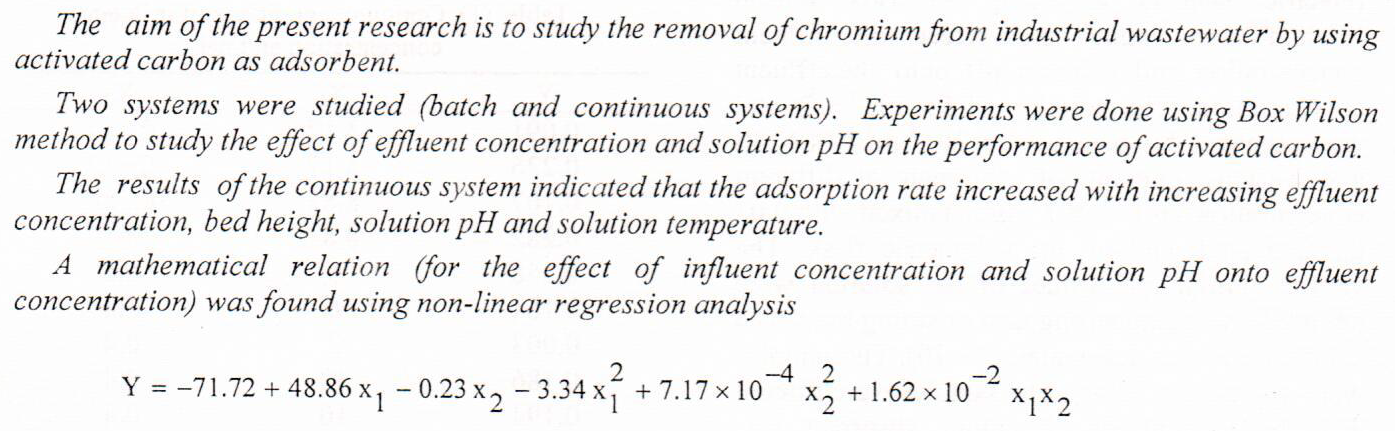

Two types of adsorbents were used to treat oily wastewater, activated carbon and zeolite. The removal efficiencies of these materials were compared to each other. The results showed that activated carbon performed some better properties in removal of oil. The experimental methods which were employed in this investigation included batch and column studies. The former was used to evaluate the rate and equilibrium of carbon and zeolie adsorption, while the latter was used to determine treatment efficiencies and performance characteristics. Expanded bed adsorber was constructed in the column studies. In this study, the adsorption behavior of vegetable oil (corn oil) onto activated carbon and zeolite was examined as a function of the concentr
... Show MoreLight naphtha one of the products from distillation column in oil refineries used as feedstock for gasoline production. The major constituents of light naphtha are (Normal Paraffin, Isoparaffin, Naphthene, and Aromatic). In this paper, we used zeolite (5A) with uniform pores size (5Aº) to separate normal paraffin from light naphtha, due to suitable pore size for this process and compare the behavior of adsorption with activated carbon which has a wide range of pores size (micropores and mesopores) and high surface area. The process is done in a continuous system - Fixed bed reactor- at the vapor phase with the constant conditions of flow rate 5 ml/min, temperature 180oC, pressure 1.6 bar and 100-gram weight o
... Show More (1)
(1)

The process for preparing activated carbon (AC) made from tea residue was described in this paper. Investigated were the physicochemical characteristics and adsorption efficiency of the produced AC. Activation with potassium hydroxide (KOH) and carbonization at 350 °C are the two key steps in the manufacturing of AC. The activated carbon was used to adsorb Tetracycline (TC). Different parameters were studied at room temperature to show their effects on the adsorption efficiency of TC. These parameters are the initial concentration of adsorbate TC, solution acidity pH, time of adsorption, and adsorbent dosage. The prepared active carbon was characterized using Fourier transform infrared spectroscopy (FTIR), scanning electron microscopy (
... Show More (5)
(2)
(5)
(2)

The process for preparing activated carbon (AC) made from tea residue was described in this paper. Investigated were the physicochemical characteristics and adsorption efficiency of the produced AC. Activation with potassium hydroxide (KOH) and carbonization at 350 °C are the two key steps in the manufacturing of AC. The activated carbon was used to adsorb Tetracycline (TC). Different parameters were studied at room temperature to show their effects on the adsorption efficiency of TC. These parameters are the initial concentration of adsorbate TC, solution acidity pH, time of adsorption, and adsorbent dosage. The prepared active carbon was characterized using Fourier transform infrared spectroscopy (FTIR), scanning electron microsc
... Show More
(5)
(2)
Adsorption techniques are widely used to remove certain classes of pollutants from waters, especially those that are not easily biodegradable. Dyes represent one of the problematic groups. The removal of methyl green from waste water using bamboo was studied in batch and continuous system. In batch system equilibrium time and adsorption isotherm was studied at different concentrations (5, 10, 15, 20, 25 and 30 ppm) and 50 mg weight of adsorbent.
Langmuir and Freundlich equations were applied for adsorption isotherm data. Langmiur equation was fitted better than Freundlich equation (R2=0.984 for Langmuir equation).The maximum percentage dye removal obtained 79.4% and adsorption capacity was 15.5 mg/g. For continuous system the breakthr
Background: White-spot lesion is one of the problems associated with the fixed orthodontic treatment. The aims of this in-vitro study were to investigate enamel damage depth on adhesive removal when the adhesive were surrounded by sound, demineralized or demineralized enamel that had been re-mineralized prior to adhesive removal using 10% Nano-Hydroxy apatite and to determine the effect of three different adhesive removal techniques. Materials and methods: Composite resin adhesive (3M Unitek) was bonded to 60 human upper premolars teeth which were randomly divided in to three groups each containing ten sound teeth and ten teeth with demineralized and re-mineralized lesions adjacent to the adhesive. A window of 2 mm was prepared on the bucca
... Show More
(2)
In this study an experimental work was done to study the possibility of using aluminum rubbish material as a coagulant to remove the colloidal particles from oily wastewater by dissolving this rubbish in sodium hydroxide solution. The experiments were carried out on simulated oily wastewater that was prepared at different oil concentrations and hardness levels (50, 250, 500, and 1000) ppm oil for (2000, 2500, 3000, and 3500) ppm CaCo3 respectively. The initial turbidity values were (203, 290, 770, and 1306) NTU, while the minimum values of turbidity that have been gained from the experiments in NTU units were (1.67, 1.95, 2.10, and 4.01) at best sodium aluminate dosages in milliliters (12, 20, 24, and 28) for
... Show MoreThe present study was conducted to evaluate the effect of fungi Gigaspora margarita and Glomus desriticola in stimulating the resistance of the capsicum annuum L. towards the chromium and lead after 60 days, planting and using the pots in the glass house. The highest concentration of chromium and lead in the root was found in the presence of the mycorrhizal mixture (194.93, 150.40) μg / g, respectively, compared to the lowest concentration (90.69, 79.37) μg / g respectively, while the highest concentration of chromium and lead in the shoot was found in the presence of the mycorrhizal mixture (94.63, 79.33) μg / g respectively, compared with the lowest concentration in the control treatment (72.58, 60.70) μg / g respectively. The results
... Show More
(3)
لمقدمة
الحمد لله رب العالمين والصلاة والسلام على سيد الأنبياء والمرسلين نبينا محمد صلى الله عليه وسلم وعلى واصحابه أجمعين ومن تبعهم وأهتدى بهداهم الى يوم الدين اما بعد :
فوظيفة القضاء وظيفة سامية يراد منها اقامة العدل ولا يستقيم حالهم الا به دفعاّ للظلم ، ولقد اولى النبي صلى الله عليه وآله وسلم ومن بعده الخلفاء الراشدون
... Show MoreSpecific microorganisms can produce bacterial nanocellulose (BNC), with acetic acid bacteria (AAB) being the most active producer. The family Acetobacteraceae includes the obligate aerobic, motile acetic acid bacteria. The BNC has attracted a lot of interest across a wide range of industries, including pharmaceuticals, due to its flexible characteristics, properties, and advantages. The present study was conducted to purify and characterize BNC produced from AAB isolated from apple vinegar. Bacterial nanocellulose was synthesized using a natural date palm liquid medium at pH 6 at 30°C for 8–10 days. The bacterial cellulose produced was then purified using a technique involving 0.1 M sodium hydroxide. To ascertain the surface mor
... Show More
(5)
(1)