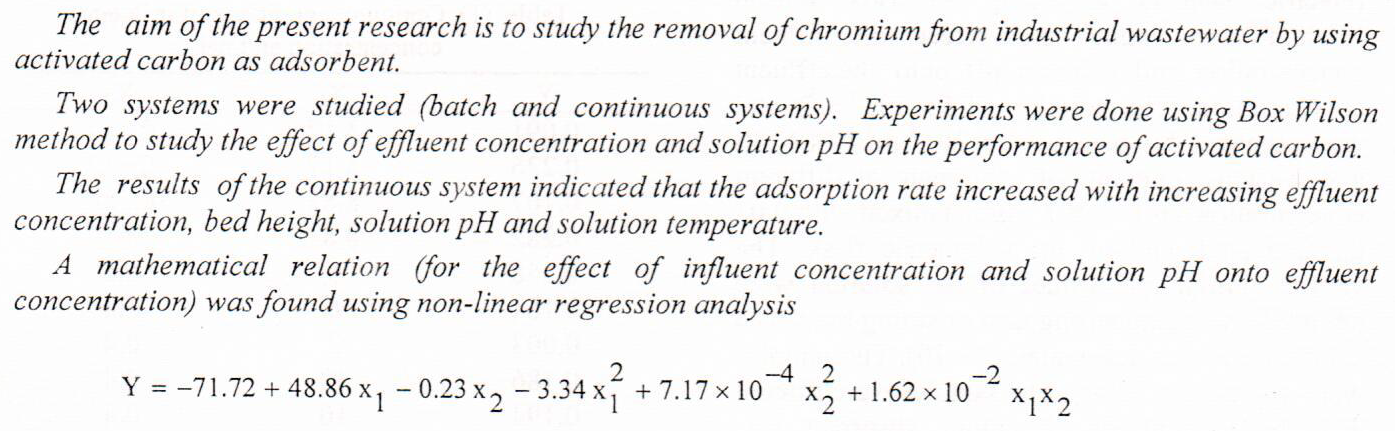
Removal of Chromium from Wastewater by Adsorption

This paper shows the characteristics of temperature and adsorbed (water vapor) mass rate distribution in the adsorber unit which is the key part to any adsorption refrigeration system. The temperature profiles of adsorption/desorption phases (Dynamic Sorption) are measured experimentally under the operating conditions of 90oC hot water temperature, 30oC cooling water temperature, 35oC adsorption temperature and cycle time of 40 min. Based on the temperature profiles, The mass transfer equations for the annulus adsorbent bed are solved to obtain the distribution of adsorption velocity and adsorbate concentration using non-equilibrium
model. The relation between the adsorption velocity with time is investigated during the process of ads
 (2)
(2)

A range of batch experiments were carried out for the estimation of the key process parameters in adsorption of Furfural from aqueous solution onto activated carbon in fixed-bed adsorber. A batch absorber model has been used to determine the external mass transfer coefficient (kf) which equal to 6.24*10-5 m/s and diffusion coefficient (Dp) which equal to 9.875*10-10 m2/s for the Furfural system. The Langmuir model gave the best fit for the data at constant temperature (30oC). The pore diffusion mathematical model using nonlinear isotherm provides a good description of the adsorption of Furfural onto activated carbon.
الهدف من العمل الحالي هو استخدام مادة غير سامة وغير مكلفة ذات قدرة عالية على امتصاص الماء ، وهي طين البوكسايت، لامتصاص صبغة البروموثيمول الزرقاء من محلول مائي. تُستخدم المركبات العضوية الاصطناعية كصبغات بشكل شبه حصري في العمليات الصناعية الحديثة مثلاً في إنتاج المنسوجات والجلود والطلاء والأغذية ومستحضرات التجميل والمستحضرات الصيدلانية. تشكل هذه الأصباغ خطرًا على البيئة عند إطلاقها نظرًا لآثارها الجا
... Show More (8)
(3)
(8)
(3)

This research provides a novel technique for using metal organic frameworks (HKUST-1) as a gas storage system for liquefied petroleum gas (LPG) in Iraqi vehicles to avoid the drawbacks of the currently employed method of LPG gas storage. A low-cost adsorbent called HKUST-1 was prepared and characterized in this research to investigate its ability for propane storage at different temperatures (25, 30, 35, and 40 oC) and pressures of (1-7) bar. HKUST-1 was made using a hydrothermal method and characterized using powder X-ray diffraction, BET surface area, scanning electron microscopic (SEM), and Fourier Transforms infrared spectroscopy (FTIR). The HKUST-1 was produced using a hydrothermal technique and possesses a high crys
... Show More
(1)
Background: Nowadays there is an increasing of the emphasis on aesthetic, dentist have been concerned about providing aesthetics and functional removable partial dentures to their patients and this was make the mission more difficult because of the goal now is achieving optimal aesthetic of the denture - while maintaining retentive, stable, and conservative to the health of supporting tooth and supporting tissue. The traditional use of metal clasp like cobalt-chromium, gold, stainless-steel and titanium hampers esthetics because of its obvious display conflicts with patient’s prosthetic confidentiality. Acetal resin (poly oxy methylene) may be used as alternative denture clasp material. This material was promoted primarily on the basis of
... Show MoreA phytoremediation experiment was carried out with kerosene as a model for total petroleum hydrocarbons. A constructed wetland of barley was exposed to kerosene pollutants at varying concentrations (1, 2, and 3% v/v) in a subsurface flow (SSF) system. After a period of 42 days of exposure, it was found that the average ability to eliminate kerosene ranged from 56.5% to 61.2%, with the highest removal obtained at a kerosene concentration of 1% v/v. The analysis of kerosene at varying initial concentrations allowed the kinetics of kerosene to be fitted with the Grau model, which was closer than that with the zero order, first order, or second order kinetic models. The experimental study showed that the barley plant designed in a subsu
... Show More
(10)
A phytoremediation experiment was carried out with kerosene as a model for total petroleum hydrocarbons. A constructed wetland of barley was exposed to kerosene pollutants at varying concentrations (1, 2, and 3% v/v) in a subsurface flow (SSF) system. After a period of 42 days of exposure, it was found that the average ability to eliminate kerosene ranged from 56.5% to 61.2%, with the highest removal obtained at a kerosene concentration of 1% v/v. The analysis of kerosene at varying initial concentrations allowed the kinetics of kerosene to be fitted with the Grau model, which was closer than that with the zero order, first order, or second order kinetic models. The experimental study showed that the barley plant designed in a subsu
... Show More
(14)
(10)
 (1)
(1)
(1)
(1)
