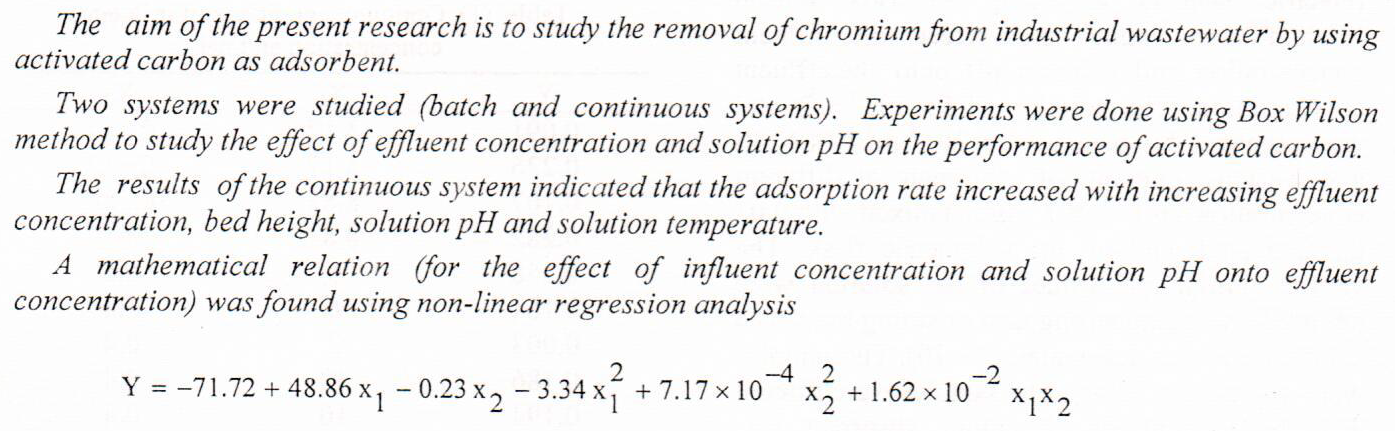
Removal of Chromium from Wastewater by Adsorption

In this study, a packed bed was used to remove pathogenic bacteria from synthetic contaminated water. Two types of packing material substrates, sand and zeolite, were used. These substrates were coated with silver nanoparticles (AgNPs), which were prepared by decomposition of Ag ions from AgNO3 solution. The prepared coated packings were characterized using scanning electron microscopy, energy-dispersive X-ray spectroscopy and transmission electron microscopy. The packed column consisted of a PVC cylinder of 2 cm diameter and 20 cm in length. The column was packed with silver nanoparticlecoated substrates (sand or zeolite) at a depth of 10 cm. Four types of bacteria were studied: Escherichia coli, Shigella dysenteriae, Pseudomonas aerugi
... Show More (5)
(5)

 (18)
(16)
(18)
(16)


In this study, the use of non-thermal plasma theory to remove toxic gases emitted from a vehicle was experimentally investigated. A non-thermal plasma reactor was constructed in the form of a cylindrical tube made of Pyrex glass. Two stainless steel rods were placed inside the tube to generate electric discharge and plasma condition, by connecting with a high voltage power supply (up to 40 kV). The reactor was used to remove the contaminants of a 1.25-liter 4-cylinder engine at ambient conditions. Several tests have been carried out for a ranging speed from 750 to 4,500 rpm of the engine and varying voltages from 0 to 32 kV. The gases entering the reactor were examined by a gas analyzer and the gases concentration ratio
... Show More
(4)
(45)
The present work aims to study the removal of dyes from wastewater by reverse osmosis process. Two dyes were used direct blue 6, and direct yellow. Experiments were performed with feed concentration (75 – 450 ppm), operation temperature (30 – 50 oC) and time (0.2 – 2.0 hr). The membrane used is thin film composite membrane (TFC). It was found that modal permeate concentration decreases with increasing feed concentration and time operating, while permeate concentration increases with increasing feed temperature. Also it was found that product rate increase with increasing temperature, but it decrease with increasing feed concentration and time. The concentration of reject solution showed an increase with increasing feed concentratio
... Show More
(31)
(25)
Desulfurization of a simulated diesel fuel by different adsorbents was studied in a fixed-bed adsorption process operated at ambient temperature and pressure. Three different adsorption beds were used, commercial activated carbon, Cu-Y zeolite, and layered bed of 15wt% activated carbon followed by Cu-Y zeolite.Initially Y-zeolite was prepared from Iraqi rice husk and then impregnated with copper. In general, the adsorbents tested for total sulfur adsorption capacity at break through followed the order Ac/Cu-Y zeolite>Cu-Y zeolite>Ac. The best adsorbent, Ac/Cu-Y zeolite is capable of producing more than 30 cm3 of simulated diesel fuel per gram of adsorbent with a weighted average content of 5 ppm-S, while Cu-Y zeolite producing of
... Show More
(7)
Physical and chemical adsorption analyses were carried out by nitrogen gas using ASTM apparatus at 77 K and hydrogen gas using volumetric apparatus at room temperature respectively. These analyses were used for determination the effect of coke deposition and poisoning metal on surface area, pore size distribution and metal surface area of fresh and spent hydrodesulphurization catalyst Co-MoAl2O3 .Samples of catalyst (fresh and spent) used in this study are taken from AL-Dura refinery. The results of physical adsorption shows that surface area of spent catalyst reduced to third compare with fresh catalyst and these catalysts exhibit behavior of type four according to BET classification ,so, the pores of these samples are cylindrical, and the
... Show MoreEM International
The present work elucidates the utilization of activated carbon (AC) and activated carbon loaded with silver nanoparticles (AgNPs-AC) to remove tetracycline (TC) from synthetically polluted water. The activated carbon was prepared from tea residue and loaded with silver nanoparticles. Scanning electron microscopy (SEM), X-ray diffraction (XRD), Fourier transform infrared spectroscopy (FTIR), and Brunauer-Emmett-Teller (BET) were used to characterize the activated carbon (AC) and silver nanoparticles-loaded activated carbon (AgNPs-AC). The impact of various parameters on the adsorption effectiveness of TC was examined. These variables were the initial adsorbate concentration (Co), solution acidity (pH), adsorption time (t), and dosag
... Show More
(2)
(1)