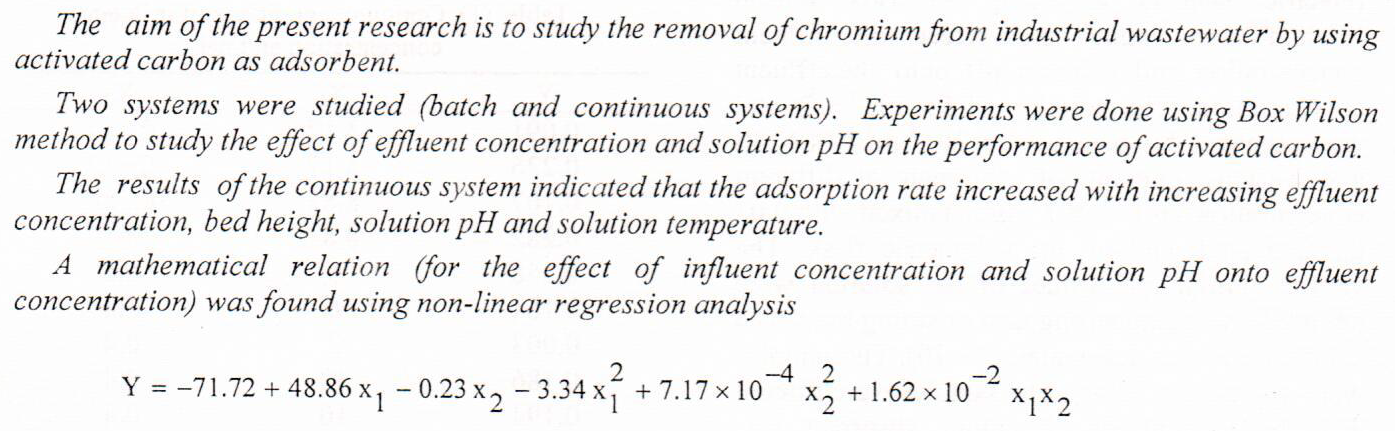
Removal of Chromium from Wastewater by Adsorption

Background: Dentin removed during root canal system instrumentation for creating adequate geometry for the canal and cleaning the canal. A new instrument had been marketed with the aim of optimum shaping of all parts of the canal system, however, no information present about the amount of dentin removal compared to conventional rotary system. This study investigated the amount of dentin removal when the canal instrumented by SAF compared with ProTaper by using high resolution computed tomography (micro CT). Materials and Methods: Twenty extracted single canalled teeth were utilized for this study; and randomly divided into 2 groups. In the first group, the root canals were prepared by using protaper rotary system till F2 and the root canal
... Show More (7)
(7)
 (6)
(6)



The main parameters and methods influencing the removal of Gentian Violet (GV) dye from aqueous media were investigated using a stachy plant in this study. The surface of the stachy plant was determined using FTIR spectra. Adsorption is influenced by the adsorbent's characteristic groups. The research took into account the usual conditions for GV dye adsorption by the stachy plant, such as the impact of contact time. Mass dosage , after 0.3 g the amount of adsorbed dye declines. Study pH and ionic strength, the results obtained showed that at pH 3 the largest adsorption of (GV) was seen, while at pH 9, the lowest adsorption was observed at 298 K, the adsorption kinetics and equilibrium constants were achieved, and the equilibr
... Show More
(1)
(2)
(1)
In this study, hexadecyltrimethylammonium bromide (HDMAB) - bentonite was synthesized by placing alkylammonium cation onto bentonite. Adsorption of textile dye such as direct Yellow 50 on natural bentonite and HDMAB -bentonite was investigated. The effects of pH, contact time,dosage clay and temperature were investigated experimentally .The Langmuir and Freundlish isotherms equations were applied to the data and values of parameters of these isotherm equations were evaluated. The study indicated that using 0.2 g of HDMAB (hexadecyltrimethylammonium bromide) lead to increase the percentage removal(R%) from 78% for pure bentonite to 99 %. The optimum pH value for the adsorption experiments was found to be pH=3 and therefore all the experim
... Show More
(3)
This study examined the adsorption behavior of anionic dye (orange G) from aqueous solution onto the raw and activated a mixture of illite, kaolinite and chlorite clays from area of Zorbatiya (east of Iraq).The chemical treatment involved alkali and acid activation. The alkali activation obtained by treated the raw clay (RC) with 5M NaOH (ACSO) and the acid activation founded by treated it with 0.25M HCl (ACH) and 0.25M (ACS). The thermal treatment carried out by calcination the produce activated clay at 750oC for acid activation and 105oC for alkali activation. Batch
... Show MoreIn this paper, two types of iron oxide nanomaterial (Fe3O4) and nanocomposite (T-Fe3O4) were created from the bio-waste mass of tangerine peel. These two materials were utilized for adsorption tests to remove cefixime (CFX) from an aqueous solution. Before the adsorption application, both adsorbents have been characterized by various characterizations such as XRD, FTIR, VSM, TEM, and FESEM. The mesoporous nano-crystalline structure of Fe3O4 and T-Fe3O4 nanocomposite with less than 100-nm diameter is confirmed. The adsorption of the obtained adsorbents was evaluated for CFX removal by adjusting several operation parameters to optimize the removal. The optimal conditions for CFX removal were found to be an initial concentration of 40 and 50 m
... Show More
(17)
Aleppo bentonite was investigated to remove ciprofloxacin hydrochloride from aqueous solution. Batch adsorption experiments were conducted to study the several factors affecting the removal process, including contact time, pH of solution, bentonite dosage, ion strength, and temperature. The optimum contact time, pH of solution and bentonite dosage were determined to be 60 minutes, 6 and 0.15 g/50 ml, respectively. The bentonite efficiency in removing CIP decreased from 89.9% to 53.21% with increasing Ionic strength from 0 to 500mM, and it increased from 89% to 96.9% when the temperature increased from 298 to 318 K. Kinetic studies showed that the pseudo second-order model was the best in describing the adsorption sys
... Show More
(9)
(6)
(23)
(22)
(35)
(35)