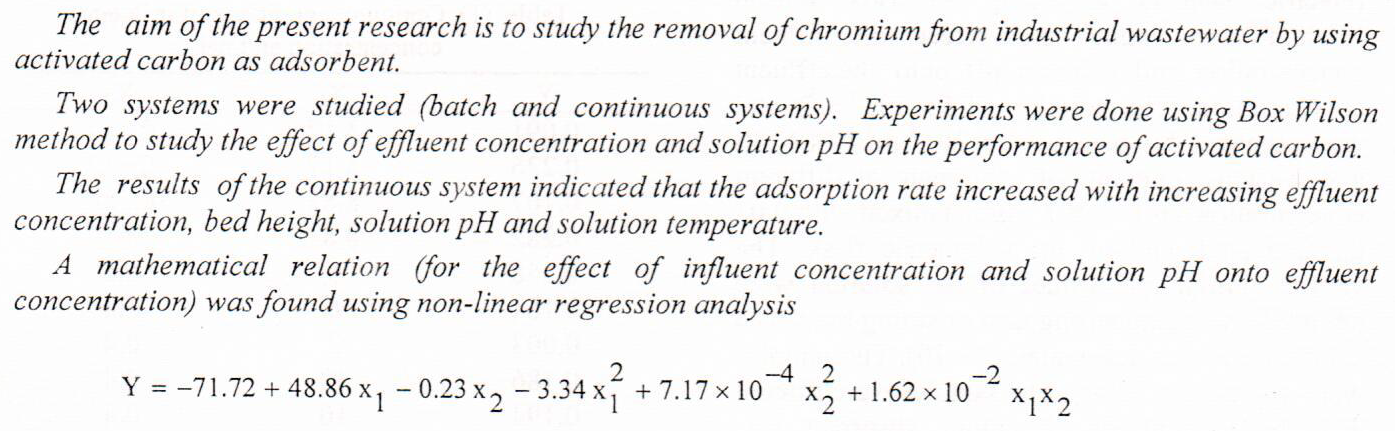
Removal of Chromium from Wastewater by Adsorption

Box-Wilson experimental design method was employed to optimized lead ions removal efficiency by bulk liquid membrane (BLM) method. The optimization procedure was primarily based on four impartial relevant parameters: pH of feed phase (4-6), pH of stripping phase (9-11), carrier concentration TBP (5-10) %, and initial metal concentration (60-120 ppm). maximum recovery efficiency of lead ions is 83.852% was virtually done following thirty one-of-a-kind experimental runs, as exact through 24-Central Composite Design (CCD). The best values for the aforementioned four parameters, corresponding to the most restoration efficiency were: 5, 10, 7.5% (v/v), and 90 mg/l, respectively. The obtained experimental data had been
... Show More (3)
(3)

A rapid, simple and sensitive spectrophotometric method for the determination of trace amounts of chromium is studied. The method is based on the interaction of chromium with indigo carmine dye in acidic medium and the presence of oxalates as a catalyst for interaction, and after studying the absorption spectrum of the solution resulting observed decrease in the intensity of the absorption. As happened (Bleaching) for color dye, this palace and directly proportional to the chromium (VI) amount was measured intensity of the absorption versus solution was figurehead at a wavelength of 610 nm. A plot of absorbance with chromium (VI) concentration gives a straight line indicating that Beer’s law has been obeyed over the range of 0.5
... Show More
Water pollution is widely regarded as one of the most pressing global challenges, exacerbated by human progress in industrial, agricultural, and technological sectors. Wastewater often contains non-biodegradable heavy metals that accumulate in living organisms. This accumulation poses significant risks to both environmental ecosystems and human health. The structures and surface morphology were characterized by FTIR, UV-vis measurements, XRD, SEM, and AFM. TiO2 nanoparticles could remove heavy metal ions (Pb2+, Cd2+, and Cr3+) from two samples (laboratory samples and real samples from Babylon battery factory in Al-Waziriya, Baghdad/Iraq) and measured by AAS. The results indicated that the removal percentages of heavy metal ions by T
... Show More
Effluent from incompetent wastewater treatment plants (WWTPs) contains a great variety of pollutants so support water treatments are essential. The present work studies the removal of phosphate species from aqueous solutions by adsorption on to spherical Calcined Sand -Clay mixture (CSCM) used a natural, local and low-cost adsorbent. Batch experiments were performed to estimate removal efficiency of phosphate. The adsorption experiments were carried out as function of pH, dose of adsorbent, initial concentration, temperature and time of adsorption. The efficient removal was accomplished for pH between 10 and 12. The experimental results also showed that the removal of phosphate by (CSCM) was rapid (the % removal 98.9%, 92%, 90%, 89% in 6
... Show MoreThe zeolite's textural properties have a significant effect on zeolite's effectiveness in the different industrial processes. This research aimed to study the textual properties of the NaX and FeX zeolites using the nitrogen adsorption-desorption technique at a constant low temperature. According to the International Union of Pure and Applied Chemistry, the adsorption-desorption isotherm showed that the studied materials were mixed kinds I/II isotherms and H3 type hysteresis. The Brunauer-Emmett-Teller isotherm was the best model to describe the nitrogen adsorption-desorption better than the Langmuir and Freundlich isotherms. The obtained adsorption capacity and Brunauer-Emmett-Teller surface area values for NaX were greater than FeX. Ac
... Show More
(3)
The production of biodiesel generates soap impurities that hinder biodiesel performance and complicate its purification. This study presents a novel approach for soap removal from biodiesel using NiO–doped ZnO nanoparticle (NP) adsorbent. The NPs are synthesized using a gliding arc discharge (GAD) method as a non-thermal plasma source (NTP). NiO doping reduced the bandgap energy by 74%, reduced the crystallite size, and increased the surface area by 78%, entailing lattice strain and structural modifications. Soap removal efficiency was 99.7% for NiO–doped ZnO within 16 min, compared with 95.5% for ZnO. Soap uptake as high as 2320 mg/g NiO–doped ZnO was reported, which could be equally fitted by Langmuir and Freundlich isotherms su
... Show MoreRemoving Congo red (CR) is critical in wastewater treatment. We introduce a combination of electrocoagulation (EC) and electro-oxidation (EO) to address the elimination of CR. We also discuss the deposition of triple oxides (Cu–Mn–Ni) simultaneously on both anodic and cathodic graphite electrodes at constant current density. These electrodes efficiently worked as anodes in the EC-EO system. The EC-CO combination eliminated around 98 % of the CR dye and about 95 % of the Chemical Oxygen demand (COD), and similar results were obtained with the absence of NaCl. Thus, EC-EO is a promising technique to remove CR in an environmentally friendly pathway.
 (11)
(7)
(11)
(7)
SKF Sami I. Jafar, Mohammad J. Kadhim, Engineering and Technology Journal, 2018 - Cited by 4
The current study was designed to remove Lead, Copper and Zinc from industrial wastewater using Lettuce leaves (Lactuca sativa) within three forms (fresh, dried and powdered) under some environmental factors such as pH, temperature and contact time. Current data show that Lettuce leaves are capable of removing Lead, Copper and Zinc ions at significant capacity. Furthermore, the powder of Lettuce leaves had highest capability in removing all metal ions. The highest capacity was for Lead then Copper and finally Zinc. However, some examined factors were found to have significant impacts upon bioremoval capacity of studied ions, where best biosorption capacity was found at pH 4, at temperature 50º C and contact time of 1 hour.
(5)
Corncob is an agricultural biomass waste that was widely investigated as an adsorbent of contaminants after transforming it into activated carbon. In this research carbonization and chemical activation processes were achieved to synthesize corncob-activated carbon (CAC). Many pretreatment steps including crushing, grinding, and drying to obtain corncob powder were performed before the carbonization step. The carbonization of corncob powder has occurred in the absence of air at a temperature of 500 °C. The chemical activation was accomplished by using HCl as an acidic activation agent. Fourier transform infrared spectroscopy (FT-IR), scanning electron microscopy (SEM), X-ray diffraction (XRD), and Brunauer–Emmett–Teller (BET) facilitate
... Show More
(6)
(7)
