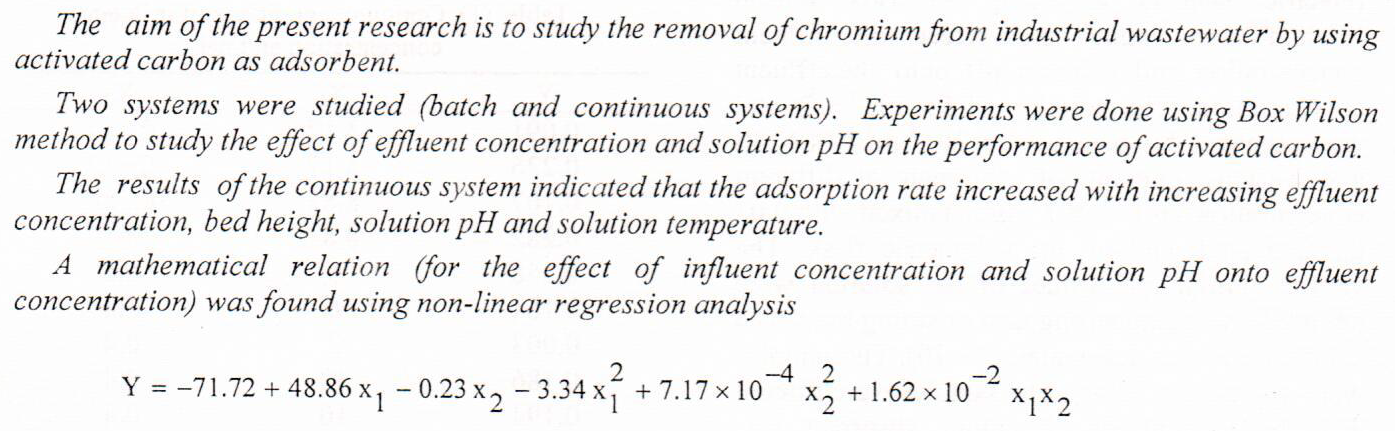
Removal of Chromium from Wastewater by Adsorption

 (22)
(22)
 (20)
(20)



Shear and compressional wave velocities, coupled with other petrophysical data, are vital in determining the dynamic modules magnitude in geomechanical studies and hydrocarbon reservoir characterization. But, due to field practices and high running cost, shear wave velocity may not available in all wells. In this paper, a statistical multivariate regression method is presented to predict the shear wave velocity for Khasib formation - Amara oil fields located in South- East of Iraq using well log compressional wave velocity, neutron porosity and density. The accuracy of the proposed correlation have been compared to other correlations. The results show that, the presented model provides accurate
... Show More
An experimental and theoretical works were carried out to model the wire condenser in the domestic refrigerator by calculating the heat transfer coefficient and pressure drop and finding the optimum performance. The two methods were used for calculation, zone method, and an integral method. The work was conducted by using two wire condensers with equal length but different in tube diameters, two refrigerants, R-134a and R-600a, and two different compressors matching the refrigerant type. In the experimental work, the optimum charge was found for the refrigerator according to ASHRAE recommendation. Then, the tests were done at 32˚C ambient temperature in a closed room with dimension (2m*2m*3m). The results showed that th
... Show More
While conservative access preparations could increase fracture resistance of endodontically treated teeth, it may influence the shape of the prepared root canal. The aim of this study was to compare the prepared canal transportation and centering ability after continuous rotation or reciprocation instrumentation in teeth accessed through traditional or conservative endodontic cavities by using cone-beam computed tomography (CBCT).
Forty extracted intact, matured, and 2-rooted human maxillary first premolars were selected for this
(8)
(7)
This work includes preparation of Az, Qz, and Tz derivatives from the reaction of Schiff base (Sb) derivative with anthranilic acid, chloroacetyl chloride, and sodium azide, as well as, the characterization via FT-IR, 1H-NMR, and 13CNMR. The anticorrosion inhibition of these compounds was studied and the measurements of carbon steel (CS) corrosion in sodium chloride solution 3.5% (blank) and inhibitor in solutions were calculated at a temperature range of 293-323 K by the technique of electrochemical polarization. In addition, some thermodynamic and kinetic activation parameters for inhibitor and blank solutions (Ea⋇, ΔH⋇, ΔS⋇, and ΔG⋇) were determined. The results showed high inhibition efficacy for all the prepared compounds,
... Show More
(6)
The melting duration in the photovoltaic/phase-change material (PV/PCM) system is a crucial parameter for thermal energy management such that its improvement can realize better energy management in respect to thermal storage capabilities, thermal conditions, and the lifespan of PV modules. An innovative and efficient technique for improving the melting duration is the inclusion of an exterior metal foam layer in the PV/PCM system. For detailed investigations of utilizing different metal foam configurations in terms of their convective heat transfer coefficients, the present paper proposes a newly developed mathematical model for the PV/PCM–metal foam assembly that can readily be implemented with a wide range of operating condition
... Show More
(40)
(40)
(6)
(7)
Background In recent years, there has been a notable increase in the level of attention devoted to exploring capabilities of nanoparticles, specifically gold nanoparticles AuNPs, within context of modern times. AuNPs possess distinct biophysical properties, as a novel avenue as an antibacterial agent targeting Streptococcus Mutans and Candida Albicans. The aim of this study to create a nano-platform that has the potential to be environmentally sustainable, in addition to exhibiting exceptional antimicrobial properties against Streptococcus Mutans as well as Candida Albicans. Methods this study involved utilization of
(8)
(6)
(1)
The effects of T-shaped fins on the improvement of phase change materials (PCM) melting are numerically investigated in vertical triple-tube storage containment. The PCM is held in the middle pipe of a triple-pipe heat exchanger while the heat transfer fluid flows through the internal and external pipes. The dimension effects of the T-shaped fins on the melting process of the PCM are investigated to determine the optimum case. Results indicate that while using T-shaped fins improves the melting performance of the PCM, the improvement potential is mainly governed by the fin’s body rather than the head. Hence, the proposed T-shaped fin did not noticeably improve melting at the bottom of the PCM domain; additionally, a flat fin is ad
... Show More
(45)
(33)