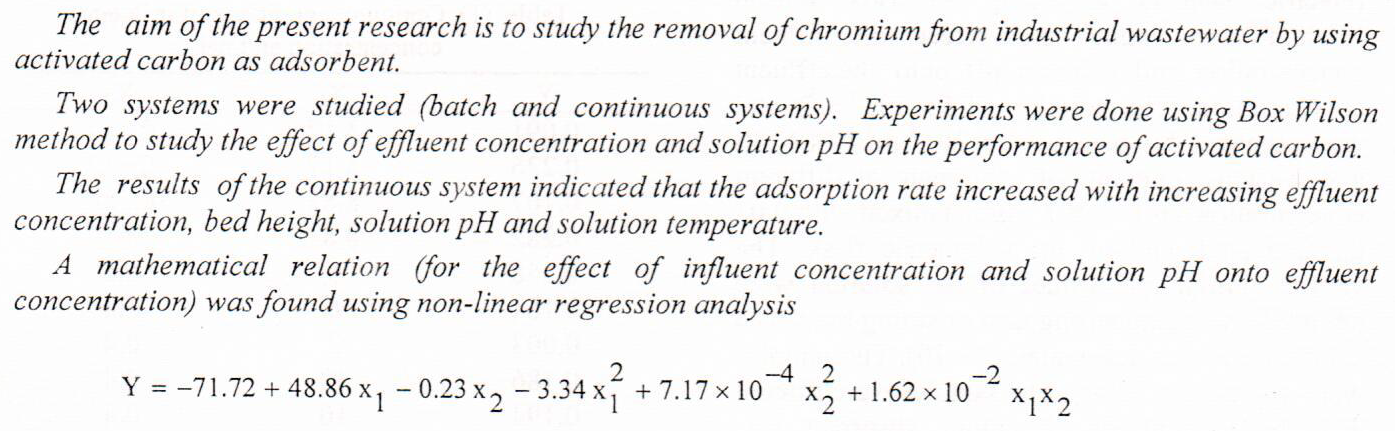
Removal of Chromium from Wastewater by Adsorption

Oily carwash wastewater is a high organic and chemical wastewater. This paper targeted to investigate a treatment to decrease the water consumption and contaminants in car-washing stations. Electrocoagulation combined with ultrasonic energy (Sono-Electrocoagulation) was suggested so that the carwash wastewater is treated to be reused. The effect of both the voltage and time of treatment on the removal of COD, turbidity, conductivity, and total dissolved solids (TDS) were studied at constant initial pH 7 and electrode distance 2 cm. The results showed the best results of removal COD, turbidity, TDS, and reduce electrical conductivity is when the voltage was 30 V and a treatment time of 90 minutes.
<
... Show More (3)
(3)

This study was aimed to assess the efficiency of N.oleander to remove heavy metals such as Copper (Cu) from wastewater. A toxicity test was conducted outdoor for 65-day to estimate the ability of N.oleander to tolerate Cu in synthetic wastewater. Based on a previous range-finding test, five concentrations were used in this test (0, 50, 100, 300, 510 mg/l). The results showed that maximum values of removal efficiency was found 99.9% on day-49 for the treatment 50 mg/l. Minimum removal efficiency was 94% day-65 for the treatment of 510 mg/l. Water concentration was within the permissible limits of river conservation and were 0.164 at day-35 for the 50 mg/l treatment, decreased thereafter until the end of the observation, and 0.12 at d
... Show More
This study investigated the treatment of dairy wastewater using the electrocoagulation method with iron filings as electrodes. The study dealt with real samples collected from local factory for dairy products in Baghdad. The Response Surface Methodology (RSM) was used to optimize five experimental variables at six levels for each variable, for estimating chemical oxygen demand (COD) removal efficiency. These variables were the distance between electrodes, detention time, dosage of NaCl as electrolyte, initial COD concentration, and current density. RSM was investigated the direct and complex interaction effects between parameters to estimate the optimum values. The respective optimum value was 1 cm for the distance between electrodes, (6
... Show More (3)
(2)
(3)
(2)

This work focuses on the use of biologically produced activated carbon for improving the physi-co-chemical properties of water samples obtained from the Tigris River. An eco-friendly and low-cost activated carbon was prepared from the Alhagi plant using potassium hydroxide (KOH) as an impregnation agent. The prepared activated carbon was characterised using Fourier-transform infrared spectroscopy to determine the functional groups that exist on the raw material (Alhagi plant) and Alhagi activated carbon (AAC). Scanning electron microscope–energy-dispersive X-ray spectroscope was also used to investigate the surface shape and the elements that compose the powder. Brunauer–Emmett–Teller surface area analysis was used to evaluate the spe
... Show More
(7)
The removal of Ibuprofen antibiotics (IBU) by photo-degradation UV/H2O2/Fe+2 system was investigated in a batch reactor under different initial concentrations of H2O2 (100-500) mg/L, Fe+2 (10-40) mg/L, pH (3-9) and initial concentrations of IBU (10-80) mg/L, and their relationship with the degradation efficiency were studied. The result demonstrated that the maximum elimination of IBU was 85.54% achieved at 300 mg/L of H2O2, 30 mg/L of Fe+2, pH=3, and irradiation time of 150 min, for 10 mg/L of IBU. The results have shown that the oxidation reagent H2O2 plays a very important role in IBU degradation.
(9)
In this study, sawdust as a cheap method and abundant raw material was utilized to produce active carbon (SDAC). Physiochemical activation was utilized where potassium hydroxide used as a chemical activating agent and carbon dioxide was used as a physical activating agent. Taguchi method of experimental design was used to find the optimum conditions of SDAC production. The produced SDAC was characterized using SEM to investigate surface morphology and BET to estimate the specific surface area. SDAC was used in aqueous lead ions adsorption. Adsorption process was modeled statistically and represented by an empirical model. The highest specific surface area of SDAC was 688.3 m2/gm. Langmuir and Freundlich isotherms were used to
... Show MoreThe finding of novel pollutants in a multitude of surface water bodies worldwide has recently caused environmentalists to face challenges. Therefore, the development of low-cost, efficient technologies is required to provide a safe, pollution-free water environment. The attapulgite surface was used in this study because it has a good absorbent surface for removing bromocresol purple dye from its aqueous solutions. Because attapulgite has a high absorption capacity, it can be used to remove pollutants in both its normal and modified states. Factors affecting adsorption were studied, such as the weight of the adsorbent surface, the initial concentration of the adsorbent, contact time, and the effect of temperature. Clay was ground, cleaned mu
... Show MoreOxidation of sulfur compounds in fuel followed by an adsorption process were studied using two modes of operation, batch mode and continuous mode (fixed bed). In batch experiment oxidation process of kerosene with sulfur content 2360 ppm was achieved to study the effect of amount of hydrogen peroxide(2.5, 4, 6 and 10) ml at different temperature(40, 60 and 70)°C. Also the effect of amount acetic acid was studied at the optimal conditions of the oxidation step(4ml H2O2 and 60 °C).Besides, the role of acetic acid different temperatures(40, 60, 70) °C and 4ml H2O2, effect of reaction time(5, 30, 60, 120, 300) minutes at temperatures(40,60) °C, 4ml H2O2 and 1 mlHAC)&
... Show MoreSorption is a key factor in removal of organic and inorganic contaminants from their aqueous solutions. In this study, we investigated the removal of Xylenol Orange tetrasodium salt (XOTS) from its aqueous solution by Bauxite (BXT) and cationic surfactant hexadecyltrimethyl ammonium bromide modified Bauxite (BXT-HDTMA) in batch experiments. The BXT and BXT-HDTMA were characterized using FTIR, and SEM techniques. Adsorption studies were performed at various parameters i.e. temperature, contact time, adsorbent weight, and pH. The modified BXT showed better maximum removal efficiency (98.6% at pH = 9.03) compared to natural Bauxite (75% at pH 2.27), suggesting that BXT-HDTMA is an excellent adsorbent for the removal of XOTS from water. The equ
... Show More
(16)
(14)
