Removal of Chromium from Wastewater by Adsorption
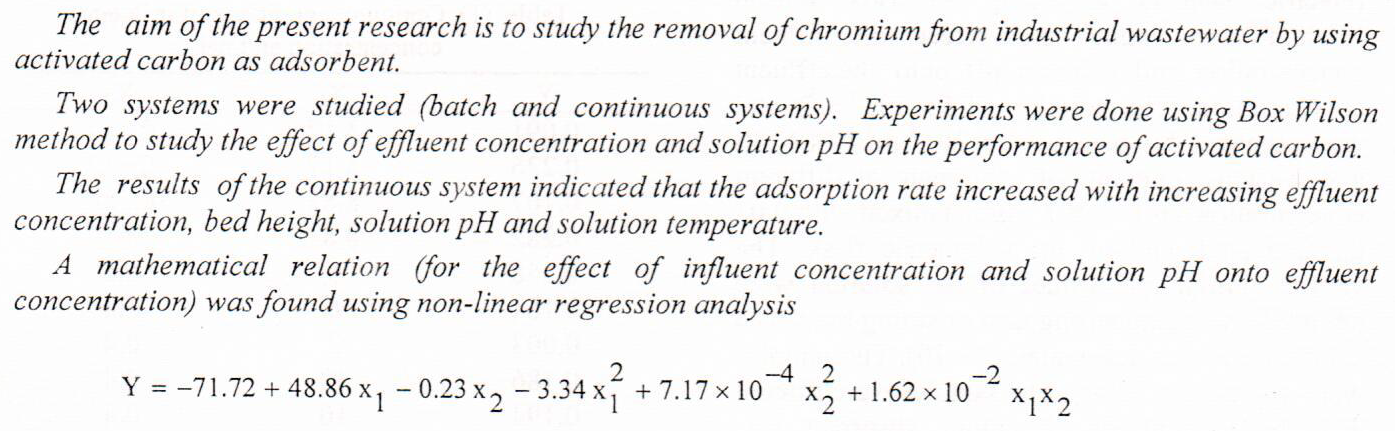

 (5)
(5)
 (5)
(5)



An environmentally friendly technique was used to prepare titanium dioxide@ silver (core shell) (TiO₂@Ag NPs) using chard leaf extract, a natural stabilizer and reductant. A nanocomposite (NCs) of TiO₂@Ag supported by halloysite nanotubes (HNTs), TiO2@Ag/HNT NCs, was prepared under microwave irradiation. The microwave technique is used to accelerate the reaction and enhance the homogeneity of nanoparticle distribution. Spectroscopic and structural analyses were performed on the resulting nanocomposite. X-ray diffraction (XRD) revealed a clear crystalline structure with grain sizes ranging from 7 to 15 nm, with an average of ~11 nm, the transmission electron microscope (TEM) revealed that the size of nanoparticles in the TiO₂@Ag/HNT N
... Show More
Activated carbon was Produced from coconut shell and was used for removing sulfate from industrial waste water in batch Processes. The influence of various parameter were studied such as pH (4.5 – 9.) , agitation time (0 – 120)min and adsorbent dose (2 – 10) gm.
The Langmuir and frandlich adsorption capacity models were been investigated where showed there are fitting with langmmuir model with squre regression value ( 0.76). The percent of removal of sulfate (22% - 38%) at (PH=7) in the isotherm experiment increased with adsorbent mass increasing. The maximum removal value of sulfate at different pH experiments is (43%) at pH=7.

(5)
(5)
The research discussed the possibility of adsorption of Brilliant Blue Dye (BBD) from wastewater using 13X zeolite adsorbent, which is considered a byproduct of the production process of potassium carbonate from Iraqi potash raw materials. The 13X zeolite adsorbent was prepared and characterized by X-ray diffraction that showed a clear match with the standard 13X zeolite. The crystallinity rate was 82.15% and the crystal zeolite size was 5.29 nm. The surface area and pore volume of the obtained 13X zeolite were estimated. The prepared 13X zeolite showed the ability to remove BBD contaminant from wastewater at concentrations 5 to 50 ppm and the removal reached 96.60% at the lower pollutant concentration. Adsorption measurements versus tim
... Show More
(9)
(3)
This study depicts the removal of Manganese ions (Mn2+) from simulated wastewater by combined electrocoagulation/ electroflotation technologies. The effects of initial Mn concentration, current density (C.D.), electrolysis time, and different mesh numbers of stainless steel screen electrodes were investigated in a batch cell by adopting Taguchi experimental design to explore the optimum conditions for maximum removal efficiency of Mn. The results of multiple regression and signal to noise ratio (S/N) showed that the optimum conditions were Mn initial concentration of 100 ppm, C.D. of 4 mA/cm2, time of 120 min, and mesh no. of 30 (wire/inch). Also, the relative significance of each factor was attained by the analysis of variance (ANO
... Show More
(7)
This study depicts the removal of Manganese ions (Mn2+) from simulated wastewater by combined electrocoagulation/ electroflotation technologies. The effects of initial Mn concentration, current density (C.D.), electrolysis time, and different mesh numbers of stainless steel screen electrodes were investigated in a batch cell by adopting Taguchi experimental design to explore the optimum conditions for maximum removal efficiency of Mn. The results of multiple regression and signal to noise ratio (S/N) showed that the optimum conditions were Mn initial concentration of 100 ppm, C.D. of 4 mA/cm2, time of 120 min, and mesh no. of 30 (wire/inch). Also, the relative significance of each factor was attained by the analysis
... Show More
(7)