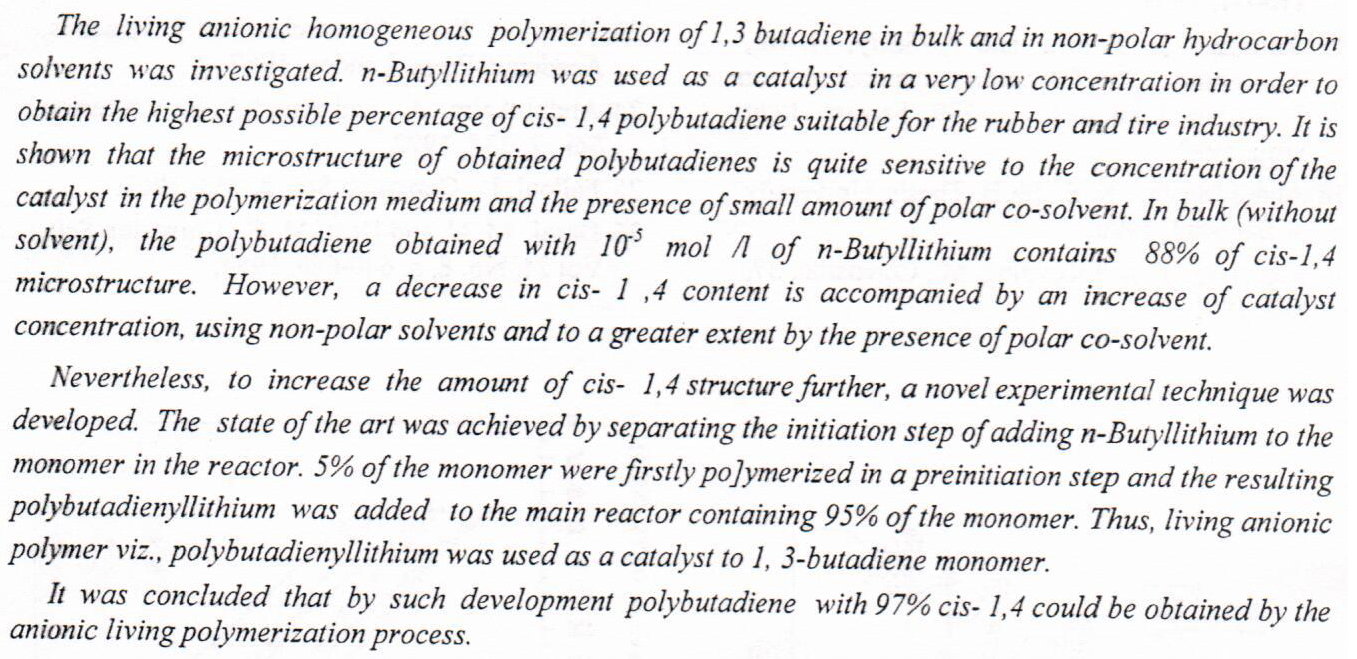
New Development in the Process for the Production of Polybutadiene Rubber

Improving" Jackknife Instrumental Variable Estimation method" using A class of immun algorithm with practical application
 (33)
(33)
 (27)
(27)


 (1)
(1)
(14)
(15)
(1)
(1)
(14)
(15)
The new bidentate ligand 2-amino-5-phenyl-1,3,4-oxadiazole (Apods) was prepared by the reaction of benzaldehyde semicarbazone with bromine and sodium acetate in acetic acid gave. The prepared ligand was identified by Microelemental Analysis, FT.IR, UV-Vis and 1HNMR spectroscopic techniqes. Treatment of the prepared ligand with the following selected metal ions (MnII, CoII, NiII, CuII and ZnII) in aqueous ethanol with a 1:2 M:L ratio, yielded a series of complexes of the general formula [M(L)2Cl2].The prepared complexes were characterized using flame atomic absorption, (C.H.N)Analysis, FT.IR and UV-Vis spectroscopic methods as well as magnetic susceptibility and conductivity measurements. Chloride ion content was also evaluated by Mohr metho
... Show More
(1)
(1)
Five derivatives of thiadiazole were prepared with aldehydes and alkyl halides, compoundA: 2-amino-5-thiol-1,3,4- thiadiazole, compound B :2-(o-hydroxybenzylidine)amino-5-thiol-1,3,4-thiadiazole, compoundC: 2(2-butan-lidine)amino-5-thiol-1,3,4-thiadiazole, compound E: 2- amino-5-(2-Propanylthio)-1,3,4-thiadiazol) and compound F:2(o-chlorobenzylamino)-5-(2-propanyl thio)-1,3,4 thiadiazol. All prepared compounds were diagnosed by (IR) and (UV) Spectroscopy. All of those compounds were screened for their anti-microbial activity in vitro. The results show that most of the compounds A, B, C exhibited moderate to good activity against Gram-positive bacteria and the same compound exhibit low to moderate activity on most gram-negative bacte
... Show MoreThe purpose of this work is to study the classification and construction of (k,3)-arcs in the projective plane PG(2,7). We found that there are two (5,3)-arcs, four (6,3)-arcs, six (7,3)arcs, six (8,3)-arcs, seven (9,3)-arcs, six (10,3)-arcs and six (11,3)-arcs. All of these arcs are incomplete. The number of distinct (12,3)-arcs are six, two of them are complete. There are four distinct (13,3)-arcs, two of them are complete and one (14,3)-arc which is incomplete. There exists one complete (15,3)-arc.
Thermomechanical analysis (TMA) and differential scanning calorimetry (DSC) are used to investigate the effect of molding and annealing of polyester on the behavior of thermal expansion and crystallization since these factors play role in the reprocessing or recycling of the polymer. The dynamic mode of the TMA provides enhanced characterization information about the polyester since it separates the transitions into reversible and irreversible signals, and also reveals the progress of the amorphous regions as the polyester loses strength with the increasing temperature approaching melting. Slow cooling after annealing brings crystallization that may be attributed to molecular chain straightening due to orientation.