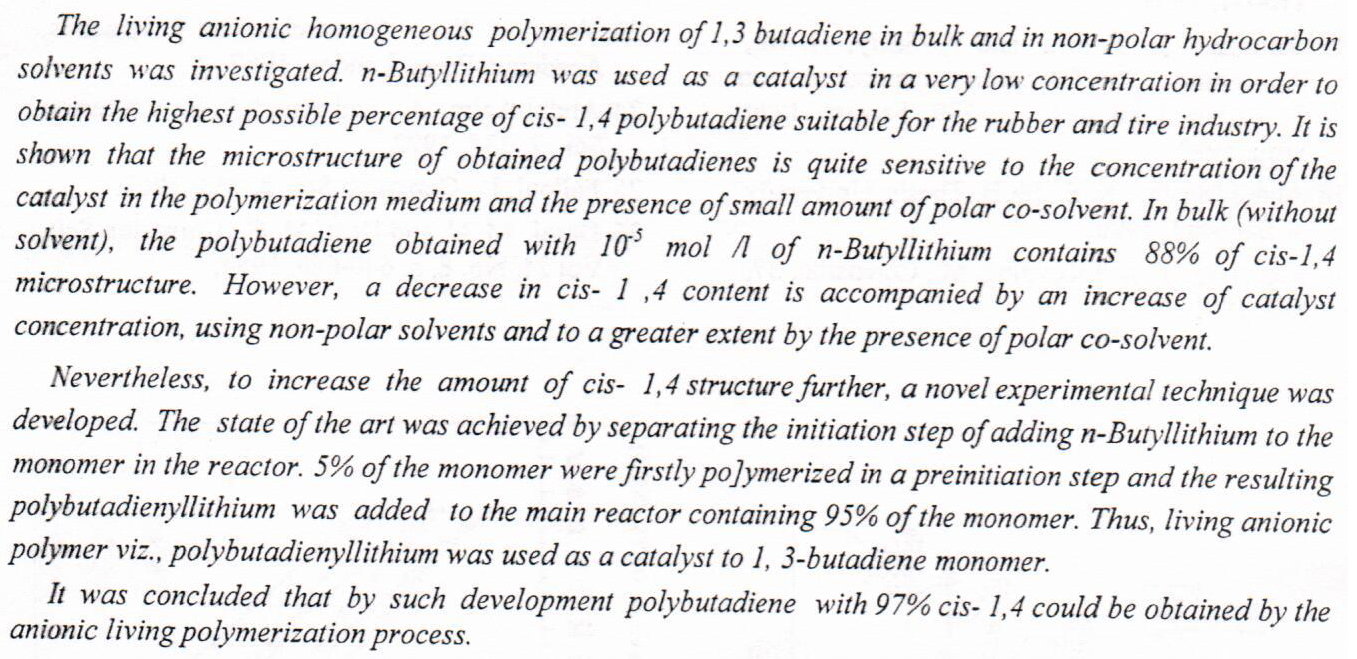
New Development in the Process for the Production of Polybutadiene Rubber

Aim: surface modification of titanium using fiber laser 1064 nm to enhance the bond strength to resin cement. Material and Methods: thirty titanium discs of 0.6 cm x 0.3 cm (diameter and thickness respectively) were categorized after preparation into three groups (n=10) as follows: control group with no surface treatment and two test groups were treated with fiber laser after estimation the appropriate parameters in the pilot study which are 81 ns pulse duration, 30,000 Hz frequency, 50 µm spot size and 10,000 mm/s scanning speed and different average power values (10 W and 20 W) depending on the tested group. Titanium discs surface characterization was performed by scanning electron microscope (SEM), a
... Show More
Early detection of eye diseases can forestall visual deficiency and vision loss. There are several types of human eye diseases, for example, diabetic retinopathy, glaucoma, arteriosclerosis, and hypertension. Diabetic retinopathy (DR) which is brought about by diabetes causes the retinal vessels harmed and blood leakage in the retina. Retinal blood vessels have a huge job in the detection and treatment of different retinal diseases. Thus, retinal vasculature extraction is significant to help experts for the finding and treatment of systematic diseases. Accordingly, early detection and consequent treatment are fundamental for influenced patients to protect their vision. The aim of this paper is to detect blood vessels from
... Show More (2)
(2)

We demonstrate that the selective hydrogenation of acetylene depends on energy profile of the partial and full hydrogenation routes and the thermodynamic stability of adsorbed C2H2 in comparison to C2H4.
 (27)
(26)
(27)
(26)


In this research, some thermophysical properties of ethylene glycol with water (H2O) and two solvent mixtures dimethylformamide/ water (DMF + H2O) were studied. The densities (ρ) and viscosities (η) of ethylene glycol in water and a mixed solvent dimethylformamide (DMF + H2O) were determined at 298.15 K, t and a range of concentrations from 0.1 to1.0 molar. The ρ and η values were subsequently used to calculate the thermodynamics of mixing including the apparent molar volume (ϕv), partial molar volume (ϕvo) at infinite dilution. The solute-solute interaction is presented by Sv results from the equation ∅_v=ϕ_v^o+S_v √m. The values of viscosity (B) coefficients and Falkenhagen coefficient(A) of the Jone-Dole equation and Gibbs fre
... Show More4-[(2-hydroxy-4,6-dimethylphenyl)diazenyl]-1,5-dimethyl-2-phenyl-1H-pyrazol-3(2H)-one has been readied by combination the diazonium salt of 4-aminoantipyrine with 3,5-dimethylphenol. Spectral studies ( FTIR, UV-Vis, 1H and 13CNMR) and microelemental analysis (C.H.N) are use to identified of the ligand. Complexes of some transition metals were performed as well depicted. The formation of complexes were characterized by using atomic absorption of flame, elemental analysis, infrared and UV-Vis spectral process as well conductivity and magnetic quantifications. Nature of compounds produced have been studied followed the mole ratio and continuous contrast methods, Beer's law followed during a concentration scope (1×10⁻⁴ - 3×10⁻⁴ M/L). height m
... Show MoreThe use of blended cement in concrete provides economic, energy savings, and ecological benefits, and also provides. Improvement in the properties of materials incorporating blended cements. The major aim of this investigation is to develop blended cement technology using grinded local rocks . The research includes information on constituent materials, manufacturing processes and performance characteristics of blended cements made with replacement (10 and 20) % of grinded local rocks (limestone, quartzite and porcelinite) from cement. The main conclusion of this study was that all types of manufactured blended cement conformed to the specification according to ASTM C595-12 (chemical and physical requirements). The percentage of the compress
... Show MoreThin filis have been prepared from the tin disulphide (SnS2 ), the pure and the doped with copper (SnS2:Cu) with a percentages (1,2,3,4)% by using ahemical spray pyrolysis techniqee on substrate of glass heated up to(603K)and sith thicknesses (0.7±0.02)?m ,after that the films were treated thermally with a low pressure (10-3mb) and at a temperature of (473K) for one hour. The influence of both doping with copper and the thermal treatment on some of the physical characteristics of the prepared films(structural and optical) was studied. The X-ray analysis showed that the prepared films were polycrystalline Hexagonal type. The optical study that included the absorptance and transmitance spectra in the weavelength range (300-900)nm
... Show More
(1)
The nuclear density distributions and size radii are calculated for one-proton 8B, two-proton 17Ne, one-neutron 11Be and two-neutron 11Li halo nuclei. The theoretical outlines of calculations assume that the nuclei understudy are composed of two parts: the stable core and the unstable halo. The core part is studied using the radial wave functions of harmonic-oscillator (HO) potentials, while the halo is studied through Woods-Saxon (WS) potential. The long tail behaviour which is the main characteristic of the halo nuclei are well generated in comparison with experimental data. The calculated size radii are in good agreement with experimental values. The elastic electron scattering form factors of the C0 component are also c
... Show More
(4)
(1)
Classical cryptography systems exhibit major vulnerabilities because of the rapid development of quan tum computing algorithms and devices. These vulnerabilities were mitigated utilizing quantum key distribution (QKD), which is based on a quantum no-cloning algorithm that assures the safe generation and transmission of the encryption keys. A quantum computing platform, named Qiskit, was utilized by many recent researchers to analyze the security of several QKD protocols, such as BB84 and B92. In this paper, we demonstrate the simulation and implementation of a modified multistage QKD protocol by Qiskit. The simulation and implementation studies were based on the “local_qasm” simulator and the “FakeVigo” backend, respectively. T
... Show More
(2)
(1)
