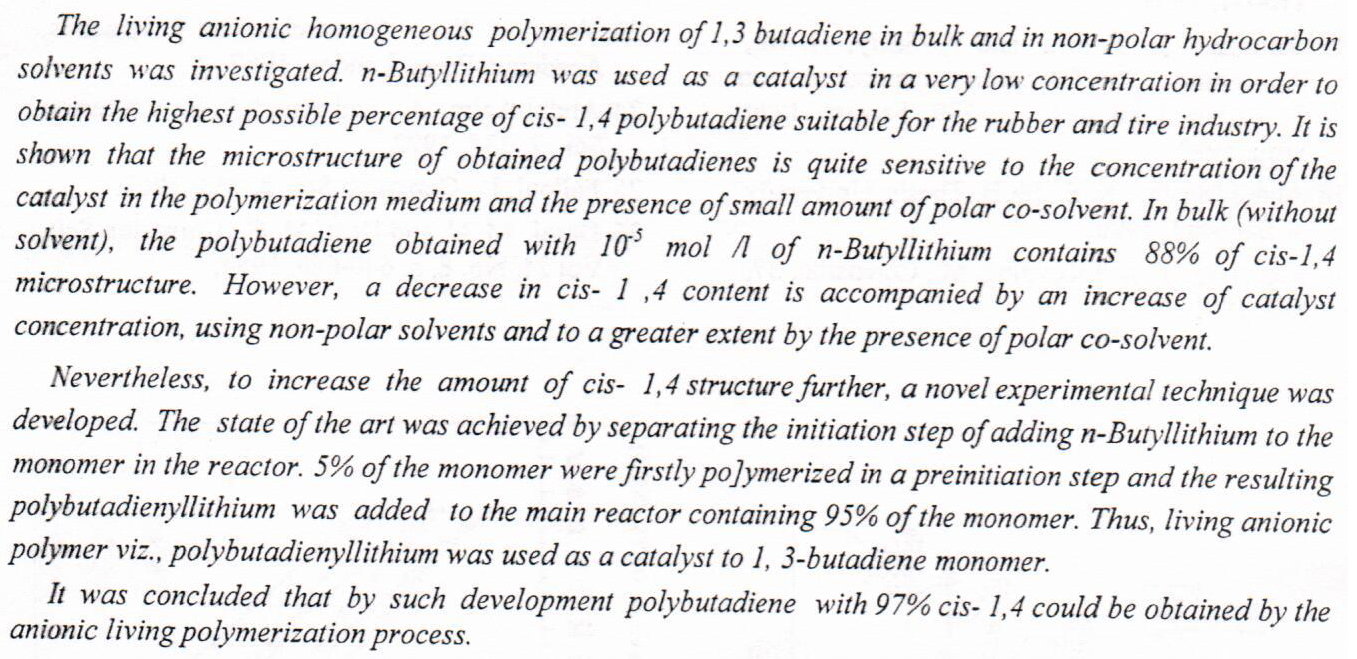
New Development in the Process for the Production of Polybutadiene Rubber

In this work, new Schiff bases of quinazolinone derivatives (Q1-Q5) were synthesized from methyl anthranilate. The synthesis involved three steps. In the first step, methyl anthranilate was reacted with isothiocyanatobenzene, producing the thiourea derivative K1. The second step entailed reacting K1 with hydrazine hydrate, synthesizing 3-amino-2-(phenylamino) quinazolin-4(3H)-one (K2). The third step involved reaction of K2 with various aromatic aldehydes, yielding the Schiff bases derivatives Q1-Q5. The chemical structures of these compounds were identified by FT-IR,1H NMR and 13C NMR spectroscopy. The newly synthesized derivatives (Q1-Q5) were subjected to rigorous evaluation to assess their efficacy as corrosion inhibitors for ca
... Show More (3)
(3)
 (4)
(4)


This paper proposes improving the structure of the neural controller based on the identification model for nonlinear systems. The goal of this work is to employ the structure of the Modified Elman Neural Network (MENN) model into the NARMA-L2 structure instead of Multi-Layer Perceptron (MLP) model in order to construct a new hybrid neural structure that can be used as an identifier model and a nonlinear controller for the SISO linear or nonlinear systems. Two learning algorithms are used to adjust the parameters weight of the hybrid neural structure with its serial-parallel configuration; the first one is supervised learning algorithm based Back Propagation Algorithm (BPA) and the second one is an intelligent algorithm n
... Show More
(2)
The Cu(II) was found using a quick and uncomplicated procedure that involved reacting it with a freshly synthesized ligand to create an orange complex that had an absorbance peak of 481.5 nm in an acidic solution. The best conditions for the formation of the complex were studied from the concentration of the ligand, medium, the eff ect of the addition sequence, the eff ect of temperature, and the time of complex formation. The results obtained are scatter plot extending from 0.1–9 ppm and a linear range from 0.1–7 ppm. Relative standard deviation (RSD%) for n = 8 is less than 0.5, recovery % (R%) within acceptable values, correlation coeffi cient (r) equal 0.9986, coeffi cient of determination (r2) equal to 0.9973, and percentage capita
... Show More
(6)
(1)

In this paper, an estimate has been made for parameters and the reliability function for Transmuted power function (TPF) distribution through using some estimation methods as proposed new technique for white, percentile, least square, weighted least square and modification moment methods. A simulation was used to generate random data that follow the (TPF) distribution on three experiments (E1 , E2 , E3) of the real values of the parameters, and with sample size (n=10,25,50 and 100) and iteration samples (N=1000), and taking reliability times (0< t < 0) . Comparisons have been made between the obtained results from the estimators using mean square error (MSE). The results showed the
... Show More
(6)
(1)
Image classification is the process of finding common features in images from various classes and applying them to categorize and label them. The main problem of the image classification process is the abundance of images, the high complexity of the data, and the shortage of labeled data, presenting the key obstacles in image classification. The cornerstone of image classification is evaluating the convolutional features retrieved from deep learning models and training them with machine learning classifiers. This study proposes a new approach of “hybrid learning” by combining deep learning with machine learning for image classification based on convolutional feature extraction using the VGG-16 deep learning model and seven class
... Show More
(6)
(4)
The main objective of this study is to determine the suitable excitation wavelengths for
urine components reaching to select the suitable lasers to execute the auto fluorescence due to their
high intensities. The auto fluorescence was measured at 305, 325 and 350 nm excitation wavelengths
for eleven urine samples which were also analyzed by conventional methods (chemical and
microscopic examination). Data manipulation using Matlab package programming language showed
that urine sample with normal chemical and biological components have emission peaks which are
different from the infected urine samples. Despite the complexity of the composition of urine,
fluorescence maxima can be observed. Most likely, the peaks obser
The main objective of this study is to determine the suitable excitation wavelengths for
urine components reaching to select the suitable lasers to execute the auto fluorescence due to their
high intensities. The auto fluorescence was measured at 305, 325 and 350 nm excitation wavelengths
for eleven urine samples which were also analyzed by conventional methods (chemical and
microscopic examination). Data manipulation using Matlab package programming language showed
that urine sample with normal chemical and biological components have emission peaks which are
different from the infected urine samples. Despite the complexity of the composition of urine,
fluorescence maxima can be observed. Most likely, the peaks obser
Forward osmosis (FO) process was applied to concentrate the orange juice. FO relies on the driving force generating from osmotic pressure difference that result from concentration difference between the draw solution (DS) and orange juice as feed solution (FS). This driving force makes the water to transport from orange juice across a semi-permeable membrane to the DS without any energy applied. Thermal and pressure-driven dewatering methods are widely used, but they are prohibitively energy intensive and hence, expensive. Effects of various operating conditions on flux have been investigated. Four types of salts were used in the DS, (NaCl, CaCl2, KCl, and MgSO4) as osmotic agent and the experiments were performed at the concentration of
... Show MoreCadmium is one of the heavy metal found in the wastewater of many industries. The electrocoagulation offers many advantages for the removal of cadmium over other methods. So the removal of cadmium from wastewater by using electrocoagulation was studied to investigate the effect of operating parameters on the removal efficiency. The studied parameters were the initial pH, initial concentration, and applied voltage. The study experiments were conducted in a batch reactor with with two pairs of aluminum electrodes with dimension and 2mm in thick with 1.5 cm space between them. The optimum removal was obtained at pH =7, initial concentration = 50 mg/L, and applied voltage = 20 V and it was 90%.
(10)