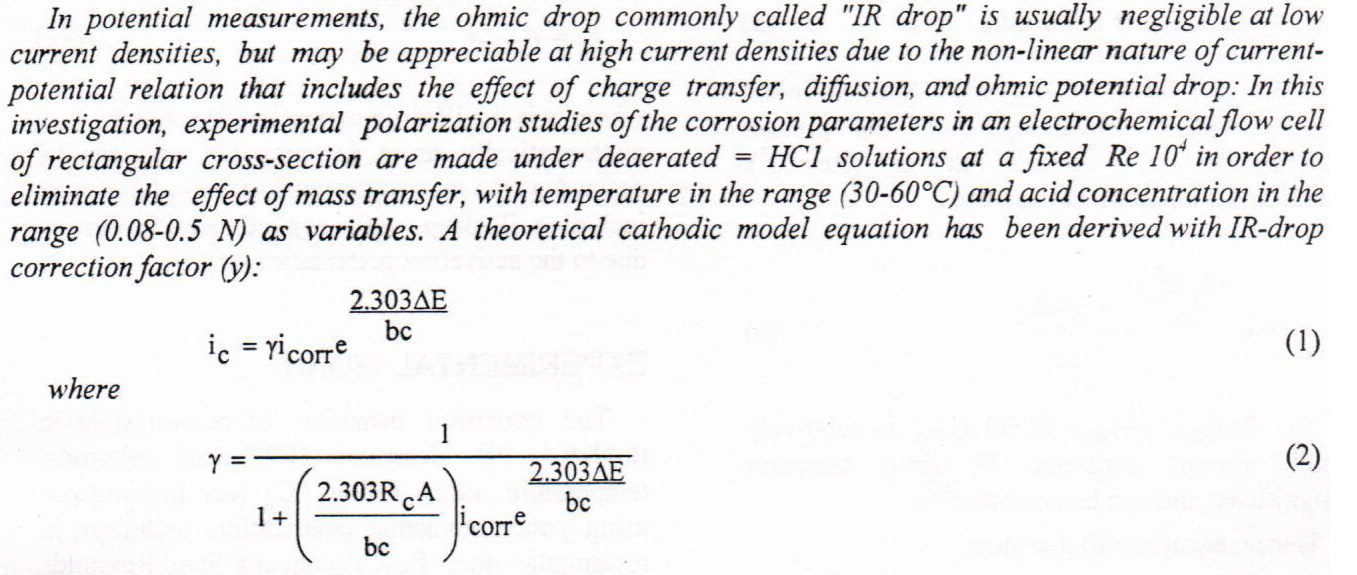
Determination of Corrosion Parameters for a Cathodic Reaction Complicated by IR Drop Effect in a Flow System

A steganography hides information within other information, such as file, message, picture, or video. A cryptography is the science of converting the information from a readable form to an unreadable form for unauthorized person. The main problem in the stenographic system is embedding in cover-data without providing information that would facilitate its removal. In this research, a method for embedding data into images is suggested which employs least significant bit Steganography (LSB) and ciphering (RSA algorithm) to protect the data. System security will be enhanced by this collaboration between steganography and cryptography.
 (4)
(4)
 (3)
(3)


A new method for the determination of the drug cefalexin in some Pharmaceuticals using (UV-Vis) and indirect Flame Atomic Absorption Spectrophotometer (FAAS) , Fe III should forms a chelating complex with cefalexin (CEX –Fe III) at pH (1-8) and the best pH for the formation of (CEX –Fe III) chelating complex was (2) .The complex extracted with Methanol and Dimethy-Sulphoxide .The mole-ratio method has been used to determine the structure of chelate (CEX - Fe III) and found to be 2:1 LM ( Ligand : Metal.) .
Keywords : Cefalexin , chelating complex.
This study included collecting of 150 specimens of the Iraqi Bird Bulbule Pycnonotus lecuotis mesoptamiae (Pycnotidae , Passeriformes), from the 1st of November 2004 to 30th of October 2005 in the city of Baghdad and its suburbs, in concern of identifying the internal parasite of the digestive tract of these birds and studying the diseases resulted from the infection. The study showed that the bird Bulbule is Parasitized by Four types of Cestodes ,two of them are recorded in this kind of bird in Iraq for the first time ,Paradicranotinae anormalis and Haploparaxis sp. , and the other two are Raillietina tetragona and Allohymenolepsis sp. ,and by two types of Pin Worm(Trematode) that are identified for the first time in the Bird Bulb
... Show More
(1)
(5)
(5)

The corrosion behavior of copper and carbon steel in 1M concentration of hydrochloric acid (HCl) and sulphuric acid (H2SO4) has been studied. The corrosion inhibition of copper and carbon steel in 1M concentration of hydrochloric acid (HCl) and sulphuric acid (H2SO4) by Ciprofloxacin has been investigated. Specimens were exposed in the acidic media for 7 hours and corrosion rates evaluated by using the weight loss method. The effect of temperature (from 283 ºK to 333 ºK), pH (from 1to 6), inhibitor concentration (10-4 to 10-2) has been studied. It was observed that sulphuric acid environment was most corrosive to the metals because of its oxidizing nature, followed by hydrochloric acid. The rate of metal dissolution increased with incre
... Show More
(2)
A potentiostatic study of the behaviour of Inconel (600) in molar sulphuric acid has been carried out over the temperature range 293-313 K. Values have been established for the potentials and current densities of the corrosion, active-passive transition, passivity and transpassive states. For corrosion, the current density (ic) and potential (Ec) have been determined from well-defined Tafel lines. The potential and current density prior to the commencement of passivity have been obtained corresponding respectively to the critical potential (Ecr( and to the current density (icr) for the active-passive transition state. The passive range was defined by the respective potentials and current densities for passive film formation and dissolutio
... Show More
The present study was conducted to evaluate the effect of different inhibitors on the corrosion rate of aluminum in 50% (v/v) ethylene glycol solution at 80°C and pH 8.0 in which the electrochemical technique of linear sweep voltammetry was employed to characterize each inhibitor function and to calculate the corrosion rate from Tafel plots generated by a computer assisted potentiostat.
It is found that both sodium dichromate and borax reduces the corrosion rate by polarizing the anodic polarization curve while sodium phosphate, potassium phosphate, and sodium benzoate reduces the corrosion rate by polarizing both the anodic and cathodic polarization curve.
When inhibitor concentration increases from I g/l up
... Show MoreIn this work the corrosion behavior of Ti-6Al-4V alloy was studied by using galvanostatic measurements at room temperature in different media which includ sodium chloride (food salt), sodium tartrate (presence in jellies, margarine, and sausage casings,etc.), sodium oxalate (presence in fruits, vegetables,etc.), acetic acid (presence in vinegar), phosphoric acid (presence in drink), sodium carbonate (presence in 7up drink,etc.), and sodium hydroxide in order to compare.
Corrosion parameters were interpreted in th
... Show More