Determination of Corrosion Parameters for a Cathodic Reaction Complicated by IR Drop Effect in a Flow System
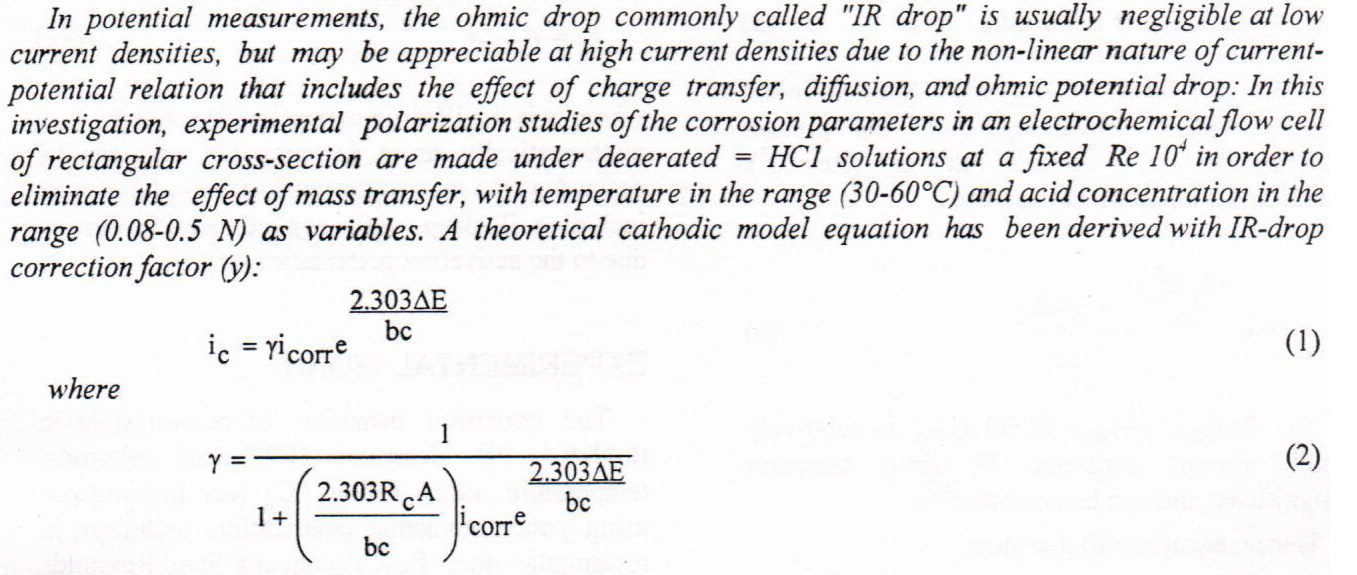

 (2)
(2)

The impact of a Schiff base namely 2-((thiophen-2-ylmethylene)amino)benzenethiol to corrode mild steel in 1 M HCl resolved was evaluated using different weight loss technique and scanning electron microscopy (SEM).different weight measurements to expand that the 2-((thiophen-2-ylmethylene) amino) benzenethiol inhibits the corrosion of mild steel through adsorbing of top for mild steel and block the active locality. The inhibitive impacts of 2-((thiophen-2-ylmethylene)amino)benzenethiol increase with increasing concentration and decrease with increasing temperature. SEM to checking revealed that the alloy surface was quite unaffected and formed protective film on its surface. The investigated
... Show More
(4)
 (1)
(1)

The current research aims to identify the time-management skills based on the post-test of the experimental group as well as to examine the effect of a training program on developing the skills of managing time among the study sample. To achieve the research objectives, the researcher designed a scale of time management skill included (30) paragraphs. The research reached that the training program is significantly effective in managing and organizing time. There are statistically significant differences in pre-posttest between the experimental and control groups.
ABSTRACT Purpose: the aim of this in vitro study was to compare the marginal gap and internal fitness between single crowns and the crowns within three-unit bridges of zirconium fabricated by CAD-CAM system. Materials and methods: A standard model from ivoclar company was used as a pattern to simulate three-units bridge (upper first molar and upper first premolar) as abutments used to fabricate stone models, eight single crowns for premolar and eight of three units bridges. Crowns and bridges fabricated by CAD-CAM system were cemented on their respective stone models then sectioned at the mid-point buccolingaully and misiodistaly and examined under stereomicroscope. Result: the marginal gap in premolar crowns and premolar within bridge we
... Show More
(1)
In this work, a CW CO2 laser was used for cutting samples of the fiber-reinforced
plastics (FRP) of three different types of reinforcing material; aramide, glass and carbon.
Cutting process was investigated throughout the variation of some parameters of cutting
process and their effects on cutting quality as well as the effect of an inert gas exist in the
interaction region and finally using a mechanical chopper in order to enhance the cutting
quality. Results obtained explained the possibility to perform laser cutting with high
quality in these materials by good control of the parameters and conditions of the process.
This study was designed to evaluate the ability of bioemulsifier to inhibit the growth of some pathogenic microorganisms. Fourteen isolates belonged to Serratia sp. were collected and tested for their ability to produce bioemulsifier. Results showed that Serratia marcescens S10 (isolated from the gut of the American cockroach) had the highest ability to produce bioemulsifier, among 14 isolates belong to Serratia spp. and it had the ability to inhibit the growth of some microorganisms. The production of bioemulsifier was detected by determination of emulsification index (E24%), qualitative drop-collapse test, emulsification activity (E.A) and measuring the surface tension (S.T). The results of bioemulsifier produced by Serratia marcescens S1
... Show More
(6)
In this paper, we characterize normal composition operators induced by holomorphic self-map , when and .Moreover, we study other related classes of operators, and then we generalize these results to polynomials of degree n.
The CdS quantum dots were prepared by chemical reaction
of cadmium oleylamine (Cd –oleylamine complex) with the
sulfite-oleylamine (S-oleylamine) with 1:6 mole ratios. The
optical properties structure and spectroscopy of the product
quantum dot were studied. The results show the dependence of the
optical properties on the crystal dimension and the formation of
the trap states in the energy band gap.
In addition to the primary treatment, biological treatment is used to reduce inorganic and organic components in the wastewater. The separation of biomass from treated wastewater is usually important to meet the effluent disposal requirements, so the MBBR system has been one of the most important modern technologies that use plastic tankers to transport biomass with wastewater, which works in pure biofilm, at low concentrations of suspended solids. However, biological treatment has been developed using the active sludge mixing process with MBBR. Turbo4bio was established as a sustainable and cost-effective solution for wastewater treatment plants in the early 1990s and ran on minimal sludge, and is easy to maintain. This
... Show More