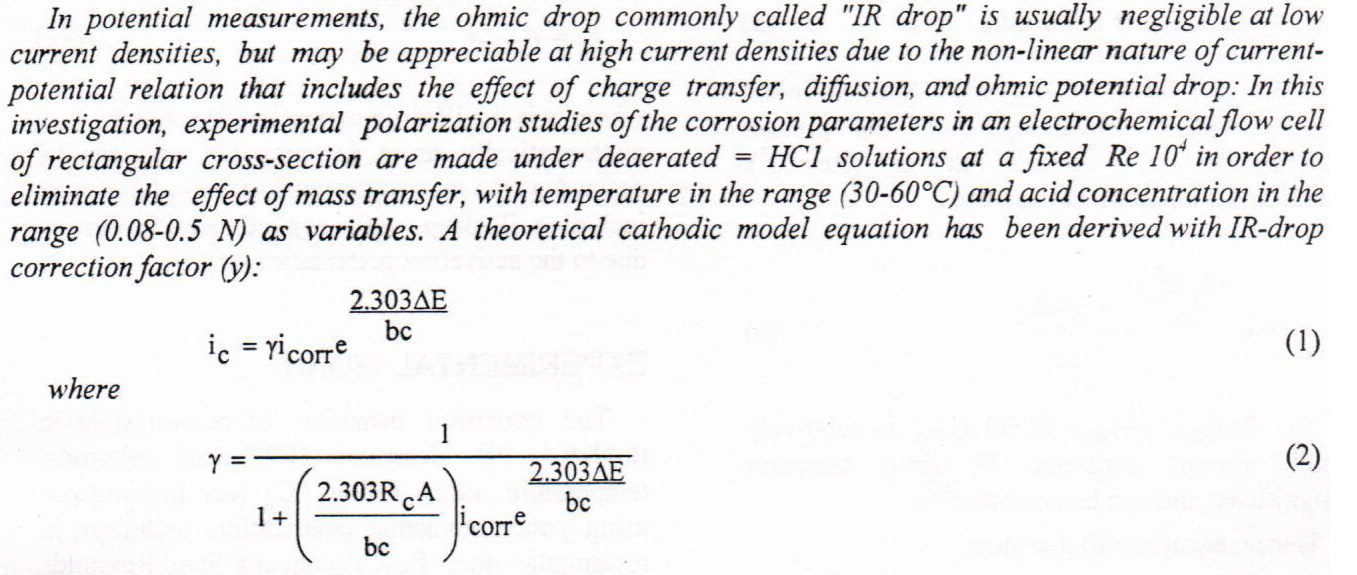
Determination of Corrosion Parameters for a Cathodic Reaction Complicated by IR Drop Effect in a Flow System

Objective: To evaluate biomarkers of insulin resistance and acute phase reactants in obese, overweight and lean subjects and investigate the associations among those biomarkers. Methodology: This cross sectional study included 158 subjects who were stratified into three groups. Group1 comprised 53 obese patients (BMI≥ 30 kg/m2); group 2 were 54 overweight subjects, and group 3 had 51 healthy lean (BMI
The electrochemical behavior of Al-17%Si alloy is investigated in 3.5wt% NaCl solution. Many alloys with addition of the different wt% magnesium metal of 1wt%, 2%, 3wt% ,4.5wt% ,and 9wt% were prepared by gravity die casting . The microstructures of prepared alloys were examined by optical and SEM microscopes. Corrosion behavior was investigated by using potentiostat instrument under static potentials test and corrosion current was recorded to determine corrosion resistance of all prepared samples. It was found that the addition of Mg metal improves the corrosion resistance of Al-17%Si alloy in 3.5%NaCl solution. The alloy containing 1%Mg shows less corrosion rate than the others while the alloys containing 4.5%Mg, 9%Mg content have
... Show More (2)
(2)

This paper studies the influence of temperature on the corrosion rate of coated AA6111 aluminum alloy used in vehicle bodies under static and vibration states. The vibration test system was collected laboratory and used for testing of five different types of paints (EASI, Numix, Lesonal, DENSO and Polaron paints) in the 5 % NaCl solution using immersion test method. Lesonal paint provided the best corrosion protection, while DENSO paints show large values of corrosion rate, other coatings exhibit moderate values. Model of paints corrosion was developed to characterize the corrosion processes occur at the surfaces. It is found that corrosion rate obtained at vibration cases is larger than static cases and vibration effect
... Show More
In this paper Alx Ga1-x As:H films have been prepared by using new deposition method based on combination of flash- thermal evaporation technique. The thickness of our samples was about 300nm. The Al concentration was altered within the 0 x 40.
The results of X- ray diffraction analysis (XRD) confirmed the amorphous structure of all AlXGa1-x As:H films with x 40 and annealing temperature (Ta)<200°C. the temperature dependence of the DC conductivity GDC with various Al content has been measured for AlXGa1-x As:H films.
We have found that the thermal activation energy Ea depends of Al content and Ta, thus the value of Ea were approximately equal to half the value of optical gap.
The primary goal of in-situ load testing is to evaluate the safety and performance of a structural system under particular loading conditions. Advancements in building techniques, analytical tools, and monitoring instruments are prompting the evaluation of the appropriate loading value, loading process, and examination criteria. The procedure for testing reinforced concrete (RC) structures on-site, as outlined in the ACI Building Code, involves conducting a 24-h load test and applying specific evaluation criteria. This article detailed a retrofitting project for an RC slab-beams system by utilizing carbon fiber-reinforced polymer (CFRP) sheets to strengthen the structure following a fire incident. The RC structure showed indicators of deter
... Show More (7)
(6)
(7)
(6)


As the reservoir conditions are in continuous changing during its life, well production rateand its performance will change and it needs to re-model according to the current situationsand to keep the production rate as high as possible.Well productivity is affected by changing in reservoir pressure, water cut, tubing size andwellhead pressure. For electrical submersible pump (ESP), it will also affected by numberof stages and operating frequency.In general, the production rate increases when reservoir pressure increases and/or water cutdecreases. Also the flow rate increase when tubing size increases and/or wellhead pressuredecreases. For ESP well, production rate increases when number of stages is increasedand/or pump frequency is
... Show More
(1)
A novel method for Network Intrusion Detection System (NIDS) has been proposed, based on the concept of how DNA sequence detects disease as both domains have similar conceptual method of detection. Three important steps have been proposed to apply DNA sequence for NIDS: convert the network traffic data into a form of DNA sequence using Cryptography encoding method; discover patterns of Short Tandem Repeats (STR) sequence for each network traffic attack using Teiresias algorithm; and conduct classification process depends upon STR sequence based on Horspool algorithm. 10% KDD Cup 1999 data set is used for training phase. Correct KDD Cup 1999 data set is used for testing phase to evaluate the proposed method. The current experiment results sh
... Show More
(9)
(6)
A theoretical study on corrosion inhibitors was done by quantum calculations includes semi-empirical PM3 and Density Functional Theory (DFT) methods based on B3LYP/6311++G (2d,2P). Benzimidazole derivative (oxo(4- ((phenylcarbamothioyl) carbamoyl)phenyl) ammonio) oxonium (4NBP) and thiourea derivative 2-((4- bromobenzyl)thio) -1H-benzo[d] imidazole (2SB) were used as corrosion inhibitors and an essential quantum chemical parameters correlated with inhibition efficiency, EHOMO (highest occupied molecular orbital energy) and ELUMO (lowest molecular orbital energy). Other parameters are also studied like energy gap [ΔE (HOMO-LUMO)], electron affinity (EA), hardness (Δ), dipole moment (μ), softness (S), ionization potential (IE), absolut
... Show More
(80)
(72)
(4)
(4)
Numerical investigation has been carried out on heat transfer and friction factor characteristics of copper-water nanofluid flow in a constant heat-fluxed tube with the existence of new configuration of vortex generator using Computational Fluid Dynamics (CFD) simulation. Two types of swirl flow generator: Classical twisted tape (CTT) and Parabolic-cut twisted tape (PCT) with a different twist ratio (= 2.93, 3.91 and 4.89) and different cut depth (= 0.5, 1.0 and 1.5 cm) with 2% and 4% volume concentration
... Show More
(38)
(30)