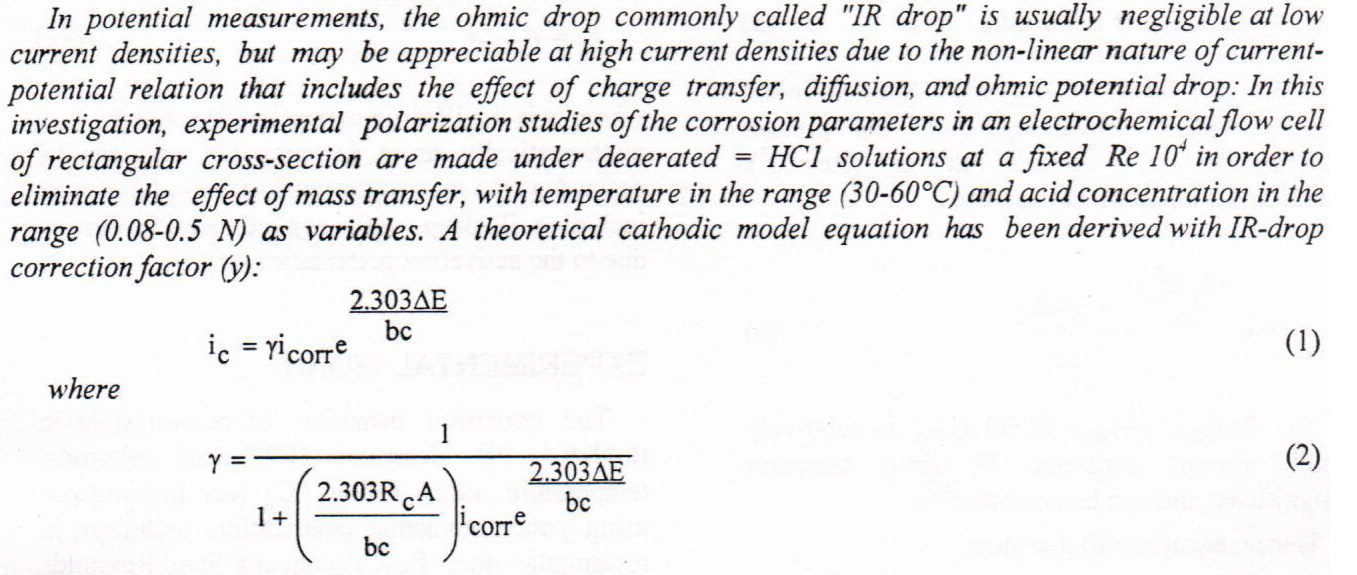
Determination of Corrosion Parameters for a Cathodic Reaction Complicated by IR Drop Effect in a Flow System

European Chemical Bulletin (ISSN 2063-5346) is a peer-reviewed journal that publishes original research papers, short communications, and review articles in all areas of chemistry. European Chemical Bulletin has eight sections, namely
One of the most difficult tasks in modern medical societies is the process of identifying a cure for many infectious diseases caused by drug-resistant microbes. Therefore, it has become necessary to discover new compounds that work in this regard. The currently prepared Schiff base, derived from thiazole, has a biological activity against bacteria and biofilms and its activity increases when it is associated with copper, zinc and platinum ions and forms metal complexes. This study highlights the synthesis and evaluation of novel biological compounds as inhibitors of bacterial growth and biofilms. A three newly complexes are resulting from the reaction of a new Schiff base ligand (LC) with metal ions (Zn, Cu, Pt). The new ligand (LC)
... Show More
Abstract: Two different shapes of offset optical fiber was studied based on coreless fiber for refractive index (RI)/concentration (con.) measurement, and compare them. These shapes are U and S-shapes, both shapes structures were formed by one segment of coreless fiber (CF) was joined between two single mode (SMF) lead in /lead out with the same displacement (12.268µm) at both sides, the results shows the high sensitive was achieved in a novel S-shape equal 98.768nm/RIU, to our knowledge, no one has ever mentioned or experienced it, it’s the best shape rather than the U-shape which equal 85.628nm/RIU. In this research, it was proved that the offset form has a significant effect on the sensitivity of the sensor. Addi
... Show MoreA new tridentate ligand has been synthesized derived from phenyl(pyridin-3-yl)methanone. Three coordinated metal complexes were prepared by complexation of the new ligand with Cu(II), Ni(II) and Zn(II) metal salts. The new Schiff base “benzyl -2-[phenyl(pyridin-3-yl)methylidene]hydrazinecarbodithioate” and the new metal complexes were characterized using various physico-chemical and spectroscopic techniques. From the analysis results, the expected structure to the metal complexes are octahedral in geometry for Cu(II) complex, square planner for Ni(II) and tetrahedral for Zn(II) complex. The new compounds are expected to show strong bioactivity against bacteria and cancer cells.
1-[4-(4-Acetyl-2-hydroxy-phenylazo)-phenyl]-ethanone (L1) and 1-[3-Hydroxy-4(4-nitro-phenylazo)-phenyl]-ethanone (L2) were readied by combination the diazonium salts of amines with 3-hydroxyacetophenone. (C.H.N) analyses, infrared spectra, UV–vis electronic absorption spectra, 1H and 13CNMR spectral mechanisms are use to identified of the ligands. Complexes of Ni+2 and Cu+2 were performed as well depicted. The formation of complexes has been identified by using atomic absorption of flame, elemental analysis, infrared spectra and UV-Vis spectral process as well conductivity and magnetic quantifications. Nature of compounds produced have been studied obeyed the mole ratio and continuous contrast methods, Beer's law followed during a concent
... Show MoreBackground: Appreciation of the crucial role of risk factors in the development of coronary artery disease (CAD) is one of the most significant advances in the understanding of this important disease. Extensive epidemiological research has established cigarette smoking, diabetes, hyperlipidemia, and hypertension as independent risk factors for CADObjective: To determine the prevalence of the 4 conventional risk factors(cigarette smoking, diabetes, hyperlipidemia, and hypertension) among patients with CAD and to determine the correlation of Thrombolysis in Myocardial Infarction (TIMI) risk score with the extent of coronary artery disease (CAD) in patients with unstable angina /non ST elevation myocardial infarction (UA/NSTEMI).Methods: We
... Show MoreAbstract: Iatrogenic furcal root perforations are serious complications during dental treatment. This study was aimed to compare the sealing ability of new bioceramic root repair material TotalFill® with the other perforation repair materials (GIC, MTA and Biodentine) using a dye- extraction method.Materials and Methods: Forty extracted, human mandibular molars with non-fused well developed root were collected. Artificial perforations were made from the external surface of the teeth. Then the teeth were randomly divided into 4 experimental groups (n= 10) according to the type of repair material used in this study; Medifil glass ionomercement, TotalFill® bioceramic root repair material, BiodentineTM and MTA Plus. The specimens were then im
... Show More
Bank credit is extremely important, as the generated revenues by a main focus of any bank earnings no matter how many and varied sources of revenue other, and without losing the bank and the main role function as an intermediary in financial economics . But at the faltering customers in payment of loans . Therefore , uses a method of financial analysis using ratios as one of the important tools to measure the clients ability to pay , in spite of the need for the Bank analyzed the trend in this regard is focused on three main areas ( liquidity, profitability, and borrowing ) and can be to add another field is the possibility to cover fixed charges of the profits generated. Finally I would like to emphas
Series of new complexes of the type [M2 (L)Cl4 ] are prepared from the new ligand[N1 ,N4 -bis(benzo[d]thiazol-2- yl)succinamide (L) derived from ethan-1,2-dicarbonyl chloride and 2-aminobenzothiozole,where, M= Ni(ii), Cu(ii) and Zn(ii) alsocomplexes of mix-ligands, the type [M(L)(8-HQ)]Cl, where, M = Ni(ii), Cu(ii) and Zn(ii),8-HQ= 8-Hydroxyquinoline. Chemical forms are obtained from their 1 H, 13CNMR, Mass spectra (for (L)), FT-IR and U.V spectrum, melting point, molar conduct.Using flame (AA), % M is determined in the complexes.The content of C, H, N and S in the (L) and its complexes was specified. Magnetic susceptibility and thermal analysis (TGA) of prepared compounds were measured.The propose geometry for all complexes[M2 (L)Cl4 ] wa
... Show More