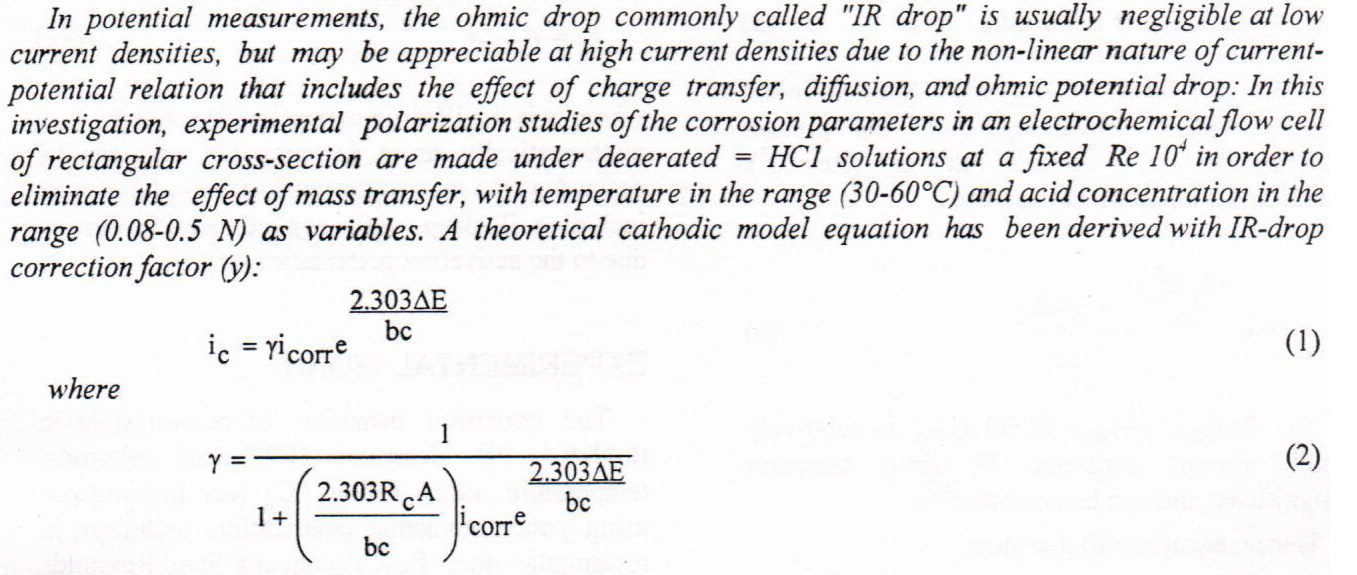
Determination of Corrosion Parameters for a Cathodic Reaction Complicated by IR Drop Effect in a Flow System

This study includes design and synthesis of new non-steroidal anti-inflammatory agents (NSAIDs) with expected cyclooxygenase-2 (COX-2) selective inhibition to achieve better activity and low gastric side effects. Two series of compounds have been designed and synthesized as potential NSAIDs,these are: Salicylamide derivatives (compounds 3,4,5 ) and Diflunisal derivatives (compounds 10&11). In vivo acute anti-inflammatory effect of one of the synthesized agents (compound 3) was evaluated in the rat using egg-white induced paw edema model of inflammation. Preliminary pharmacological study revealed that compound 3 exhibited less anti-inflammatory effect compared to that of aspirin after
... Show More
This research sought to present a concept of cross-sectional data models, A crucial double data to take the impact of the change in time and obtained from the measured phenomenon of repeated observations in different time periods, Where the models of the panel data were defined by different types of fixed , random and mixed, and Comparing them by studying and analyzing the mathematical relationship between the influence of time with a set of basic variables Which are the main axes on which the research is based and is represented by the monthly revenue of the working individual and the profits it generates, which represents the variable response And its relationship to a set of explanatory variables represented by the
... Show More
ABSTRACT : Bacillus cereus and Pseudomonas aeruginosa is the ability to produce a wide antimicrobial active compounds (Bacillin and S-Pyocin) against pathogenic microorganism. In vitro assay with the antagonists of both crude bacteriocin and partial by precipitation 75% ammonium sulfate showed that the effectively inhibited growth of the following (Candida kefyer and Fusarium spp) and Propionibacterium acnes. The results showed the inhibition zone of reached Bacillin (9-13 mm), while Pyocin (13 - 16mm) in solid medium.
 (10)
(10)

New complexes of the some trivalent transition metal ions of the uracil such as [M(Ura)3Cl3] and mixed ligand metal complexes with uracil and oxalic acid [M(Ura)2(OA)(OH2)Cl].H2O type, where (Ura)=Uracil, (OA= Oxalic acid dihydrate, (M= Cr+3 and Fe+3) were synthesized and characterized by the elemental analysis, FT.IR, electronic spectra, mass spectra and magnetic susceptibility as well as the conductivity measurements. Six–coordinated metal complexes were suggested for the isolated complexes of Cr+3 and Fe+3 with molecular formulas dependent on the nature of uracil and oxalic acid present. The proposed molecular structure for all complexes with their ions is octahedral geometries. The antibacterial efficiency was tested of metal salts, l
... Show More (4)
(4)
A series of coumarin derivatives linked to amino acid ester side chains were synthesized and evaluated of their antibacterial and antifungal activity. The coumarin derivatives was alkylated by the ethyl bromoacetate and then using potassium carbonate to get alkylated hymecromone. Conventional solution method for amide bond formation was used as a coupling method between the carboxy-protected amino acids with acetic acid side chain of coumarin derivatives. The DCC/ HOBt coupling reagents were used for peptide bond formation. The proposed analogues were successfully synthesized and their structural formulas were consistent with the proposed struct
... Show More
(47)
(41)

compound [1] was formed from the reaction of benzoin and benzaldehyde in the presence of ammonia, which was reacted with sodium hydride in DMF to obtain imidazole salt. This salt was reacted with adipoyl chloride to give compound [2]. Acid hydrazide derivative [3] was obtained from the reaction of compound [2] with hydrazine hydrate. After that Shiff bases [4-9] have been synthesized from the reaction of compound [3] with different aromatic aldehydes. These new formed compounds were diagnosed by 13C-NMR, 1H-NMR for some of them (in Ahl-Albate University in Jordan) and FT-IR spectroscopy (In Baghdad University). All of the prepared products have been studied their biological activities toward two kinds of bacteria. These products show
... Show More
(10)
Purpose: To assess the antioxidant and antineoplastic effects of Hibiscus sabdariffa Linn. on oral squamous cell carcinoma cells. Materials and Methods: Human squamous cell carcinoma HSCC cells were tested for cytotoxicity by a methanol extract of Hibiscus sabdariffa (MEHSP). After 24, 48, and 72 ...
(3)
Background: A diverse group of bacteria live in biofilms in the oral cavity. On dental surfaces biofilms form plaque that is potentially involved in caries and periodontal diseases. Periodic studying of plaque microflora and their antimicrobial sensitivity patterns strongly affects the clinical practice in plaque-induced oral diseases. Materials and methods: Dental plaque samples were collected from 22 patients having ages ranged between 33 and 49 years with gingivitis that met the study criteria. Plaque, gingival and gingival bleeding indices (PI, GI, GBI) were measured for each patient. Laboratory procedures included microbiological examination of plaque samples followed by antibiotic sensitivity testing using disc diffusion method were
... Show More
This search include the synthesis of some new 1,3-oxazepine derivatives have been prepared, starting from reaction of L-ascorbic acid with dry acetone in presence of dry hydrogen chloride afforded the acetal (I). Treatment of the latter with p-nitrobenzoyl chloride in dry pyridine yielded the ester (II) which was dissolved in (65%) acetic acid in absolute ethanol yielded the glycol (III). The reaction of the glycol (III) with sodium periodate in distilled water at room temperature produced the aldehyde (IV). The compound (V) [2-amino-5-mercapato-1,3,4-thiadiazole] was prepared through the reaction of thiosemicarbazide with carbon disulphide (CS2) in entity of anhydrous (Na2CO3) in (abs. ethanol ). Compound (VI) [2-(5-mercapto-1,3,4-thiadiaz
... Show More