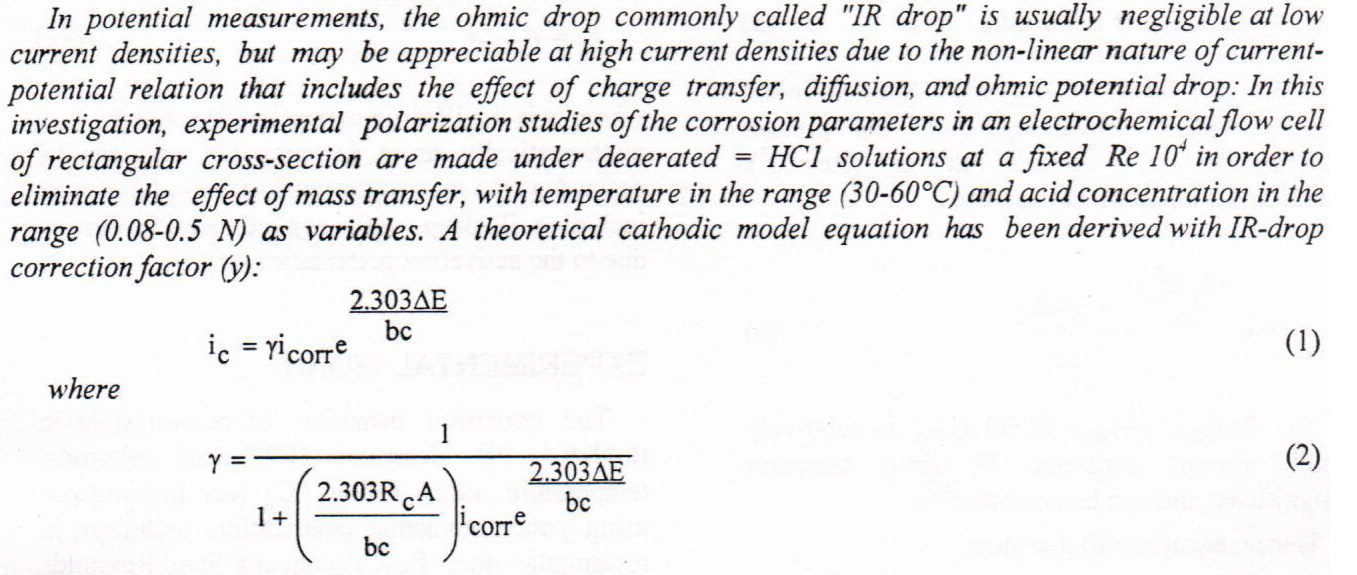
Determination of Corrosion Parameters for a Cathodic Reaction Complicated by IR Drop Effect in a Flow System

The new of compounds synthesized by sequence reactions starting from a reaction of 3-phenylenediamine or 4-phenylenediamine with chloroacetyl chloride to produce the compounds [I]a,b, then the compounds[I]a,b reacted with sodium azide to yield compounds[II]a,b that reacted 1,3-dipolarcycloaddition reaction with acrylic acid to give compounds [III]a,b these compounds reacted with methanol led to ester compounds[IV]a,b then reacted with hydrazine to give acid hydrazide [V]a,b . Finally compounds [V]a,b reacted with aromatic aldehydes to product shiff bases derivatives. The compounds characterized by mp. , IR, 1HNMR in addition to mass spectroscopy for some of them the liquid crystals properties were studied by using polarized optical microsco
... Show More (2)
(2)

This work discusses the beginning of fractional calculus and how the Sumudu and Elzaki transforms are applied to fractional derivatives. This approach combines a double Sumudu-Elzaki transform strategy to discover analytic solutions to space-time fractional partial differential equations in Mittag-Leffler functions subject to initial and boundary conditions. Where this method gets closer and closer to the correct answer, and the technique's efficacy is demonstrated using numerical examples performed with Matlab R2015a.
(6)
 (2)
(2)

This investigation aims to explore the potential of waterworks sludge (WS), low-cost byproduct of water treatment processes, as a sorbent for removing Congo Red (CR) dyes. This will be achieved by precipitating nano-sized (MgAl-LDH)-layered double hydroxide onto the surface of the sludge. The efficiency of utilizing MgAl-LDH to modify waterworks sludge (MWS) for use in permeable reactive barrier technology was confirmed through analysis with Fourier transform infrared and X-ray diffraction. The isotherm model was employed to elucidate the adsorption mechanisms involved in the process. Furthermore, the COMSOL model was utilized to establish a continuous testing model for the analysis of contaminant transport under diverse conditions.
... Show More
Although its wide utilization in microbial cultures, the one factor-at-a-time method, failed to find the true optimum, this is due to the interaction between optimized parameters which is not taken into account. Therefore, in order to find the true optimum conditions, it is necessary to repeat the one factor-at-a-time method in many sequential experimental runs, which is extremely time-consuming and expensive for many variables. This work is an attempt to enhance bioactive yellow pigment production by Streptomyces thinghirensis based on a statistical design. The yellow pigment demonstrated inhibitory effects against Escherichia coli and Staphylococcus aureus and was characterized by UV-vis spectroscopy which showed lambda maximum of
... Show More
This investigation aims to explore the potential of waterworks sludge (WS), low-cost byproduct of water treatment processes, as a sorbent for removing Congo Red (CR) dyes. This will be achieved by precipitating nano-sized (MgAl-LDH)-layered double hydroxide onto the surface of the sludge. The efficiency of utilizing MgAl-LDH to modify waterworks sludge (MWS) for use in permeable reactive barrier technology was confirmed through analysis with Fourier transform infrared and X-ray diffraction. The isotherm model was employed to elucidate the adsorption mechanisms involved in the process. Furthermore, the COMSOL model was utilized to establish a continuous testing model for the analysis of contaminant transport under diverse conditions. A st
... Show More
(11)
(9)

In this paper, split-plate airlift electrochemical reactor as an apparatus with new configuration for wastewater treatment was provided. Two aluminum plates were fixed inside the reactor and present two functions; first it works as split plates for internal loop generation of the airlift system (the zone between the two plates acts as riser while the other two zones act as downcomer) and second it works as two electrodes for electrocoagulation process. Simulated wastewater contaminated with zinc ions was used to test the performance of this apparatus for zinc removal by studying the effect of different experimental variables such as initial concentration of zinc (50-800 ppm), electrical current density (2.67-21.4 mA/cm2), init
... Show MoreIn this research, Artificial Neural Networks (ANNs) technique was applied in an attempt to predict the water levels and some of the water quality parameters at Tigris River in Wasit Government for five different sites. These predictions are useful in the planning, management, evaluation of the water resources in the area. Spatial data along a river system or area at different locations in a catchment area usually have missing measurements, hence an accurate prediction. model to fill these missing values is essential.
The selected sites for water quality data prediction were Sewera, Numania , Kut u/s, Kut d/s, Garaf observation sites. In these five sites models were built for prediction of the water level and water quality parameters.
(3)
Pure Cu (CZTSe) and Ag dopant CZTSe (CAZTSe) thin films with Ag content of 0.1 and 0.2 were fabricated on coring glass substrate at R.T with thickness of 800nm by thermal evaporation method. Comparison between the optical characteristics of pure Cu and Ag alloying thin films was done by measuring and analyzing the absorbance and transmittance spectra in the range of (400-1100)nm. Also, the effect of annealing temperature at 373K and 473K on these characteristics was studied. The results indicated that all films had high absorbance and low transmittance in visible region, and the direct bang gap of films decreases with increasing Ag content and annealing temperature. Optical parameters like extinction coefficientrefractive index, and
... Show MoreBackground: Coronavirus, which causes respiratory illness, has been a public health issue in recent decades. Because the clinical symptoms of infection are not always specific, it is difficult to expose all suspects to qualitative testing in order to confirm or rule out infection as a test. Methods: According to the scientific studies and investigations, seventy-three results of scientific articles and research were obtained using PubMed, Medline, Research gate and Google Scholar. The research keywords used were COVID-19, coronavirus, blood parameters, and saliva. Results: This review provides a report on the changes in the blood and saliva tests of those who are infected with the COVID-19.COVID-19 is a systemic infection that has
... Show More
(4)
(3)