Determination of Corrosion Parameters for a Cathodic Reaction Complicated by IR Drop Effect in a Flow System
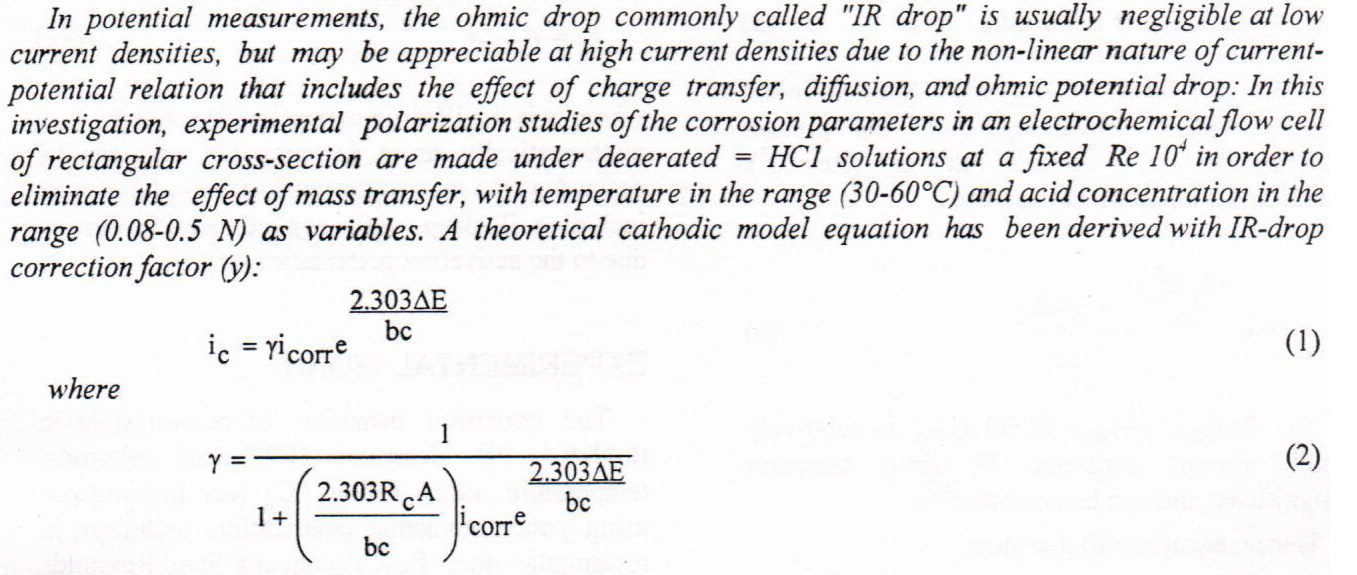

 (5)
(5)
 (3)
(3)



The aim of this study is to develop a novel framework for managing risks in smart supply chains by enhancing business continuity and resilience against potential disruptions. This research addresses the growing uncertainty in supply chain environments, driven by both natural phenomena-such as pandemics and earthquakes—and human-induced events, including wars, political upheavals, and societal transformations. Recognizing that traditional risk management approaches are insufficient in such dynamic contexts, the study proposes an adaptive framework that integrates proactive and remedial measures for effective risk mitigation. A fuzzy risk matrix is employed to assess and analyze uncertainties, facilitating the identification of disr
... Show More
Abstract: The study aimed to investigate the effect of oral administration of hot aqueous extract of beetle cocoon Larinus maculatus Faldermann, in a two doses 50 and100mg/Kg/B.wt for 3 and 6 weeks respectively on the levels of serum glucose, weight of body, and lipid profile in male mice Mus musculus. The results revealed that there was a significant (p<0.05) decrease in serum glucose level was dose and period dependent. Weight of body also reduced significantly (p<0.05) with doses and period dependent. The lipid profile level significantly (p<0.05) decreased in dose and period’s manner in each of Total cholesterol (TC), Triglyceride (TG), High Density Lipoprotein- (HDL), Low Density Lipoprotein (LDL), and Very Low Density Lipoprotei
... Show MoreThis study investigates consecutive reaction assisted by pervaporation for the first time. It studies the saponification of diethyladipate DA with sodium hydroxide NaOH solution synchronous with separating ethanol from the reaction mixture through an aqueous – organic membrane. The effect of time on some variables such as: permeated ethanol concentration EtOH wt%, separation factor (α), concentration of NaOH solution CB in the reaction medium and the conversion of DA to monoethyladipate (the intermediate product) was studied. It was shown that EtOH wt% and the conversion increased with increasing time unlike CB but (α) showed the existence of maximum value during the time of experiment. The process of reaction assisted by pervaporation
... Show More
AlPO4 solid acid catalyst was prepared in order to use it in transesterification reaction of edible oil after supporting it with tungsten oxide. The maximum conversion of edible oil was obtained 78.78% at catalyst concentration (5gm.), temperature 70°Ϲ, 30/1 methanol/edible oil molar ratio, and time 5hr. The study of kinetics of the transesterification reaction of edible oil indicates that the reaction has an order of 3/2, while the value of activation energy for transesterification reaction is 51.367 kJ/mole and frequency factor equal 26219.13(L/ mol.minute).
(1)
AlPO4 solid acid catalyst was prepared in order to use it in transesterification reaction of edible oil after supporting it with tungsten oxide. The maximum conversion of edible oil was obtained 78.78% at catalyst concentration (5gm.), temperature 70°Ϲ, 30/1 methanol/edible oil molar ratio, and time 5hr. The study of kinetics of the transesterification reaction of edible oil indicates that the reaction has an order of 3/2, while the value of activation energy for transesterification reaction is 51.367 kJ/mole and frequency factor equal 26219.13(L/ mol.minute).
(1)
This research presents a numerical study to simulate the heat transfer by forced convection as a result of fluid flow inside channel’s with one-sided semicircular sections and fully filled with porous media. The study assumes that the fluid were Laminar , Steady , Incompressible and inlet Temperature was less than Isotherm temperature of a Semicircular sections .Finite difference techniques were used to present the governing equations (Momentum, Energy and Continuity). Elliptical Grid is Generated using Poisson’s equations . The Algebraic equations were solved numerically by using (LSOR (.This research studied the effect of changing the channel shapes on fluid flow and heat transfer in two cases ,the first: cha
... Show MoreThe objective of drilling parameters optimization in Majnoon oilfield is to arrive for a methodology that considers the past drilling data for five directional wells at 35 degree of inclination as a baseline for new wells to be drilled. Also, to predicts drilling performance by selecting the applied drilling parameters generated the highest rate of penetration (ROP) at each section. The focal point of the optimization process is to reduce drilling time and associated cost per each well. The results of this study show that the maximum ROP could not be achieved without sufficient flow rate to cool and clean the bit in clay intervals (36" and 24") hole sections. Although the influence of combination of Weight on Bit (WOB), Round per minute
... Show More
The objective of drilling parameters optimization in Majnoon oilfield is to arrive for a methodology that considers the past drilling data for five directional wells at 35 degree of inclination as a baseline for new wells to be drilled. Also, to predicts drilling performance by selecting the applied drilling parameters generated the highest rate of penetration (ROP) at each section. The focal point of the optimization process is to reduce drilling time and associated cost per each well. The results of this study show that the maximum ROP could not be achieved without sufficient flow rate to cool and clean the bit in clay intervals (36" and 24") hole sections. Although the influence of combination of Weight on Bit (WOB), Round per mi
... Show More
Abstract
This paper is an experimental work to determinate the effect of welding velocity and formed arc energy for CO2-MAG fusion weld pool. The input parameters (arc voltage, wire feed speed and gas flow rate) were investigated to find their effects on the weld joint efficiency. Design of experiment with response surface methodology technique was used to build empirical mathematical models for welding velocity and arc energy in term of the input welding parameters. The predicted quadratic models were statistically checked for adequacy purpose by ANOVA analysis. Additionally, numerical optimization was conducted to obtain the optimum values for welding velocity and arc energy. A good agree
... Show More