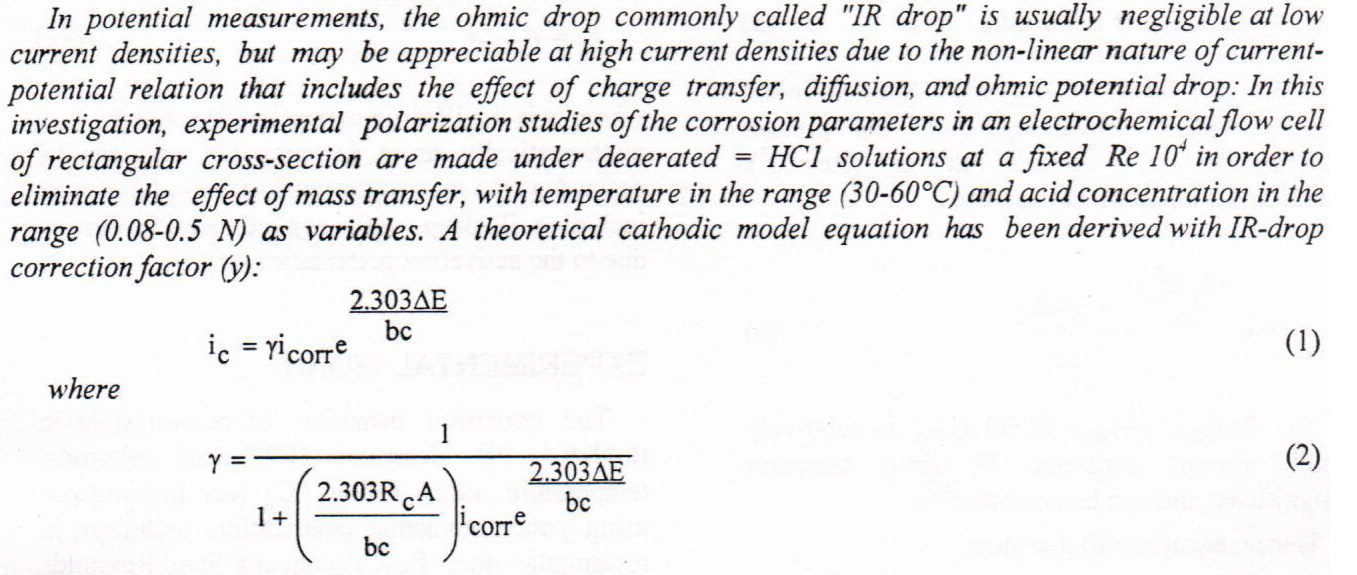
Determination of Corrosion Parameters for a Cathodic Reaction Complicated by IR Drop Effect in a Flow System

The matter of handwritten text recognition is as yet a major challenge to mainstream researchers. A few ways deal with this challenge have been endeavored in the most recent years, for the most part concentrating on the English pre-printed or handwritten characters space. Consequently, the need to effort a research concerning to Arabic texts handwritten recognition. The Arabic handwriting presents unique technical difficulties because it is cursive, right to left in writing and the letters convert its shapes and structures when it is putted at initial, middle, isolation or at the end of words. In this study, the Arabic text recognition is developed and designed to recognize image of Arabic text/characters. The proposed model gets a single l
... Show MoreBackground: Helicobacter pylori are important gastrointestinal pathogen associated with gastritis, peptic ulcers, and an increased risk of gastric carcinoma. There are several popular methods for detection of H. pylori (invasive and non-invasive methods) each having its own advantages, disadvantages, and limitations, and by using PCR technique the ability to detect H. pylori in saliva samples offers a potential for an alternative test for detection of this microorganism. Materials and methods: The study sample consists of fifty participants of both genders, who undergo Oesophageo-gastrodudenoscopy at the Gastroenterology Department of Al-Kindy Teaching Hospital Baghdad/ Iraq, during five months period from January 2014 to May 2014. They we
... Show More (30)
(30)
 (30)
(30)



Bacteriocin is an important antimicrobial peptide that can be used in industrial and medical fields due to its characteristics of antibacterial, food preservation and anticancer activities. Fifty isolates of Bacillus sp were collected from different soil samples which were already recognized via morphological and biochemical identification process. The isolates were screened for bacteriocin production effective against Staphylococcus spp in order to select the highest producing isolate. The isolate NK16 showed the maximum bacteriocin production (80 AU/ml) which was further characterized as Bacillus subtilis NK 16 through using API identification system (API 20E and API 50CHB). Then, next step was to detect the optimal conditions for maximum
... Show More
(11)
(4)
The density functional B3LYP is used to investigate the effect of decorating the silver (Ag) atom on the sensing capability of an AlN nanotube (AlN-NT) in detecting thiophosgene (TP). There is a weak interaction between the pristine AlN-NT and TP with the sensing response (SR) of approximately 9.4. Decoration of the Ag atom into the structure of AlN-NT causes the adsorption energy of TP to decrease from − 6.2 to − 22.5 kcal/mol. Also, the corresponding SR increases significantly to 100.5. Moreover, the recovery time when TP is desorbed from the surface of the Ag-decorated AlN-NT (Ag@AlN-NT) is short, i.e., 24.9 s. The results show that Ag@AlN-NT can selectively detect TP among other gases, such as N2, O2, CO2, CO, and H2O.
The present work was done in an attempt to build systematic procedures for treating warts by 810 nm diode laser regarding dose parameters, application parameters and laser safety. The study was done in Al- Kindy Teaching Hospital in Baghdad, Iraq during the period from 1st October 2003 till 1st April 2004. Fifteen patients completed the treatment and they were followed for the period of 3 months. Recalcitrant and extensive warts were selected for the study. Patients were randomly divided into 3 groups to be treated by different laser powers 9, 12 and 15 W, power density of 286 W/cm2, 381W/cm2, 477 W/cm2 pulse duration of 0.2 s, interval of 0.2 s and repeated pulses were used. The mode of application was either circular or radial. Pain oc
... Show MoreCopper electrodeposition by electrorefining process in acidic sulfate media contains 40 g/l of cupric ions and 160 g/l of sulfuric acid was achieved to study the influence of the operating parameters on cathode purity, surface morphology, deposition rate, current efficiency and power consumption. These operating parameters and there ranges are: current density 200, 300 and 400 A/m2, electrolyte temperature 35, 50 and 65 oC, electrodes spacing 15, 30 and 45 mm and electrolyte residence time 6, 4 and 2 h were utilized. XRF, SEM and EDX analyses were attained to clarify the properties of the produced cathode.
Structure type and disorder have become important questions in catalyst design, with the most active catalysts often noted to be “disordered” or “amorphous” in nature. To quantify the effects of disorder and structure type systematically, a test set of manganese(III,IV) oxides was developed and their reactivity as oxidants and catalysts tested against three substrates: methylene blue, hydrogen peroxide, and water. We find that disorder destabilizes the materialsthermodynamically, making them stronger chemical oxidantsbut not necessarily better catalysts. For the disproportionation of H2O2 and the oxidative decomposition of methylene blue, MnOx-mediated direct oxidation competes with catalytically mediated oxidation, making the most
... Show More
(24)
(25)