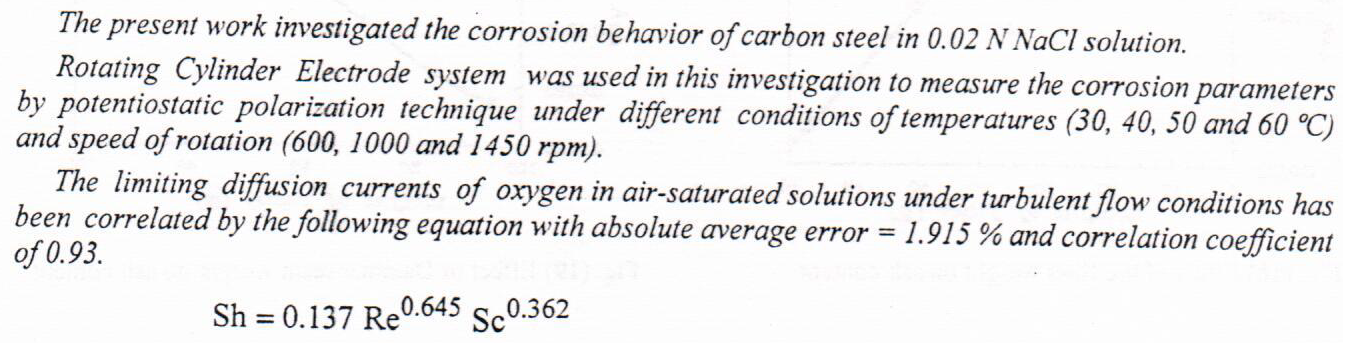
Effect of Velocity and Temperature on Mass Transfer of Oxygen in Corrosion Processes

Fumonisin B1 is toxic secondary metabolites compound produced by Fusarium spp. on maize and maize products causes health problems to human and animal. Therefore, this research is planned to study the effect of FB1 on the expression of TLR-2 & 4 in liver and kidney cells of mice. Four group of male mice were orally administrated with single dose of FB1 toxin as the following: 0 ppb, 800 ppb, 1200 ppb and 1600 ppb. After two weeks all animals were sacrificed, liver and kidney autopsies were taken and the level of TLR-2 & 4 detected in each four group by immunohistochemistry technique (IHC). According to the IHC examination of groups (1, 2, 3 and 4) strong expression of TLR2 in liver and kidney were (0%, 33.3%, 100%, 100%), respectively. This
... Show More (1)
(1)
 (6)
(6)
 (4)
(4)


The development of the perforated fin had proposed in many studies to enhance the heat transfer from electronic pieces. This paper presents a novel derivative method to find the temperature distribution of the new design (inclined perforated) of the pin fin. Perforated with rectangular section and different angles of inclination was considered. Signum Function is used for modeling the variable heat transfer area. Set of parameters to handle the conduction and convection area were calculated. Degenerate Hypergeometric Equation (DHE) was used for modeling the Complex energy differential equation and then solved by Kummer’s series. In the validation process, Ansys 16.0-Steady State Thermal was used. Two geometric models were consider
... Show More
(3)
(2)
Experimental research was carried out to investigate the performance of CFRP wrapping jackets used for retrofitting twelve square reinforced concrete (CR) column specimens damaged by exposure to fire flame, at different temperatures of 300, 500 and 700ºC, except for two specimens that were not burned. The specimens were then loaded axially till failure after gradual or sudden cooling. The specimens were divided into two groups containing two main reinforcement ratios, ρ= 0.0314 and ρ= 0.0542. This was followed by the retrofitting procedure that included wrapping all the specimens with two layers of CFRP fabric sheets. The test results of the retrofitted specimens showed that the fire damaged RC
... Show MoreIn this study, the relationship between the bare soil temperature with respect to its salinity is presented, the bare soil feature is considered only by eliminating all other land features by classifying the site location by using the support vector machine algorithm, in the same time the salinity index that calculated from the spectral response from the satellite bands is calibrated using empirical salinity value calculated from field soil samples. A 2D probability density function is used to analyze the relationship between the temperature rising from the minimum temperature (from the sunrise time) due to the solar radiation duration tell the time of the satellite capturing the scene image and the calibrated salinity index is presented. T
... Show More
(6)
(4)
(73)
(58)
Rutting is a predominant distress in asphalt pavements, particularly in hot climatic regions. This study systematically investigated the high-temperature performance of hot mix asphalt modified with five nanomaterials, namely, nano-silica (NS), nano-alumina (NA), nano-titanium (NT), nano-zinc (NZ), and carbon nanotubes (CNTs), under consistent laboratory conditions. Modification dosages were selected up to 10% for NS, NA, and NT, and up to 5% for NZ and CNTs. The experimental methodology comprised the following: (i) binder rheological characterization through rotational viscosity, G*/sinδ, and multiple stress creep recovery (MSCR) to quantify rutting susceptibility; (ii) chemical and microstructural assessments using Fourier transf
... Show More
(3)
(5)
(1)
This work describes the effect of temperature on the phase transformation of titanium dioxide (TiO2) prepared using metal organic precursors as starting materials. X-ray diffraction (XRD) was used to investigate the structural properties of TiO2 gels calcined at different temperatures (300, 500, 700) ?C. the results showed that the samples have typical peaks of TiO2 polycrystalline brookite nanopowders after calcined at (300 ?C), which confirmed by (111), (121), (200), (012), (131), (220), (040), (231), (132) and (232) diffraction peaks. Also, XRD diffraction spectra showed the presence of crystallites of anatase with low proportion of rutile phase where calcined at (500 ?C), while rutile phase domains at (700 ?C). The crystallite size of
... Show More
(1)