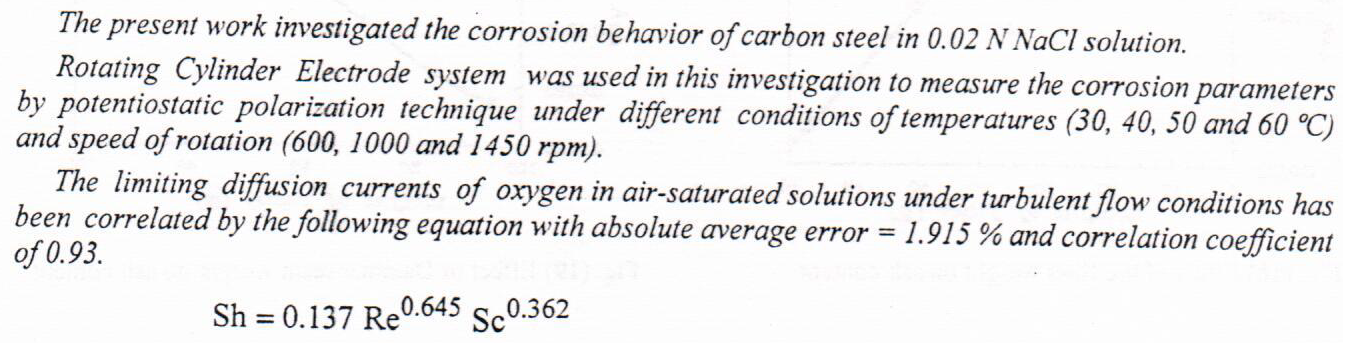
Effect of Velocity and Temperature on Mass Transfer of Oxygen in Corrosion Processes

 (62)
(62)
 (60)
(60)



Stability of laminated plate under thermal load varied linearly along thickness, is developed using a higher order displacement field which depend on a parameter “m”, whose value is optimized to get results closest to three-dimension elasticity results. Hamilton, s principle is used to derive equations of motion for laminated plates. These equations are solved using Navier-type for simply supported boundary conditions to obtain non uniform critical thermal buckling and fundamental frequency under a ratio of this load. Many design parameters of cross ply and angle ply laminates such as, number of layers, aspect ratios and E1/E2 ratios for thick and thin plates are investigated. It is observed that linear and uniform distribution of
... Show More
(3)
Municipal wastewater sources are becoming increasingly important for reuse, for irrigation purposes, so they must be treated to meet environmentally friendly local or global standards. The aim of this study is to establish, calibrate, and validate a model for predicting chemical oxygen demand for the pilot plant of mobile biofilm reactors operating from municipal wastewater in Maaymyrh located in Hilla city Using the approach of dimensional analysis. The approach of Buckingham's theorem was used to derive a model of dimensional analysis design for the forecast of (COD) in the pilot plant. The effluent concentration (COD) It has been derived as a result of the influential concentration of (COD), dissolved oxygen (DO), volume of pilot plant
... Show More
An experimental and theoretical works were carried out to model the wire condenser in the domestic refrigerator by calculating the heat transfer coefficient and pressure drop and finding the optimum performance. The two methods were used for calculation, zone method, and an integral method. The work was conducted by using two wire condensers with equal length but different in tube diameters, two refrigerants, R-134a and R-600a, and two different compressors matching the refrigerant type. In the experimental work, the optimum charge was found for the refrigerator according to ASHRAE recommendation. Then, the tests were done at 32˚C ambient temperature in a closed room with dimension (2m*2m*3m). The results showed that th
... Show More
(1)
In this work, electrochemical process was presented to polymerized eugenol on Gr.2 and Gr.5 titanium alloys before and after treated by Micro Arc Oxidation (MAO), where Gr.2 is commercial pure titanium and Gr.5 is Ti-6Al-4V dental alloys. The deposited layers were characterized by scanning electron microscopy (SEM), energy-dispersive X-ray spectroscopy (EDS), X-ray diffraction (XRD), and Fourier transform infrared spectroscopy (FTIR). The adhesion strength of polymeric thin-film was estimation by using pull-off adhesion test and the result was the adhesion strength of PE was (1.23 MPa) on Gr.2 before MAO and increase to (1.98 MPa) on Gr.2 after MAO treatment. The corrosion behavior of Gr.2 and Gr.5 alloy in artificial saliva environment at
... Show More
(28)
(12)
Two Schiff bases, namely, 3-(benzylidene amino) -2-thioxo-6-methyl 2,5-dihydropyrimidine-4(3H)-one (LS])and 3-(benzylidene amino)-6-methyl pyrimidine 4(3H, 5H)-dione(LA)as chelating ligands), were used to prepare some complexes of Cr(III), La(III), and Ce(III)] ions. Standard physico-chemical procedures including metal analysis M%, element microanalysis (C.H.N.S) , magnetic susceptibility, conductometric measurements, FT-IR and UV-visible Spectra were used to identify Metal (III) complexes and Schiff bases (LS) and (LA). According to findings, a [Cr(III) complex] showed six coordinated octahedral geometry, while [La(III), and Ce(III) complexes]were structured with coordination number seven. Schiff's bases a
... Show More
(13)
(2)
(2)