Effect of Velocity and Temperature on Mass Transfer of Oxygen in Corrosion Processes
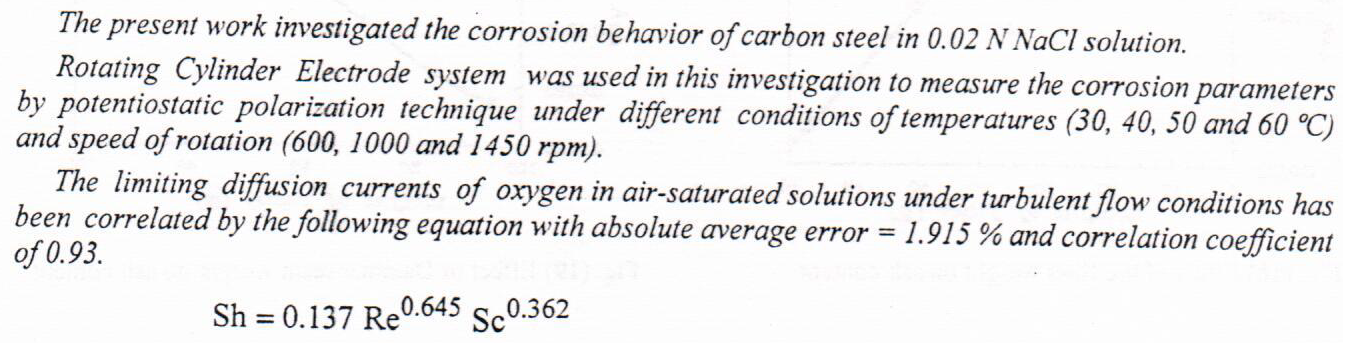

 (7)
(7)
 (3)
(3)



Background: The adenomatoid odontogenic tumor is a relatively rare benign epithelial odontogenic tumor. It contains both epithelial and mesenchymal components. Few cases presented as an extrafollicular lesion or involve the mandible or associated with other odontogenic lesions. This paper represents a rare case of an extrafollicular AOT. Case presentation: A 24-year-old female had a painless swelling on the right side of the lower jaw since one-month duration. Intraorally there was a well defined fluctuant-blue swelling in the right alveolar premolar region measuring 1×2 cm obliterating the right lower buccal vestibule. Grade II mobility in the vital 44 and 45 teeth were observed. Panoramic radiographs showed a well-defined pear shaped
... Show More
Activated carbon prepared from date stones by chemical activation with ferric chloride (FAC) was used an adsorbent to remove phenolic compounds such as phenol (Ph) and p-nitro phenol (PNPh) from aqueous solutions. The influence of process variables represented by solution pH value (2-12), adsorbent to adsorbate weight ratio (0.2-1.8), and contact time (30-150 min) on removal percentage and adsorbed amount of Ph and PNPh onto FAC was studied. For PNPh adsorption,( 97.43 %) maximum removal percentage and (48.71 mg/g) adsorbed amount was achieved at (5) solution pH,( 1) adsorbent to adsorbate weight ratio, and (90 min) contact time. While for Ph adsorption, at (4) solution pH, (1.4) absorbent to adsorbate weight ratio, and (120 min) contact
... Show More
(4)
Objectives: To compare early pregnancy outcomes, including miscarriage, ectopic pregnancy, multiple pregnancy, and congenital anomalies, among women who conceived following ovulation induction with letrozole or clomiphene citrate. Methods: A prospective comparative observational study was conducted at Al-Elwiya Maternity Teaching Hospital and a private clinic in Baghdad, Iraq, from March 2023 to December 2024. One hundred infertile women aged 21–35 years who conceived after ovulation induction with either letrozole (5 mg/day) or clomiphene citrate (100 mg/day) for five days (cycle days 3–7) were enrolled. Participants were followed through early pregnancy with serial sonography at 6, 8–11, and 18–20 weeks of gestation. Data
... Show More
Novel derivatives of 1-(´1, ´3, ´4, ´6-tetra benzoyl-β-D-fructofuranosyl)-1H- benzotriazole and 1-(´1, ´3, ´4, ´6-tetra benzoyl-β-D-fructofuranosyl)-1H- benzotriazole carrying Schiff bases moiety were synthesised and fully characterised. The protection of D- fructose using benzoyl chloride was synthesized, followed by nucleophilic addition/elimination between benzotria- zole and chloroacetyl chloride to give 1-(1- chloroacetyl)- 1H-benzotriazole. The next step was condensation reaction of protected fructose and 1-(1-chloroacetyl)-1H- benzotriazole producing a new nucleoside analogue. The novel nucleoside analogues underwent a second conden- sation reaction with different aromatic and aliphatic amines to provide new Schiff b
... Show MoreDesign and build a center basins new p-type four mirrors were studied its effect on all parameters evaluating the performance of the solar cell silicon in the absence of a cooling system is switched on and noted that the efficiency of the performance Hzzh cell increased from 11.94 to 21 without cooling either with cooling has increased the efficiency of the
(1)
(2)
The aim of this article is to solve the Volterra-Fredholm integro-differential equations of fractional order numerically by using the shifted Jacobi polynomial collocation method. The Jacobi polynomial and collocation method properties are presented. This technique is used to convert the problem into the solution of linear algebraic equations. The fractional derivatives are considered in the Caputo sense. Numerical examples are given to show the accuracy and reliability of the proposed technique.
(6)
(1)
A simple, rapid and sensitive spectrophotometric method has been proposed for the determination of La (III) using 3-hydroxy -4-(2-hydroxy-phenyl azo) naphthalene -1- sulfonic acid as a chromogenic reagent. This method is based on the formation of a red-pink colored complex, upon the reaction of La(III) with the reagent in an alkaline medium (pH= 9.50), having a maximum absorbance at 459 nm. Beer's law is valid in the concentration range 0.512 µg.ml-1 with a Sandell's sensitivity value of 0.0188 µg.cm-2 and molar absorptivity of 7376.12 L.mol-1.cm-1. The stoichiometric composition of the chelate is 1:3. The effect of the presence of different cations as interferants in the determination of La(III) under the given optimum conditions wer
... Show More