Effect of Velocity and Temperature on Mass Transfer of Oxygen in Corrosion Processes
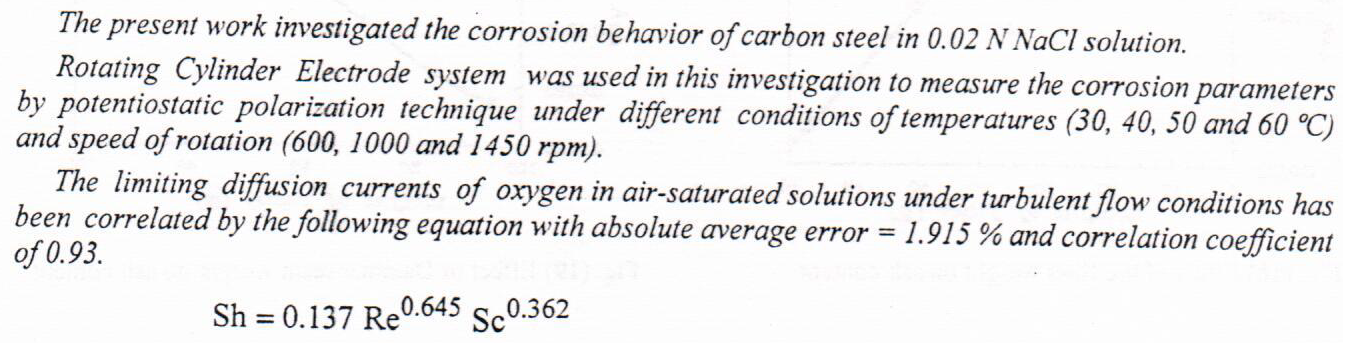

A potentiostatic study of the behaviour of Inconel (600) in molar sulphuric acid has been carried out over the temperature range 293-313 K. Values have been established for the potentials and current densities of the corrosion, active-passive transition, passivity and transpassive states. For corrosion, the current density (ic) and potential (Ec) have been determined from well-defined Tafel lines. The potential and current density prior to the commencement of passivity have been obtained corresponding respectively to the critical potential (Ecr( and to the current density (icr) for the active-passive transition state. The passive range was defined by the respective potentials and current densities for passive film formation and dissolutio
... Show More
The corrosion behavior of copper and carbon steel in 1M concentration of hydrochloric acid (HCl) and sulphuric acid (H2SO4) has been studied. The corrosion inhibition of copper and carbon steel in 1M concentration of hydrochloric acid (HCl) and sulphuric acid (H2SO4) by Ciprofloxacin has been investigated. Specimens were exposed in the acidic media for 7 hours and corrosion rates evaluated by using the weight loss method. The effect of temperature (from 283 ºK to 333 ºK), pH (from 1to 6), inhibitor concentration (10-4 to 10-2) has been studied. It was observed that sulphuric acid environment was most corrosive to the metals because of its oxidizing nature, followed by hydrochloric acid. The rate of metal dissolution increased with incre
... Show More (2)
(2)
Abstract
This paper is an experimental work to determinate the effect of welding velocity and formed arc energy for CO2-MAG fusion weld pool. The input parameters (arc voltage, wire feed speed and gas flow rate) were investigated to find their effects on the weld joint efficiency. Design of experiment with response surface methodology technique was used to build empirical mathematical models for welding velocity and arc energy in term of the input welding parameters. The predicted quadratic models were statistically checked for adequacy purpose by ANOVA analysis. Additionally, numerical optimization was conducted to obtain the optimum values for welding velocity and arc energy. A good agree
... Show More (16)
(21)
(16)
(21)


This study investigates the role of Enterprise Resources Planning (ERP) systems in improving human resources management (HRM) processes. The rapid environmental changes led to increased demand on the ERP systems, which have changed the manual effort to technology-based processes, providing solutions focusing on the integration of all departments to achieve goals for the entire organization. HRM processes are mainly made up of two classes: strategic and operational HRM. An ERP system works to integrate both of them, making HRM processes more efficient, effective and feasible to provide support to the organization as a whole (inside and outside). In this article, a modest framework is proposed to describe HRM process integrity in relation to
... Show More
(7)
The purpose of this paper is to understand the best processes that are currently used in managing talent in Australian higher education (HE) and to examine the policies in terms of talent management processes (TMPs) that are derived from objective one. Pragmatic benefits for academic institutions focused on enhancing talent.
This study selects the mixed method as its research design. In the qualitative study, there were three methods: brainstorming, focus group and individual interviews, followed by the quantitative questionnaire
(26)
(20)
Protection study of the corrosion behavior of Copper surface was conducted with several concentrations of drug. Experimentally, voltammetric measurements were used to check the inhibition eciency (% IE) in saline solution of 3.5% NaCl. The results showed an increase in the inhibition eciency with increasing the concentration of the drug was 95.90%. Theoretical treatment of the drug in the gas phase was performed using the (hyperchem-8.07) program for molecular mechanics and semi-empirical computations. The (PM3) approach was used to determine the heat of formation (1H°f), binding energy (1Eb), and total energ
(1)
Protection study of the corrosion behavior of Copper surface was conducted with several concentrations of drug. Experimentally, voltammetric measurements were used to check the inhibition efficiency (% IE) in saline solution of 3.5% NaCl. The results showed an increase in the inhibition efficiency with increasing the concentration of the drug was 95.90%. Theoretical treatment of the drug in the gas phase was performed using the (hyperchem-8.07) program for molecular mechanics and semi-empirical computations. The (PM3) approach was used to determine the heat of formation (1H˚f), binding energy (1Eb), and total energy (ET
(2)
The interaction of charged particles with the chemical elements involved in the synthesis of human tissues is one of the modern techniques in radiation therapy. One of these charged particles are alpha particles, where recent studies have confirmed their ability to generate radiation in a highly toxic localized manner because of its high ionization and short its range. In this work, We focused our study on the interaction of alpha particles with liquid water; since the water represents over 80% of the most-soft tissues, as well as, hydrogen, oxygen, and nitrogen ,because they are key chemical elements involved in the synthesis of most human tissues. The mass stopping powers of alpha particle with HଶO , COଶ, Oଶ, Hଶ and Nଶhave
... Show More