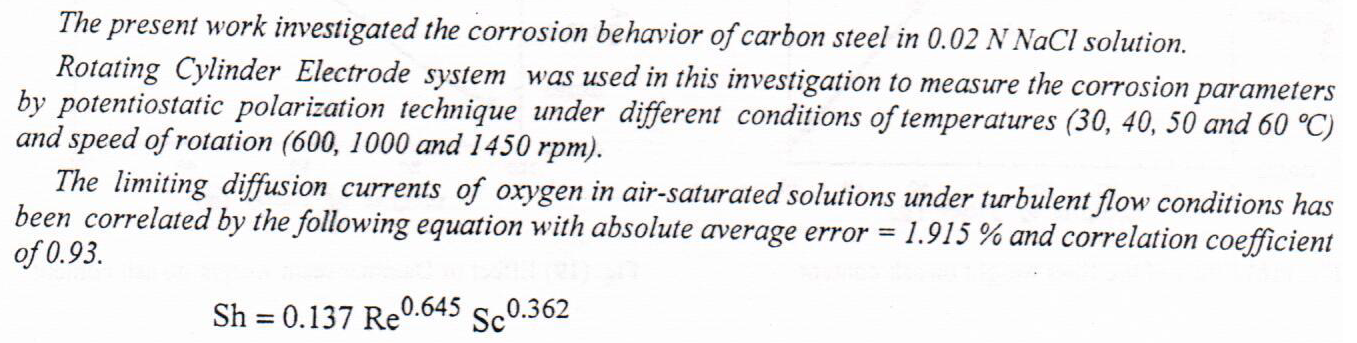
Effect of Velocity and Temperature on Mass Transfer of Oxygen in Corrosion Processes

This work is concerned with the study of the effect of cement types, particularly OPC and SRPC, which are the main cement types manufactured in Iraq. In addition, study the effect of mineral admixtures, which are HRM and SF on the resistance of high performance concrete (HPC) to internal sulphate attack. The HRM is used at (10%) and SF is used at (8 and 10)% as a partial replacement by weight of cement for both types. The percentages of sulphate investigated are (1,2 and 3)% by adding natural gypsum as a partial replacement by weight of fine aggregate. The tests carried out in this work are: compressive strength, flexural strength, ultrasonic pulse velocity, and density at the age of 7, 28, 90 and 120 days.
The r
... Show MoreEarth dams in regions with moderate to high seismic activity are crucial for protecting downstream communities. Iraq and its neighboring areas have seen recurrent seismic activity, notably the 2017 Halabja Earthquake, which potentially compromised the integrity of the existing earth dam. The Darbandikhan Dam, affected by an earthquake, has inadequacies in its crest and downstream slope, presenting a greater danger of significant earthquake-induced damage compared to cyclic shocks. Consequently, evaluating the dam's safety is essential for safeguarding downstream residents and identifying optimal ways to avert slope stability failure amid recurrent seismic activity. Iraq's seismicity map is being updated to reflect earthquake magni
... Show More

In this study, the effect of design parameters such as pipe diameter, pipe wall thickness, pipe material and the effect of fluid velocity on the natural frequency of fluid-structure interaction in straight pipe conveying fully developed turbulent flow were investigate numerically,analytically and experimentally. Also the effect of support conditions, simply-simply and clamped-clamped was investigated. Experimentally, pipe vibrations were characterized by accelerometer mounted on the pipe wall. The natural frequencies of vibration were analyzed by using Fast Fourier Transformer (FFT). Five test sections of two different pipe diameters of 76.2
mm and 50.8 mm with two pipe thicknesses of 3.7 mm and 2.4 mm and two pipe materials,stainles
 (4)
The present paper deals with studying the effect of electrical discharge machining (EDM) and shot blast peening parameters on work piece fatigue lives using copper and graphite electrodes. Response surface methodology (RSM) and the design of experiment (DOE) were used to plan and design the experimental work matrices for two EDM groups of experiments using kerosene dielectric alone, while the second was treated by the shot blast peening processes after EDM machining. To verify the experimental results, the analysis of variance (ANOVA) was used to predict the EDM models for high carbon high chromium AISI D2 die steel. The work piece fatigue lives in terms of safety factors after EDM models were developed by FEM using ANSY
... Show More
(2)
 (2)

In this investigation a high density polyethylene (HDPE) was used as a substitute to polyvinylchloride in the production of lead acid battery separators. This has been achieved by preparing mixtures of different percentages of the feed materials which include a high density polyethylene (HDPE) locally produced, filler materials such as silica and oils such as dioctylphthalate (DOP) or paraffin which were added to the mixture to improve the final properties of the separator. The materials were compounded by two roll-mills under the same conditions. The following parameters are involved: &nb
... Show MoreBackground: the aim of this study was to evaluate the effect of different surface acids treatments (37%phospjoric acid, 5%hydrofluoric acid, 1.23 acidulated phosphate fluoride) of feldspathic ceramic VITA 3D MASTER , and the effect of thermocycling on shear bond strength using a ceramic repair kit (ivoclar/vivadent). Material and Methods: sixty Nickel-Chromium metal base plates were prepared(9mm diameter,3mm depth) using lost wax technique, 2mm thick layer of ceramic(VITA 3D MASTER) fused to metal plates, all specimens were embedded in acrylic resin blocks except their examined surfaces and divided into 3 main groups 20 specimens each, Grp A: treatment with 37%phosphoric acid for 2 mins, Grp B: etching with 5% hydrofluoric acid for 2mins,
... Show MoreThe present work involves studying the effect of electrolyte composition [@1= 0.5 wt.% NH4F / 5% H2O / 5% Glycerol (GLY)/ 90% Ethylene Glycol (EG)] and [ @2= 0.5 wt. % NH4F / 5% H2O / 95% Ethylene Glycol (EG)] on the structural and photoelectrochemical properties of titania nanotubes arrays (TNTAs). TNTAs substrates were successfully carried out via anodization technique and were carried out in 40 V for one hour in different electrolytes (@1, and @2). The properties of physicochemical of TNTAs were distinguished via an X-ray Diffractometer (XRD), Field Emission Scanning Electron Microscope (FESEM), an Energy Dispersive X-ray (EDX), and UV–visible diffuse reflectance. The photoelectrochemical response of TNTAs was evaluated
... Show More
(19)
(12)
The present work involves studying the effect of electrolyte composition [@1= 0.5 wt.% NH4F / 5% H2O / 5% Glycerol (GLY)/ 90% Ethylene Glycol (EG)] and [ @2= 0.5 wt. % NH4F / 5% H2O / 95% Ethylene Glycol (EG)] on the structural and photoelectrochemical properties of titania nanotubes arrays (TNTAs). TNTAs substrates were successfully carried out via anodization technique and were carried out in 40 V for one hour in different electrolytes (@1, and @2). The properties of physicochemical of TNTAs were distinguished via an X-ray Diffractometer (XRD), Field Emission Scanning Electron Microscope (FESEM), an Energy Dispersive X-ray (EDX), and UV–visible diffuse reflectance. T
... Show More
(19)
(12)