Effect of Velocity and Temperature on Mass Transfer of Oxygen in Corrosion Processes
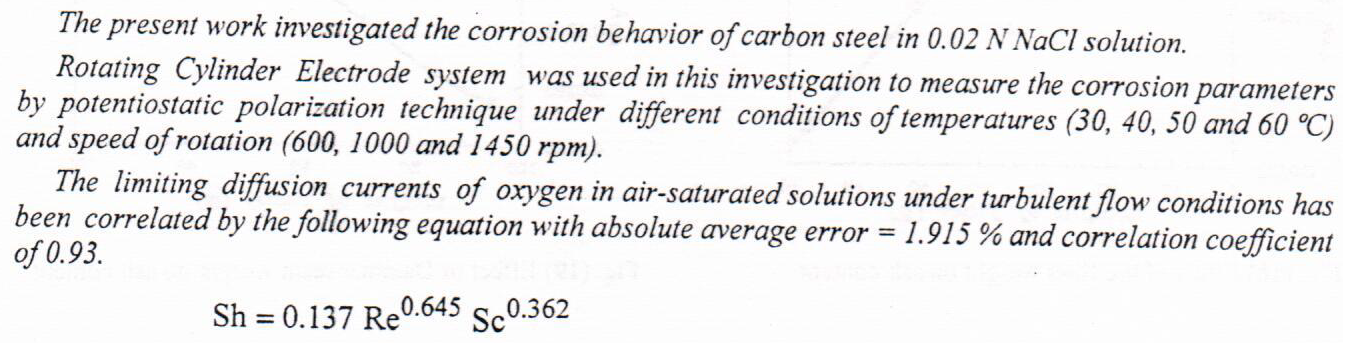

 (6)
(6)

The inhibitive action of Reactive Red (RR31) dye against corrosion of carbon steel in 1M acetic acid solution has been studied using gravimetric method at temperature ranged (288-318)K. The antibacterial activity for the different concentrations of RR31 dye against different bacterial species was studied. The experimental data indicates that this dye acts as a potential inhibitor for carbon-steel in acetic acid medium and the protection efficiency increase with increasing (RR31) dye. The adsorption of (RR31) dye on the carbon steel surface was found to follow Langmuir adsorption isotherm. Thermodynamic data for the adsorption process such as Gibbs free energy change ∆Gads, enthalpy change ∆Hads, and entropy change ∆Sads were estima
... Show MoreIntroduction and Aim: Cancers are a complex group of genetic illnesses that develop through multistep, mutagenic processes which can invade or spread throughout the body. Recent advances in cancer treatment involve oncolytic viruses to infect and destroy cancer cells. The Newcastle disease virus (NDV), an oncolytic virus has shown to have anti-cancer effects either directly by lysing cancer cells or indirectly by activating the immune system. The green fluorescent protein (GFP) has been widely used in studying the anti-tumor activity of oncolytic viruses. This study aimed to study the anticancer effect of a recombinant rNDV-GFP clone on NCI-H727 lung carcinoma cell line in vitro. Materials and Methods: The GFP gene was inserted t
... Show More
(26)
 (3)
(3)

Introduction and Aim: Cancers are a complex group of genetic illnesses that develop through multistep, mutagenic processes which can invade or spread throughout the body. Recent advances in cancer treatment involve oncolytic viruses to infect and destroy cancer cells. The Newcastle disease virus (NDV), an oncolytic virus has shown to have anti-cancer effects either directly by lysing cancer cells or indirectly by activating the immune system. The green fluorescent protein (GFP) has been widely used in studying the anti-tumor activity of oncolytic viruses. This study aimed to study the anticancer effect of a recombinant rNDV-GFP clone on NCI-H727 lung carcinoma cell line in vitro. Materials and Methods: The GFP gene was inserted t
... Show More
(26)
(3)
One of the unique properties of laser heating applications is its powerful ability for precise pouring of energy on the needed regions in heat treatment applications. The rapid rise in temperature at the irradiated region produces a high temperature gradient, which contributes in phase metallurgical changes, inside the volume of the irradiated material. This article presents a comprehensive numerical work for a model based on experimentally laser heated AISI 1110 steel samples. The numerical investigation is based on the finite element method (FEM) taking in consideration the temperature dependent material properties to predict the temperature distribution within the irradiated material volume. The finite element analysis (FEA) was carried
... Show More
(2)
This study describe the effect of temperature on the optical
properties of nickel(ii) phthalocyanine tetrasulfonic acid tetrasodium
salt (NiPcTs) organic thin films which are prepared by spin coating
on indium tin oxide (ITO-glass). The optical absorption spectra of
these thin films are measured. Present studies reveal that the optical
band gap energies of NiPcTs thin films are dependent on the
annealing temperatures. The optical band gap decreases with increase
in annealing temperature, then increased when the temperature rising
to 473K. To enhance the results of Uv-Vis measurements and get
more accurate values of optical energy gaps; the Photoluminescence
spectra of as-deposited and annealed NiPcTs thin fi
(1)
A new benzylidene derivative, namely N-benzylidene-5-phenyl-1,3,4-thiadiazol-2-amine (BPTA), has been synthesized and instrumentally confirmed with Elemental Analysis (CHN), Nuclear Magnetic Resonance (NMR), and Fourier Transform Infrared Spectroscopy (FT-IR). Titanium Dioxide (TiO2) nanoparticles (NPs) were synthesized and characterized by X-ray. The mutualistic complementary dependence of BPTA with TiO2 nanoparticles as anti-corrosive inhibitor on mild steel (MS) in 1.0 M hydrochloric acid has been tested at various concentrations and various temperatures. The methodological work was achieved by gravimetric measurement methods complemented with surface analysis. The synthesized inhibitor concentrations were 0.1 mM to 0.5 mM and the temper
... Show More
(80)