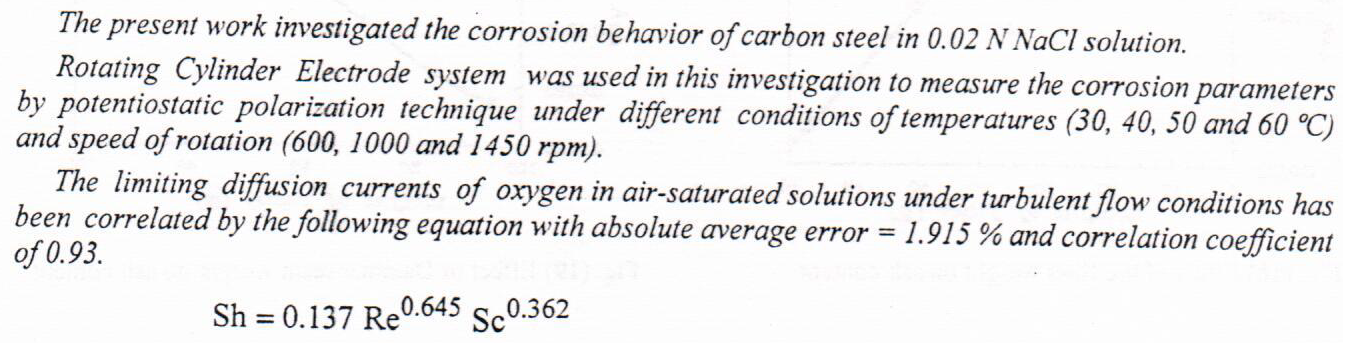
Effect of Velocity and Temperature on Mass Transfer of Oxygen in Corrosion Processes

An investigation was conducted for the improvement of viscosity index of light lubricating oil fraction (40 stock)
obtained from vacuum distillation unit of lube oil plant of Daura Refinery, using solvent extraction process.
In this study furfural solvent was used to extract the undesirable materials which reduce the viscosity index of raw
lubricating oil fraction.
The studied effecting variables of extraction were extraction temperature range from 70 to 110°C, and solvent to oil
ratio range from 1:1 to 4:1 (wt/wt).
The n-d-M method was used for calculation of carbon distribution and structural group analysis of the raffinate
produced from furfural extraction.
Also the three component phase diagram for a mixed-ba
In the present work, nanocomposite of poly (vinyl alcohol) (PVA) incorporated with functionalized graphene oxide (FGO) were fabricated using casting method. PVA was dispersed by varying content of FGO (0.3, 0.5, 0.8, 1 wt %). The PVA- FGO nanocomposite was characterized by FT‐IR, FE-SEM and XRD. Frequency dependence of real permittivity (ε’), imaginary (ε’’) and a.c conductivity of PVA/FGO and PVA/GO nanocomposite were studied in the frequency range 100 Hz- 1 MHz. The experimental results showed that the values of real (ε’) and imaginary permittivity (ε’’) increased dramatically by increasing the FGO content in PVA matrix. PVA/ FGO (1 wt %) nanocomposite revealed higher electrical conductivity of 6.4×10⁻⁴ Sm-1 compared to
... Show MoreBackground: Dental stone casts come into contact with impression materials and becomes susceptible to cross contamination from saliva and blood. This study was done to evaluate the physical and mechanical properties of dental stone type IV after treatments with various disinfecting agents and regimes (methods). Materials and Methods: Type IV dental stone and different types of disinfecting agents were used and divided into seven groups: G1: dental stone without disinfection (control group), G2: dental stone mixed with silver nitrate powder 0.5% , G3: dental stone mixed with silver nitrate powder 1%, G4: dental stone mixed with copper sulfate powder 0.5%, G5: dental stone mixed with copper sulfate powder 1% ,G6: dental stone immersed in prop
... Show More (2)
(2)
 (1)
(1)


In the present research, the electrical properties which included the ac-conductivity (σac), loss tangent of dielectric (tan δ) and real dielectric constant (ε’) are studied for nano polycarbonate in different pressures and frequencies as a function of temperature these properties were studied at selective temperature gradients which are (RT-50-100-150-250)°C. The results of the study showed that the values of dielectric constant and dissipation factor increase with increasing pressure and temperature and decreases by increasing frequency. And the results of electrical conductivity showed that it increases with increasing temperature, pressure and frequency.
Epoxy (EP) – Silica (SiO2) composites are well known composites used in microelectronic industry . So it is important to study their dielectric behavior under different conditions such as
the presence carbon black (UV absorber) and immersion in the water for 30 days .
Dielectric properties were calculated over the frequency range 102 – 106 Hz for epoxy composites with different weight % of micrometer 1.5μm SiO2 particles (60%, 65% and 70wt%) modified with 0.5wt% silane coupling agent to improve adhesion between EP and SiO2 phases .
In this study, Laser Shock Peening (LSP) effect on the polymeric composite materials has been investigated experimentally. Polymeric composite materials are widely used because they are easy to fabricate and have many attractive features. Unsaturated polyester resin as a matrix was selected and Aluminum powder with micro particles as a reinforcement material was used with different volume fraction (2.5%, 5% and 7.5%). Hand lay-up process was used for preparation the composites. Fatigue test with constant amplitude with stress ratio (R =-1) was carried out before and after LSP process with two levels of energy (1Joule and 2Joule). The result showed an increase in the endurance strength of 25.448% at 7.5% volume fraction when peened is 1J
... Show More
Dental clinicians and professionals need an affordable, nontoxic, and effective disinfectant against infectious microorganisms when dealing with the contaminated dental impressions. This study evaluated the efficiency of hypochlorous acid (HOCl) as an antimicrobial disinfectant by spraying technique for the alginate impression materials, compared with sodium hypochlorite, and its effect on dimensional stability and reproduction of details. HOCl with a concentration of 200 ppm for 5 and 10 min was compared with the control group (no treatment) as a negative control and with sodium hypochlorite (% 0.5) as a positive control. Candida albicans, Staphylococcus aureus, and Pseudomonas aeruginosa were selected to assess the antimicrobi
... Show More
(13)
(8)

The present study aimed to explain the dose-dependent possible deleterious effects of 30 day administration of Tramadol on some hematological and biochemical parameters of laboratory male rats (Rattus norvegicus), the study consisted of eighteen adult male rats randomly divided into three equal groups (each of six). Group 1 (control) were treated by intraperitoneal injection of normal saline solution (0.2 ml), group two (low dose) was treated by intraperitonealy (i.p) injection of Tramadol at a dose of 50 mg/kg/day, group three (high dose) was treated by intraperitonealy injection of Tramadol at a dose of 100 mg/kg/day for 30 days. At the end of experimental period, rats were sacrificed. Blood were collected by cardiac puncture to inv
... Show More
(4)