Effect of Velocity and Temperature on Mass Transfer of Oxygen in Corrosion Processes
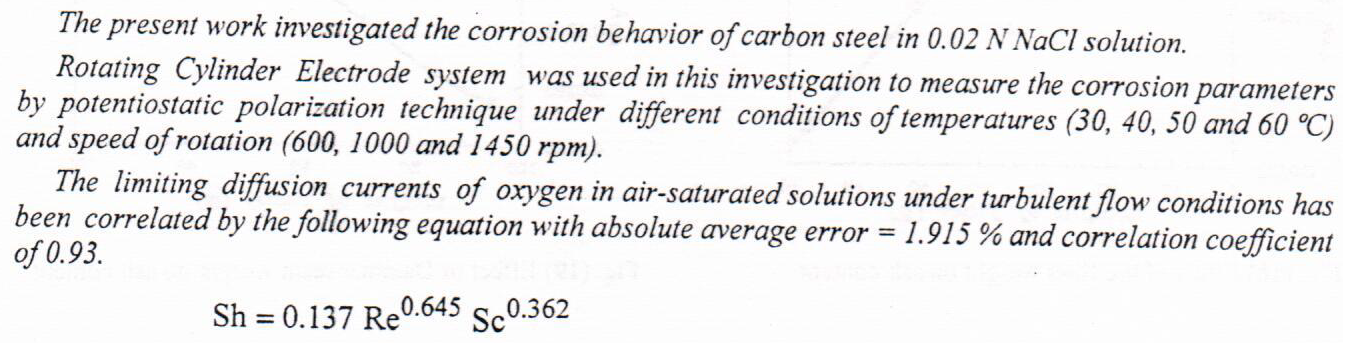

 (10)
(10)
 (10)
(10)



The experiment was carried out in College of Agricultural Engineering Sciences, University of Baghdad during November 1, 2019 to June 1, 2020. The experiment was designed according to a randomized complete block design. Each block contained 18 experimental units that included the three study factors. The first factor interaction between two inoculum densities and application methods, three levels control, treatment of seeds inoculation with 5g plant and treatment of seedlings inoculation whith 30g plant . The second factor was three -1 -1concentrations of spraying of kinetin 0, 75 and 150 mg L , and third factor include two levels of organic manure) and addition of fertilizer 2% of -1 the weight of the soil (O2). The results showed a signif
... Show MoreThis study has aimed to investigate the effect of feed forms, mash and pellet on productive performance and carcass yields of broilers. 225 unsexed birds of the hybrid Ross 308 broiler were used, with a starting weight of 45.4 g one day old. The experiment lasted up to 35 days. The birds were randomly distributed into five treatments; each treatment contained 45 chicks according to three replicates (15 birds/ replicate). The experiment’s treatments included: (T1) Control mash 100% (pellet 0%), (T2) mash 75% (pellet 25%), (T3) mash 50% (pellet 50%), (T4) mash 25% (pellet 75%) and (T5) mash 0% (pellet 100%). Results were recorded a significant superior of T4 compared with other treatments (P≤0.05) in live body weight, weight gain,
... Show More
(3)
(2)
The creation and characterisation of biodegradable blend films based on chitosan and polyvinyl alcohol for application in a range of packaging is described. The compatibility between the chitosan and PVA polymers was good. Composite films had a compact and homogeneous structure, according to the morphology analysis. The mechanical test result of PVA/CH at concentrations 5% showed, that The higher values of TS recorded in sample (p1, with 40 MPa) while the lower values appeared in sample (p9, with 22.09 MPa), the TS decreased gradually as the amount of PVA increased in blend film. While the blend film of pure Chitosan exhibits a poor mechanical strength which makes it a poor candidate for packaging but Blending CH with PVA together improved
... Show More
(1)
Pulsed-laser deposition (PLD) technique was used to prepare thin films from cerium oxide (CeO2) doped with erbium and indium oxides. In order to characterize the morphology and sensing features, these films were deposited on glass and/or single silicon substrates, respectively, with erbium and indium oxides. The morphological investigation conducted using atomic force microscope has shown an increase in the non-regularity of particle diameter with increasing doping ratios of both oxides. The maximum particle diameter of 61.45nm was obtained for 9% Eu2O3-doped CeO2. The surface roughness value of Eu2O3-doped ceria was higher than those of In2O3-doped ceria. The gas sensing measurements were done at
... Show MoreCadmium sulfide (CdS) thin films with n-type semiconductor characteristics were prepared by flash evaporating method on glass substrates. Some films were annealed at 250 oC for 1hr in air. The thicknesses of the films was estimated to be 0.5µ by the spectrometer measurement. Structural, morphological, electrical, optical and photoconductivity properties of CdS films have been investigated by X-ray diffraction, AFM, the Hall effect, optical transmittance spectra and photoconductivity analysis, respectively. X-ray diffraction (XRD) pattern shows that CdS films are in the stable hexagonal crystalline structure. Using Debye Scherrerś formula, the average grain size for the samples was found to be 26 nm. The transmittance of the
... Show More
Copper oxide nanoparticles (CuO NPs) were synthesized by two methods. The first was chemical method by using copper nitrate Cu (NO3)2 and NaOH, while the second was green method by using Eucalyptus camaldulensis leaves extract and Cu (NO3)2. These methods easily give a large scale production of CuO nanoparticles. X-ray diffraction pattern (XRD) reveals single phase monoclinic structure. The average crystalline size of CuO NPs was measured and used by Scherrer equation which found 44.06nm from chemical method, while the average crystalline size was found from green method was 27.2nm. The morphology analysis using atomic force microscopy showed that the grain size for CuO NPs was synthesized by chemical and green methods were 77.70 an
... Show More
(45)
(34)
Copper oxide nanoparticles (CuO NPs) were synthesized by two methods. The first was chemical method by using copper nitrate Cu (NO3)2 and NaOH, while the second was green method by using Eucalyptus camaldulensis leaves extract and Cu (NO3)2. These methods easily give a large scale production of CuO nanoparticles. X-ray diffraction pattern (XRD) reveals single phase monoclinic structure. The average crystalline size of CuO NPs was measured and used by Scherrer equation which found 44.06nm from chemical method, while the average crystalline size was found from green method was 27.2nm. The morphology analysis using atomic force microscopy showed that the grain size for CuO NPs was synthesized by chemical and green methods were 77.70 and 89.24
... Show More
(45)
(34)
This in vivo study was conducted to investigate the effect of different concentrations of ozonated water on experimentally skin infection with some of bacterial isolates (Pseudomonas aeruginosa and Staphylococcus aureus ) which Showed dermal infection in experimental animals after 48 hours of exposure to these Microorganisms. Results revealed that ozone has the power to accelerated the healing process depending on the perfect concentration of ozonated water used and the severity of infection & nature of causative agent , in which the recovering period was 7 days for the infection caused by P. aeruginosa and 5 day for S.aureus by using the concentration 60 µg/ml . Results also indicated in this study the stimulated effect of O
... Show More
Epilepsy is the most common neurological disorder after Alzheimer and other cerebrovascular diseases. Antiepileptic drugs (AED's) are one of the most important methods to prevent epileptic seizers. Antiepileptic drugs can cause damage to the liver which is the largest and most important glandular organ in the body with many other drugs. Carbamazepine (CBZ) is a known anticonvulsant that is widely used and known for a decade, it was used to treat trigeminal neuralgia, bipolar disorder and epilepsy and it can cause hepatotoxicity. In this study female white mice received CBZ suspension at a dose of 20 mg/kg/mouse via gastric gavage for 30 days, tissue samples were collected for scanning electron microscopy. We observed the adverse effects of
... Show More