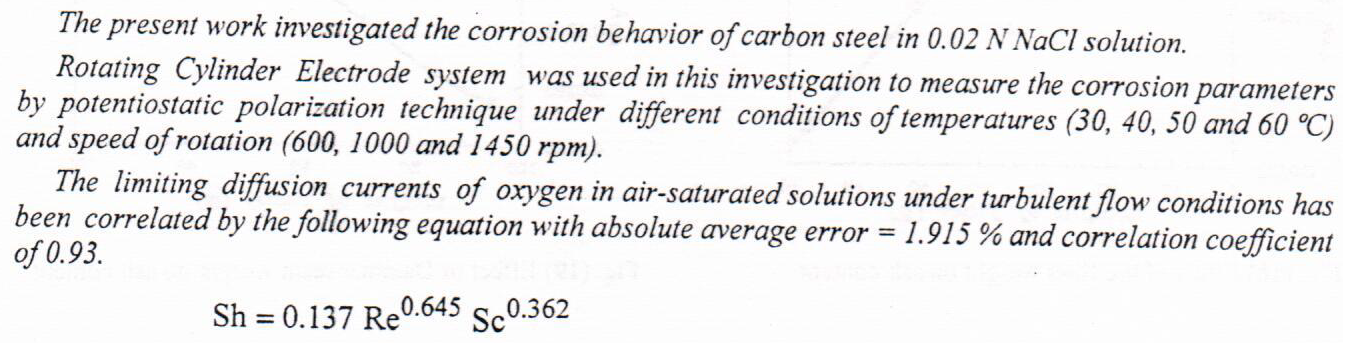
Effect of Velocity and Temperature on Mass Transfer of Oxygen in Corrosion Processes

In this paper, the Magnetohydrodynamic (MHD) for Williamson fluid with varying temperature and concentration in an inclined channel with variable viscosity has been examined. The perturbation technique in terms of the Weissenberg number to obtain explicit forms for the velocity field has been used. All the solutions of physical parameters of the Darcy parameter , Reynolds number , Peclet number and Magnetic parameter are discussed under the different values as shown in plots.
 (8)
(8)
 (2)
(2)



The present work presents a new experimental study of the enhancement of turbulent
convection heat transfer inside tubes for combined thermal and hydrodynamic entry length of one
popular “turbulator” (twisted tape with width slightly less than internal tube diameter) inserted for
fire tube boilers. Cylindrical combustion chamber was used to burn (1.6 to 7kg/h) fuel oil #2 to
deliver hot gases with ranges of Reynolds number (10500 to 21700), and (11400 to 24150) for both
empty and inserted tube respectively.A uniform wall temperature technique was used by keeping
approximately constant water temperature difference (25ºC) between inlet and exit cooling water in
parallel flow shell and tube heat exchanger. The test
(1)
The study aimed to investigate the effect of different times as follows 0.5, 1.00, 2.00 and 3.00 hrs, type of solvent (acetone, methanol and ethanol) and temperature (~ 25 and 50)ºc on curcumin percentage yield from turmeric rhizomes. The results showed significant differences (p? 0.05) in all variables. The curcumin content which were determined spectrophotometrically ranged between (0.55-2.90) %. The maximum yield was obtained when temperature, time and solvent were 50ºC, 3 hrs and acetone, respectively.
Background: Vibration decreases the viscosity of composite, making it flow and readily fit the walls of the cavity. This study is initiated to see how this improved adaptation of the composite resin to the cavity walls will affect microleakage using different curing modes
Materials and methods: Standard Class V cavities were prepared on the buccal surface of sixty extracted premolars. Teeth were randomly assigned into two groups (n=30) according to the composite condensation (vibration and conventional) technique, then subdivided into three subgroups (n=10) according to light curing modes (LED-Ramp, LED-Fast and Halogen Continuous modes). Cavities were etched and bonded with Single Bond Universal
... Show More
(1)
(2)
The increasing use of plastics in various aspects of modern life resulted in the availability of enormous amount of wastes, including a negative effect on the environment and humans. So it is necessary to find solutions to deal with these wastes and ensure to use them as solutions to use in concrete mix . In this research the production of concrete containing high and low density polyethylene has been used by (5, 10, 15)% as a replacement of part of the volume of sand, so as to obtain concrete good compressive strength as well as other benefits such as improved possibility of pumping concrete and reduce the loss of concrete for workability polymer is a material that is non-absorbable of water . It is also intended to dispose of these was
... Show More
An experiment was carried out on the fields of the college of Agriculture - Abu Ghraib, of a silty clay loam soil that has moisture of 15-16%, to study the effect of plowing and pulverization systems on some plant indicators of onion. The experiment included plowing systems with three levels (plowing with a moldboard plow, plowing by chisel plow and zero tillage plowing) as a primary factor. The second factor was that pulverization for only one time and repeating the pulverization twice through the use of the rotary tiller. The plant indicators of onion that are studied: plant length, onion diameter, onion weight and onion neck diameter. The experiment has carried out according to SPLIT PLOT design according to RCBD design by three replicat
... Show MoreThe nanocomposite on the base of synthesis Copper iodide
nanoparticles and polyvinyl alcohol (PVA/CuI) with different
concentration of CuI were obtained using casting technique.
PVA/CuI polymer composite samples have been prepared and
subjected to characterizations using FTIR spectroscopy, The FTIR
spectral analysis shows remarkable variation of the absorption peak
positions with increasing CuI concentration. The obtained results by
X-ray diffraction indicated the formation of cubic CuI particles. The
effects of CuI concentrations on the optical properties of the PVA
films were studied in the region of wavelength, (190-1100) nm.
From the derivation of Tauc's relation it was found that the direct
allowed t
(1)
Bulk polycrystalline samples have been prepared by the two-step solid state reaction process. It has been observed that as grown Tl2-xHgxSr2Ca2Cu3O10+δ (with x = 0, 0.1, 0.2, 0.3, 0.4, 0.5, 0.6, 0.8, 1) corresponds to the 2223 phase. It has been found that Tc varies with Hg content .The optimum Tc is about 120K for the composition Tl1.6Hg0.4Sr2Ca2Cu3O10+δ.The microstructure for Tl1.6Hg0.4Sr2Ca2Cu3O10+δ observed to be most dense and this phase exhibits the highest stability.
This study has been conducted to examin the effect of potassium sorbate at different level of 0.03,0.06,0.10% on the number of bacteria and mold and to extend the storage life of laboratory processed biscuit. The results indicated that the use of 0.03% potassium sorbate prolonged the storage peroid until the third month .three types of bacteria has been isolated from processed biscuit, namely, Staphylococcus aureus, Bacillus cereus, Esherichia coli using 0.06% potassium sorbate showed no growth of bacteria up to six month of storage ,while using of 0.03% and 0.06% potassium sorbate prevent the growth of mold up to three and six months of storage respectively. Both Aspergillus and Penicillium were isolated from the processed biscuit.
In this work, magnesium aluminate spinel (MA) (MgO 28 wt%, Al2O3 72 wt%) stoichiometric compound , were synthesized via solid state reaction (SSR) Single firing stage, and the impact of sintering on the physical properties and thermal properties as well as the fine structure and morphology of the ceramic product were examined. The Spinel samples were pressed at of (14 MPa) and sintering soaking time (2h). The effect of adding oxide titania (TiO2) was studied. The obtained powders were calcined at a temperature range of 1200 and 1400 °C. The calcined samples spinel were characterized by XRD, it showed the presence of developed spinel phase end also showed that the best catalyst is titania. The SEM image showed the high sintering temperat
... Show More