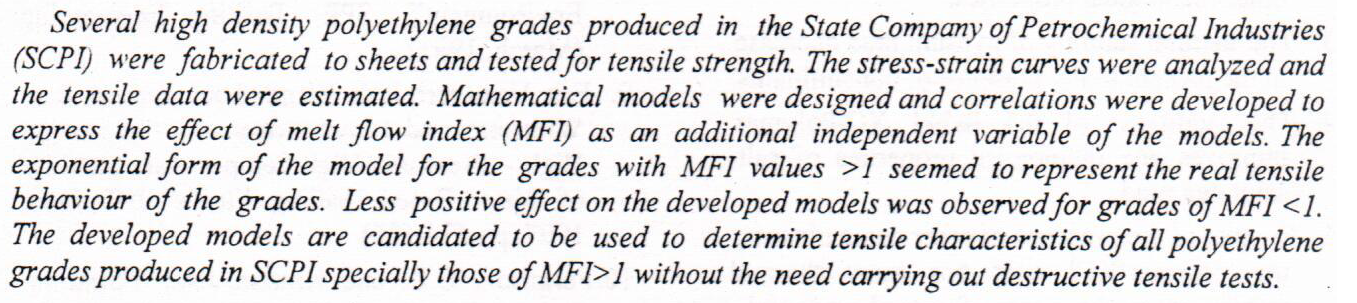
The Effect of MFI of High-Density Polyethylene on the Mathematical Modeling of Tensile Characteristic

The poor hole cleaning efficiency could causes many problems such as high torque, drag, poor hydraulics and pipe stuck. These inherent problems result in an avoidable high operation cost which this study tried to address. In this study, the effect of cutting density on hole cleaning efficiency in deviated and horizontal wells was investigated. Experiments were conducted using 40 feet (12 m) long of flow loop made from iron and PVC. However, the test section was made from PVC with (5.1m) long and (4” ID) for outer pipe and (2” OD) inner pipe. The cutting transport ratio (CTR) was determined from weight measurements for each test. Cutting Transport Ratio has been investigated for effects of the following parameters; flow rate, cu
... Show More (5)
(5)

 (1)
(1)

Background: Poly (methyl methacrylate) has been widely utilized for fabrication of dentures for many years as it has good advantages but not achieved all demands of the mechanical properties such as low transverse strength, low impact strength, low surface hardness, high water solubility and high water sorption. Material and method: To provide bonding between ZrO2 nanoparticles and PMMA matrix, the ZrO2 Nano-fillers were surface-treated with a saline coupling agent. Plasma surface treatment of polyethylene (PE) fiber was done to change surface fiber by using DC- glow discharge system. For characterization of interring any functional groups, the (FTIR) spectrum were done .then the mechanical properties studied to choose the appropriate perc
... Show More
In this paper, there are two main objectives. The first objective is to study the relationship between the density property and some modules in detail, for instance; semisimple and divisible modules. The Addition complement has a good relationship with the density property of the modules as this importance is highlighted by any submodule N of M has an addition complement with Rad(M)=0. The second objective is to clarify the relationship between the density property and the essential submodules with some examples. As an example of this relationship, we studied the torsion-free module and its relationship with the essential submodules in module M.
Background: Recently, Poly propylene fibers with and without plasma treatment have been used to reinforce heat cure denture base acrylic but, so far some of properties like tensile strength , wettability and wear resistance not evaluated yet, the aim of the study is to clarify the influence of incorporation of treated and untreated fibers on these properties. Materials and methods: Twenty one specimens were fabricated for every tested property(tensile strength, wear resistance and wettability) that classified into three groups(control, untreated poly propylene fibers reinforced specimens and Oxygen plasma treated group)and for each test sevens amples were used(n=7). Tensile strength was tested using Instron universal testing machine, wear
... Show MoreAbstract
This research aims to study the reflection of accounting for contingent assets and liabilities and provisions on Faithful Representation characteristic of accounting information, To achieve this goal has been questionnaire design has been distributed to research sample, which consists of (50) li
... Show More
(1)
(1)
Attention has recently been given to finding alternative and sustainable raw material sources for wood and metal adhesives, such as polyvinyl alcohol (PVA), corn starch (CS), arabic gum (AG), and dextrins (D). Modifying polymer dispersion using unique substances, such as modifying reactive elastomer liquid (EL) using PVA, CS, AG, or D results in sufficiently moisture-resistant adhesive joins. In the present study, the physical characteristics of EL/blended with the natural polymers PVA, CS, AG, and D, based on high-density fiberboard (HDF) wood and aluminum (Al) adhesives and coatings, were investigated and compared to those of pure EL. The EL was blended with PVA, CS, AG, or D at a ratio of 60/40 (w/w) to form EL/blends. The che
... Show More
(1)
The current research aims to analyze the mathematics book for the first intermediate grade according to the dimensions of mathematical power by answering the following question: What is the percentage of the availability of the dimensions of mathematical power included in the content of the mathematics textbook for first-grade students, average, in its first, and second parts for the academic year 2020-2021, approved by the Iraqi Ministry of Education / General Directorate of Curricula? The research community was determined by middle school mathematics books, and middle school students for middle ,and high school day schools affiliated to the Directorate of Education in Dhi Qar, and by the intentional test, the research sample was s
... Show More