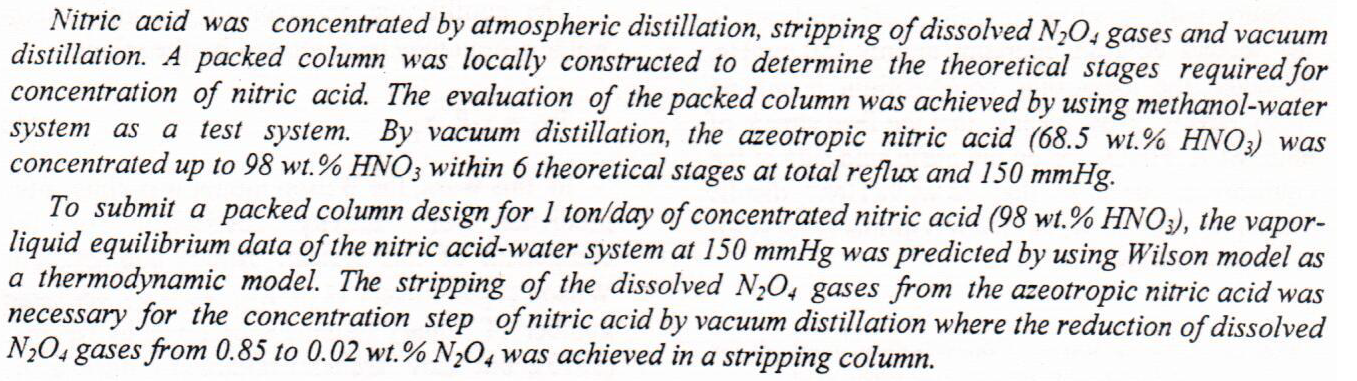
Concentration of Nitric Acid by Vacuum Distillation

Gypseous soil is a collapsible soil, which causes large deformations in buildings that are constructed on it. Various methods have been used to minimise this effect, such as replacing the gypseous soil or using soil stabilisation (grouting or soil improvement). This study was carried out on four types of gypseous soils that have different properties and various gypsum contents. The testing was carried out on remoulded samples to evaluate the compressibility of gypseous soil under different conditions. The samples were grouted with acrylate liquid. The relationships between the injection pressure and the radius of flow, between time of injection and radius of flow, and between time and quantity of acrylate liquid are investigated on
... Show More (21)
(21)

This study on the plant of Ain –AL Bason Catharanthus roseous showed the ability of callus cells that is produced by In Vitro culture technique and transformed to the accumulated media (MS 40gm/L sucrose ,2gm/L IAA Indole acetic acid , 0.5gm/L Tryptophan) to produce Vinblastine and Vincristine compounds. Extraction, purification and quantitive determination of Vinblastine and Vincristine compounds using High performance liquid chromatography technique (HPLC)were carried out. The results showed that the highest concentration of Vinblastine and Vincristine compounds were ( 4.653,12.5 (ppm /0.5 dry Wight respectively from transformed callus cells from MS 40 gm /L sucrose , 2 gm / L NAA Naphthaline acetic acid .
الوصف A simple chemistry method approach was used to synthesise new ligand derivate from L-ascorbic acid and its complexes. All of them were water-soluble and are used quite extensively in the medical and pharmaceutical fields. This study synthesised the new ligand derivative from L-ascorbic acid-base using the following steps: A 5, 6-O-isopropylidene-L-ascorbic acid was prepared by reacting dry acetone with L-ascorbic acid followed by reacting it with trichloroacetic acid to yield [chloro (carboxylic) methylidene]-5, 6-O-isopropylidene-L-ascorbic acid in the second stage. In the third stage, the derivative was reacted with (methyl (6-methyl-2-pyridylmethyl) amine to create a new ligand (ONMILA). This novel ligand was identified using
... Show MoreKE Sharquie, AA Noaimi, AM Oweid, JSSDDS, 2009 - Cited by 2
The adsorption behavior of Bismarck brown (BB) dye from aqueous solutions onto graphene oxide GO and graphene oxide-g-poly (n-butyl methacrylate-co-methacrylic acid) GO-g-pBCM as adsorbents was investigated. The prepared GO and GO-g-pBCM were characterized by Fourier transform infrared spectroscopy FTIR, which confirmed the compositions of the prepared adsorbents. Adsorption of BB dye onto GO and GO-g-pBCM was explored in a series of batch experiments under various conditions. The data were examined utilizing Langmuir and Freundlich isotherms. The Langmuir isotherm was seen as increasingly reasonable from the experimental information of dye on formulating adsorbents. Kinetic investigations showed that the experimental data were fitted ve
... Show More (16)
(5)
(16)
(5)


The ligand [Potassium (E)-(4-(((2-((1-(3-aminophenyl) ethylidene) amino)-4-oxo-1,4- dihydropteridin-6-yl) methyl) amino)benzoyl)-L-glutamate] was prepared from the condensation reaction of folic acid with (3-aminoacetophenone) through Schiff reaction to give a new Schiff base ligand [H2L]. The ligand [H2L] was characterized by elemental analysis CHN, atomic absorption (A.A), (FT-I.R.), (U.V.-Vis), TLC, E.S. mass (for spectroscopes), molar conductance, and melting point. The new Schiff base ligand [H2L], reacts with Mn(II), Co(II), Ni(II), Cu(II), Cr(III) and Cd(II) metal ions and (2-aminophenol), (metal : derivative ligand : 2-aminophenol) to give a series of new mixed complexes in the general formula:- K3[M2(HL)(HA)2], (where M=Mn(II) and
... Show MoreA new series of chalcone derivatives featuring an oxadiazole-quinoline moiety were successfully synthesized through a multi-step reaction sequence, commencing with quinoline-2-carboxylic acid as the starting material. First, the carboxylic group was chlorinated to form an acid chloride, following reacted with hydrazine hydrate. The resulting product underwent cyclization with carbon disulfide in an alkaline solution to produce 5-(quinolin-2-yl)-1,3,4-oxadiazole-2-thiol, followed by alkylation using chloroacetone. In the final step, an aldol condensation reaction was carried out by grinding the acetone derivative with various aromatic aldehydes, yielding the desired chalcones. The synthesized compounds were characterized by Rf, FTIR,
... Show More
A simple chemistry method approach was used to synthesise new ligand derivate from L-ascorbic acid and its complexes. All of them were water-soluble and are used quite extensively in the medical and pharmaceutical fields. This study synthesised the new ligand derivative from L-ascorbic acid-base using the following steps: A 5,6-O-isopropylidene-L-ascorbic acid was prepared by reacting dry acetone with L-ascorbic acid followed by reacting it with trichloroacetic acid to yield [chloro(carboxylic)methylidene]-5,6-O-isopropylidene-L-ascorbic acid in the second stage. In the third stage, the derivative was reacted with (methyl(6-methyl-2-pyridylmethyl)amine to create a new ligand (ONMILA). This novel ligand was identified using a number
... Show More
(6)
(1)
A procedure, depending on the derivatization and determination of aniline was depicted andvalidated in this study. 8-hydroxyquinoline (8-HQ) was used as the derivatizing agent for thedetermination of aniline. An optimization study was performed for the derivatization reaction, i.e.,the diazonium coupling reaction, the optimum parameters were as follows: 22 mM of hydrochloricacid, 54mM of sodium hydroxide, and 1.8mM of sodium nitrate. The optimization study of themethod of cloud point extraction (CPE) revealed that the extraction solvent was 0.5 ml of Triton X-100, the optimum temperature was 90 °C, and the incubation time was 25 min. The linearity,correlation coefficients, molar absorptivities, and limits of detection were improved using t
... Show More