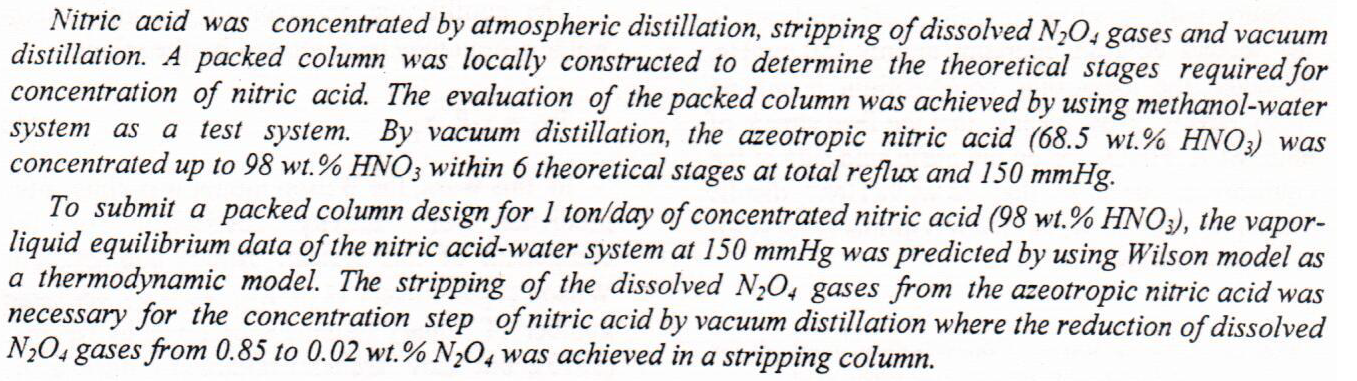
Concentration of Nitric Acid by Vacuum Distillation

This work was conducted to study the extraction of eucalyptus oil from natural plants (Eucalyptus camaldulensis leaves) using water distillation method by Clevenger apparatus. The effects of main operating parameters were studied: time to reach equilibrium, temperature (70 to100°C), solvent to solid ratio (4:1 to 8:1 (v/w)), agitation speed (0 to 900 rpm), and particle size (0.5 to 2.5 cm) of the fresh leaves, to find the best processing conditions for achieving maximum oil yield. The results showed that the agitation speed of 900 rpm, temperature 100° C, with solvent to solid ratio 5:1 (v/w) of particle size 0.5 cm for 160 minute give the highest percentage of oil (46.25 wt.%). The extracted oil was examined by HPLC.
This research presents a new study in reactive distillation by adopting a consecutive reaction . The adopted consecutive reaction was the saponification reaction of diethyl adipate with NaOH solution. The saponification reaction occurs in two steps. The distillation process had the role of withdrawing the intermediate product i.e. monoethyl adipate from the reacting mixture before the second conversion to disodium adipate occurred. It was found that monoethyl adipate appeared successfully in the distillate liquid. The percentage conversion from di-ester to monoester was greatly enhanced (reaching 86%) relative to only 15.3% for the case of reaction without distillation .This means 5 times enhancement . The presence of two layers in both
... Show More (1)
(1)

This study was conducted according to contract with the North Refineries Company-Baiji and deals with the hydrodesulphurization of vacuum gas oil of Kirkuk crude oil, boiling range 611-833 K. A trickle bed reactor packed with a commercial cobalt-molybdenum on alumina catalyst was used. The operating conditions were: temperature range 583-643 K, liquid hourly space velocity range 1.50-3.75 1/h, hydrogen to oil ratio about 250 l/l and pressure kept constant at 3.5MPa.
The results showed that the aromatic content decreased and sulfur removal increased with increasing temperature and decreasing space velocity. The properties (viscosity, density, flash point and carbon residue) of the products decrease with temperature increasing, but the
This study is an attempt to find whether arginine metabolism dysregulation by arginase activity is related to hyperglycemia, followed by changes in nitric oxide (NO) generation in type 2 diabetic patients. This study includes 42 control subjects (Group I), and 92 Iraqi patients with type 2 diabetes mellitus (T2DM). The patient group was subdivided into two groups: Group II (54) with T2DM only and Group III (38) with T2DM and dyslipidemia (who were treating with atorvastatin along with diabetes treatment). The samples were obtained to measure arginase activity and NO levels. Serum arginase activity increased significantly in patients(groupII and groupIII) compared to control group. While serum NO level was significantly lower in diabetic pa
... Show More (17)
(4)
(17)
(4)


Cardiovascular disorders are refer to the class of diseases that involve the heart or blood vessels (arteries and veins). While the term technically refers to any disease that affects the cardiovascular system. Cholesterol is classified as a sterol (a contraction of steroid and
... Show More
Thin films of Zinc Selenide ZnSe have been prepared by using thermal evaporation in vacuum technique (10-5Torr) with thickness (1000, 2700, 4000) A0 and change electrode material and deposited on glass substrates with temperature (373K) and study some electrical properties at this temperature . The graphs shows linear relation between current and voltage and the results have shown increases in the value of current and electrical conductivity with increase thickness and change electrode material from Aluminum to Copper
(12)
(11)
The study of the dynamic behavior of packed distillation column was studied by frequency response analysis using Matlab program. A packed distillation column (80 mm diameter) (2000 mm height) filled with glass packing (Raschig Rings 10mm), packing height (1500 mm) has been modified for separation of methanol-water mixture (60 vol%). The column dynamic behavior was studied experimentally under different step changes in, feed rate (±30%), reflux rate (±22%), and reboiler heat duty (±150%), the top and bottom concentration of methanol were measured. A frequency response analysis for the above step response was carried out using Bode diagram, the log modulus and the phase angle were used to analyze the process model. A Matlab progra
... Show More